Gandhinagar: An Indian Institute of Technology Gandhinagar (IITGN) research team has won a seed grant to develop India’s first indigenous cooling tech for EVs, AI infrastructure, railways & high-performance electronics. This technology can address two major issues – cooling of the fast-growing AI-driven data centres in India, where cooling is now a primary constraint and safety concerns around electric-vehicle battery thermal management.
The researchers won a Rs 20 lakh seed grant at ‘MATRIx 2026’ (Materials Research, Innovation & Entrepreneurship Expo), organised by the Indian Institute of Metals (IIM), the professional body for metallurgists.
This indigenous manufacturing technology could help address industrial thermal management through a new generation of liquid cold plates. Titled ‘Advanced Chill Tech,’ this innovation rethinks how liquid cold plates are manufactured, creating an avenue for an affordable, scalable and sustainable innovation.
A video demonstrating this research can be viewed and downloaded from – https://drive.google.com/file/d/1xuJb7PYbh65–tdAAcrPCpIGldPRaYJ7/view
The research team has filed an Indian patent application, ‘A Friction Stir Channeled Cooling Plate,’ jointly with its industry partner, Epsilon Engineering Pvt. Ltd. The technology has also reached Technology Readiness Level (TRL) 7, with prototypes successfully validated in an operational environment. The largest prototype can withstand pressures more than 35 bar (well above industry requirements), and has passed fatigue and tensile testing.
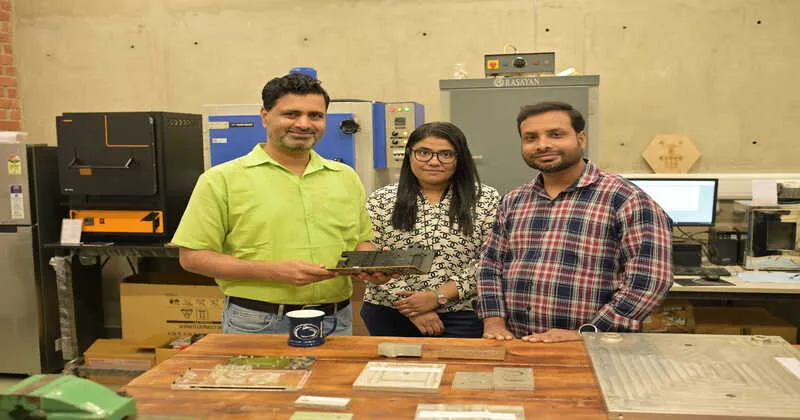
The project was led by Dr Amit Arora, Associate Professor in IITGN’s Department of Materials Engineering, together with Ms Prachi Sharma and Mr Rizwan Qureshi, final-year doctoral students in the department. This team pitched the technology at the IIM MATRIx 2026.
The team has also published papers in Journal of Materials Engineering and Performance (https://doi.org/10.1007/s11665-024-10597-1), Machines (https://doi.org/10.3390/machines12070494), Journal of Manufacturing Processes (10.1016/j.jmapro.2023.02.066 & https://doi.org/10.1016/j.jmapro.2019.03.021)
Liquid cold plates are metal components containing internal channels through which coolant flows to extract heat from high-power electronic systems, similar to a car radiator that removes heat from an engine. They are widely used in battery thermal management systems, data centres, railways, power electronics, defence, aerospace and other applications where excessive heat can affect performance, safety and reliability.
The difficulty lies in forming the channels inside a solid plate. This is of extreme importance today, given the sudden surge in demand for data centres and their thermal management.
Most commercial liquid cold plates are manufactured using vacuum brazing, a process that joins multiple metal components at high temperatures. According to the research team, though this method is an industry staple, it is capital and energy-intensive.
Elaborating about this technical issue, Dr Amit Arora, Associate Professor, Department of Materials Engineering, IIT Gandhinagar, said, “Brazing’s success rate runs at only about 40 to 60 per cent, with a large fraction of plates being scrapped for hidden defects or leaks. With the cold plates being manufactured by fusing multiple joints, any potential leak is not a nuisance but an electrical and thermal hazard.” Additionally, due to the lack of indigenous infrastructure for manufacturing vacuum-brazed components, India continues to rely heavily on imported technologies for these products.
Dr Amit Arora, who also leads the Advanced Materials Processing Research Group (AMPRG) at IIT Gandhinagar, added, “To overcome these limitations, we have developed a manufacturing approach based on ‘Friction Stir Channeling’ (FSC). Instead of joining multiple components, the process creates integrated internal cooling channels within a single metal plate using a rotating tool that plastically deforms the material without melting it.”
Prachi Sharma, a final-year doctoral student at IITGN, added, “Our objective was to develop an alternative manufacturing approach that addresses the limitations of conventional liquid cold plate fabrication while making the technology more accessible for the Indian industry.”
Rizwan Qureshi, who led the manufacturing process development, added, “Winning the Rs 20 lakh seed grant at IIM Matrix 2026 is a proud milestone for our team. It will enable us to bridge the gap between laboratory research and market deployment, helping us transform a promising research outcome into a viable technology venture. The funding will support larger-scale testing, intellectual property development, product refinement, and commercialisation efforts.”
Beyond its technical advantages, the researchers believe the innovation has the potential to strengthen India’s manufacturing ecosystem by enabling the domestic production of a critical engineering component currently sourced largely from imports.
One of its immediate applications is in railways, where liquid cold plates are used to cool high-power electronic systems (IGBTs) in modern high-speed trains and metro coaches. The IITGN team has developed and tested prototypes for high-speed rail applications.
In addition, the technology is well-suited for EV battery thermal management, AI-driven data centres, GPU cooling, power electronics, defence and aerospace systems, and metallurgical industries. By replacing a multi-step, energy-intensive manufacturing process with a single-step solid-state process, the technology reduces manufacturing time, energy consumption, material waste and carbon emissions while supporting the objectives of ‘Make in India’ and Atmanirbhar Bharat.
The research group at IITGN has worked on friction-stir-based manufacturing processes for the past decade to understand the FSC process and develop tools to control the channel geometry and dimensions. Earlier studies demonstrated the feasibility of fabricating internal mini-channels, while the present work advances the technology to manufacture macro-channel liquid cold plates suitable for industrial applications.
What started as a purely scientific inquiry into the formation of channels using FSC has culminated in a product that is the need of the hour and completely indigenous. The group today has the capability to design cooling channels suitable for any heat load. The result is a leak-proof cold plate with improved structural integrity, which, the team says, also reduces manufacturing time, energy consumption, and material waste.
Prachi Sharma’s role focused on optimising the cooling channel geometry through thermal simulations to meet industrial performance requirements. She stated that translating those designs into manufacturable products while maintaining thermal performance was one of the key challenges during development.
Rizwan Qureshi added, “Scaling the process from laboratory-scale channels to industrial-scale cooling plates required extensive optimisation of tool design and process parameters. Successfully demonstrating repeatable manufacturing and validating the prototypes with industry partners gave us the confidence to move towards commercialisation.”