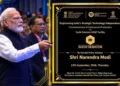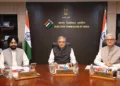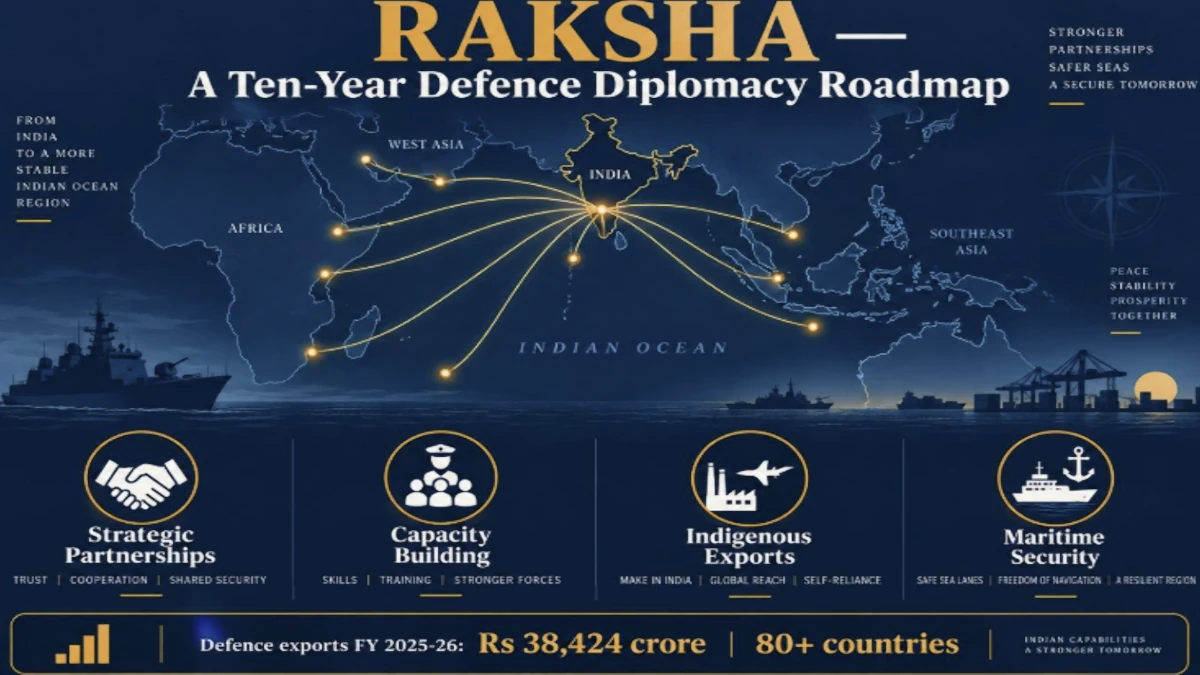
At Kartavya Bhawan, Raksha Mantri Shri Rajnath Singh released RAKSHA, a document on defence diplomacy that sets out Indian strategic roadmap and vision for global defence partnerships over the next ten years. On the same day, he sat across from Mr Theo Francken, Belgium’s Minister of Defence and Foreign Trade and watched multiple Memoranda of Understanding and contracts under Defence Industrial Cooperation get signed. One event was a theory of engagements with foreign and local expansion, the other was the export. It is rare for a policy document to acquire a case study on its own release date.
आ नो भद्राः क्रतवो यन्तु विश्वतः
“Let noble thoughts come to us from every side” (Rigveda 1.89.1)
The Ministry of Defence describes RAKSHA as marking a shift in India’s strategic engagement aligning the national security objectives with proactive global cooperation, fostering long-term stability and mutual growth.
India has conducted defence diplomacy for decades without ever publishing what it thought it was doing. Exercises were announced, contracts were signed, warships made port calls and each was reported as a discrete event. A country that declines to state its intent preserves flexibility, it also supports the ability to be planned around. RAKSHA trades a measure of the first for a great deal of the second.
Three services. Two ministries. The NSCS. Anyone who has watched Indian defence policy knows how those calendars converge on a single point of acceptance. The services run exercises. Defence Production chases order books. South Block manages the politics. RAKSHA real innovation may simply be that all three signed the same page on the same morning.
Four Pillars, One Logic making Viksit and Surakshit Bharat
The framework rests on four pillars: strategic partnerships which means deeper bilateral and multilateral security cooperation. Second is capacity building, through joint military exercises, training programmes and the sharing of best practices with friendly nations. Third is indigenous exports that promotes Make in India platforms to establish the country as a reliable global defence manufacturing hub and last one is maritime security which is constantly strengthening India role as a Net Security Provider and First Responder in the Indian Ocean Region.
That last link is India’s most underrated asset. The National Defence Academy, the Indian Military Academy and the Defence Services Staff College have trained foreign officers for generations, many of whom now command their own armies and sit on their own procurement boards. No advertising budget buys that kind of access. RAKSHA is the first guide book to treat this alumni network as deliberate strategic capital rather than an agreeable by product of hospitality.
The Balance Sheet Behind the Surakshit Bharat
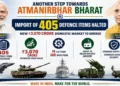
Ten years ago this framework provided the future path. Today it is extrapolation and the arithmetic is unforgiving in the right direction. Indian defence exports touched an all-time high of Rs 38,424 crore in FY 2025-26 i.e up Rs 14,802 crore, 62.66 per cent over the previous years of Rs 23,622 crore. Defence Public Sector Undertakings supplied 54.84 per cent and the private sector 45.16 per cent, with DPSU exports alone surging 151 per cent year-on-year. Indian equipment now reaches more than 80 countries and the count of Indian exporters climbed from 128 to 145 in twelve months.
India Defence Trajectory
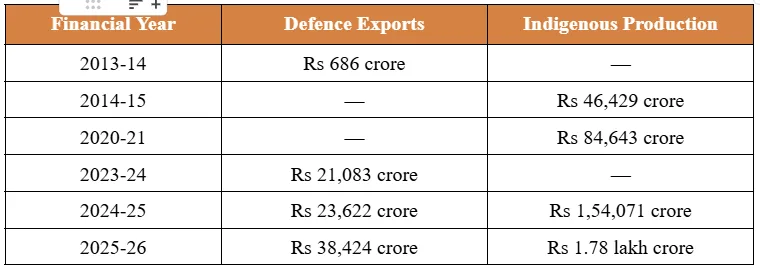 Source: Press Information Bureau, Ministry of Defence (April 2026 and June 2026 releases). Dashe indicate figures not stated in the cited releases for that year.
The baseline sharpens it. Exports stood at Rs 686 crore in FY 2013-14. Indigenous production has risen from Rs 46,429 crore in 2014-15 to Rs 1.78 lakh crore in 2025-26, a 15.6 per cent above the previous fiscal of Rs 1,54,071 crore and 110 per cent above FY 2020-21 Rs 84,643 crore. The defence budget moved from Rs 2.53 lakh crore in 2013-14 to Rs 7.85 lakh crore in 2026-27.
Some of this is engineering. The Department of Defence Production rebuilt its export authorisation portal and simplified the Standard Operating Procedure and licensing friction, not factory capacity had long been the binding constraint. The 2020 target of Rs 35,000 crore in annual exports by 2025-26 has already been passed, the standing goal is Rs 3 lakh crore in production and Rs 50,000 crore in exports by 2029.
MOU with Belgium
Which brings us back to Mr Francken, who articulated India’s own case with useful bluntness. Trust had been built, he said; what was needed now was concrete cooperation not non-binding declarations, but joint training, industrial projects and opportunities for companies. He draws a line “India is modernising one of the largest armed forces in the world, and the scale of that programme converts technology access into serious orders.”
Belgian technology with Indian skill and scale, precisely what RAKSHA third pillar describes. The substantive step was industrial rather than ministerial. The Belgian Security and Defence Industry association and the Society of Indian Defence Manufacturers signed a cooperation agreement a link between the two countries industry bodies rather than their governments, easing company-level participation in co-development under Make in India. Belgian Prime Minister Mr Bart de Wever was in India on the same visit. Shri Rajnath Singh, speaking at the India-Belgium Ministers Meeting, framed the moment that the world is passing through great geopolitical and economic turmoil, mostly not of India’s making and the challenges must nonetheless be handled.
The ocean as doctrine of Vashudhev Kutumbakam
The maritime pillar carries the longest lineage. In March 2015 at Port Louis, Prime Minister Narendra Modi set out SAGAR: Security and Growth for All in the Region. A decade later, again in Mauritius it widened into MAHASAGAR: Mutual and Holistic Advancement for Security and Growth Across Regions, stretching the frame from the Indian Ocean littoral to the wider Global South.
The 2004 tsunami response, relief to Myanmar after Cyclone Nargis in 2008, drinking water flown to the Maldives in its 2014 freshwater crisis and Operation Brahma following the 2025 Myanmar earthquake are the working résumé behind “First Responder”. In 2026, sixteen like-minded maritime nations sailed under the Indian Ocean Ship SAGAR initiative, a convergence the Naval Chief called rare and significant. RAKSHA does not invent this role. It gives it a calendar.
The invisible infrastructure and why ten years
Doctrine without staffing is decoration and here the groundwork predates the document. India has extended its defence attaché network into Africa, Armenia, Poland and the Philippines, standing up entirely new defence wings in countries identified as export markets a break from the habit of clustering military diplomats in a few large capitals. A Defence Wing at the Embassy of India in Rabat was announced during engagement with Morocco. In March 2026, Rashtriya Raksha University convened a Defence Attaché Roundtable, which the Raksha Mantri welcomed for advancing Global South-centric cooperation models, restating India’s ambition to be a Vishwa Mitra.
Because nothing in this domain matures faster, a co-production line takes atleast five years to commission. A training pipeline takes a decade to produce commanders. A frigate ordered now sails in the 2030s. Publishing a ten-year horizon tells partners and industry alike that the direction will not be renegotiated each budget session and predictability is the single most valuable thing a defence partner can offer.
Raksha does not mean conquest or command. It means protection, guardianship, the act of shielding. A country writing a global military framework chose a word about defending rather than dominating a consistent with Vishwa Mitra and a civilisation that has long described the world as one family. Defence diplomacy is a core pillar of India’s foreign policy and RAKSHA supplies the actionable vision for the next decade, keeping India an anchor of peace, stability and a rule-based order.