There is an old saying in the energy business: every war in the Gulf eventually becomes everyone’s problem. The ongoing Iran-America tensions and the broader Hormuz crisis have done precisely that, except this time, the world is not just scrambling for oil. It is, finally, scrambling away from it.
Oil prices before the war were around $70 a barrel. They are now at $120 and climbing toward $200, while the floor, if peace comes, sits around $65. That $130 swing is not just a number. It is the electric shock a sleeping world needed to rethink a century-old addiction.
The world’s energy dependence on petroleum is staggering when you lay it bare. The global economy consumes roughly 162 crore litres of petroleum every single day. Every year, human civilisation burns through approximately 730 litres of oil per person on the planet. The United States alone accounts for nearly 20% of global petroleum consumption, one country, one-fifth of the entire supply. When the strait through which 20% of that supply flows become a flashpoint, the consequences ripple from Mumbai to Minneapolis.
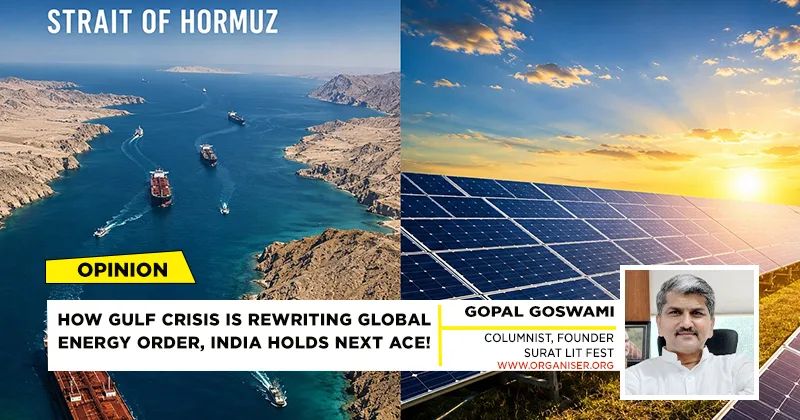
The Strait of Hormuz is not just a shipping lane. It is the jugular of the modern economy. Iran’s ability to choke or threaten that passage, regardless of whether it ultimately does, sends oil traders into a frenzy and energy ministers into emergency sessions. The current crisis has exposed, brutally and without apology, what energy experts have warned for decades: building civilisation on a resource concentrated in one volatile region was always a gamble. The bill is now due.
Here is the counterintuitive truth: geopolitical crises have historically been the most powerful accelerant for clean energy transitions. The 1973 Arab oil embargo triggered the first serious research into solar photovoltaics. The 1979 Iranian revolution prompted nuclear energy expansion across Europe. And this current Gulf war? It may finally tip the scales toward something far more consequential, the end of oil’s monopoly as the world’s primary energy currency.
Three serious alternatives have emerged from the chaos: solar energy, which is already commercial and scalable; advanced nuclear energy, which is carbon-free and dense; and thorium-based breeder reactors, which represent the most extraordinary energy opportunity of the 21st century and one where India sits on a goldmine.
India has now ranked third globally in renewable energy installed capacity, reaching 250.52 GW as of December 2025, according to IRENA Renewable Energy Statistics 2026. That is not a projection but a fact.
India’s solar energy installed capacity crossed the 100 GW mark in January 2025, and has reached 132.85 GW by November 2025, an increase of over 41% in a single year. For perspective, India’s solar capacity was just 2.8 GW in 2014. That is a 3,450% increase in a decade.
In June 2025, India achieved 50% of its cumulative installed power capacity from non-fossil sources, five years ahead of its 2030 target under the Paris Agreement. This is not merely an environmental achievement. This is strategic. Every megawatt of solar installed is one less barrel of imported oil, one less dollar shipped to the Gulf, one less vulnerability to the Hormuz chokepoint.
But solar has a fundamental limitation that its most enthusiastic advocates sometimes forget to mention it only works when the sun shines. Storage technology is catching up, but it has not solved the baseload problem, the round-the-clock, all-weather power that a 1.4-billion-person economy with steel plants, hospitals, and data centres demands. That is precisely where atomic energy enters the picture, and where India’s position becomes extraordinary.
Nuclear energy currently provides about 10% of global electricity from just over 400 reactors operating across 30 countries. Unlike solar or wind, nuclear plants run 24 hours a day, 365 days a year, with a capacity factor above 90%. One kilogram of uranium fuel contains roughly 45,000 times the energy of one kilogram of coal. One kilogram of thorium contains even more, approximately 3.5 million times the energy of coal, when used in a breeder cycle.
Nuclear energy contributes only about 3% of India’s total electricity generation today, even though India operates 19 pressurised heavy water reactors. But the ambition and the technological foundation, to change that number dramatically is now in place.
A fast breeder reactor is, in engineering terms, one of the most elegant machines ever conceived. Unlike conventional reactors that consume fuel in a straightforward burn, a breeder reactor produces more fissile material than it consumes. It literally breeds new fuel as it generates electricity. Put uranium-238, a “fertile” material considered nuclear waste by most countries into a breeder, and it converts it into plutonium-239, which can be used as fresh reactor fuel. The cycle becomes partially self-sustaining.
The Uranium-238 “blanket” surrounding the fuel core undergoes nuclear transmutation to produce more fuel, thus earning the name ‘Breeder’. The use of Thorium-232 as a blanket is also envisaged in this stage. By transmutation, Thorium will create fissile Uranium-233, which will be used as fuel in the third stage.
This is not theoretical. This is happening right now, in Kalpakkam, Tamil Nadu.
The 500 MW Prototype Fast Breeder Reactor (PFBR) at Kalpakkam attained first criticality on 6 April 2026, marking a “significant step toward strengthening India’s long-term energy security and advancing its indigenous nuclear technology capabilities.”
Once fully operational, India will become only the second country after Russia to have a commercial fast breeder reactor. Every other programme in the United States, France, Germany, Japan has been scaled back or shut down. India is now poised to strengthen its position among a small group of nations with advanced fast reactor capabilities.
Now we arrive at the most jaw-dropping element of this story.
India has the world’s largest reserves of thorium. The known reserves are estimated to be between 457,000 and 508,000 tonnes. India holds about 25% of the world’s known thorium reserves, while possessing only 1–2% of global uranium.
Think about what that means in the context of the current Gulf crisis. Saudi Arabia controls 17% of global proven oil reserves and leverages it for extraordinary geopolitical influence. India sits on 25% of the world’s thorium a fuel that, in a breeder cycle, is far more energy-dense than oil and produces essentially zero carbon emissions.
Indian nuclear scientists estimate that the country could produce 500 GW of power for at least four centuries using just the country’s economically extractable thorium reserves. Four centuries of energy independence. No Gulf, no OPEC, no Hormuz Strait.
Thorium also has a proliferation advantage that uranium lacks. Uranium-233 bred from thorium is far harder to weaponise than plutonium, giving India stronger non-proliferation credentials and a more attractive export proposition to the international community.
Once fully commercialised, India will become only the second country in the world after Russia to successfully operate a commercial fast breeder reactor. The global market for reactor technology is enormous, currently dominated by Russian Rosatom and, to a lesser degree, American, French, and Korean suppliers. India’s entry into this market, with a domestically designed, domestically built, thorium-compatible reactor, could reshape who holds the keys to global energy infrastructure.
Strategic vision that Indian policymakers need to crystallise urgently
India currently imports over 70% of its uranium. It imports roughly 85% of its crude oil, paying foreign exchange worth hundreds of billions of dollars annually to Gulf nations and Russia. The current conflict has demonstrated again that this dependence is a national security vulnerability, not merely an economic one.
The three-stage nuclear programme conceived by Dr. Homi J. Bhabha in the 1950s was always about arriving at this moment: a thorium-fuelled, self-sustaining energy economy. Fast breeder technology forms the vital bridge between the current fleet of pressurised heavy water reactors and the future deployment of thorium-based reactors, leveraging the country’s abundant thorium resources for long-term clean energy generation.
The PFBR at Kalpakkam, fully designed and constructed indigenously by BHAVINI with significant contribution from more than 200 Indian industries including MSME, is proof that India does not need to buy this technology. It built it. The next logical step is to sell it.
Countries across Southeast Asia, Africa, and the developing world are desperate for affordable, reliable baseload electricity that does not require them to bow to Gulf monarchies or Western energy companies. India with thorium reserves, indigenous reactor designs, and a track record of nuclear non-proliferation is uniquely positioned to be their supplier.
Does the world have an alternative to petroleum?
The answer, in 2026, is yes and it is more robust than at any point in history. Solar is already cheaper than coal in most markets and is scaling at an extraordinary pace. India alone added nearly 45 GW of solar capacity in a single financial year. But solar cannot do it alone. The baseload problem demands nuclear, and the future of nuclear, cleaner, cheaper, and self-fuelling, runs on thorium.
The Gulf crisis has accelerated a transition that was already underway. The question is not whether oil’s dominance ends, but who shapes what comes next. From limited uranium resources to a future powered by thorium, India’s three-stage programme is now moving steadily from design to delivery.
A nation that was once defined by energy poverty could, within a generation, become the OPEC of the atomic age, not by accident, but by design, patience, and a 70-year-old vision that is finally arriving at its moment. The present leadership is capable enough to put forth the desired courage to implement national interests against the oil & dollar lobby.