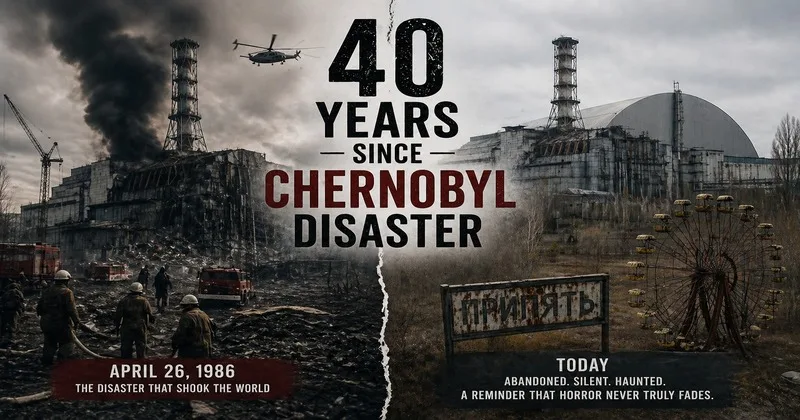
Exactly 40 years ago, this day – on April 26, 1986, the explosion at Chernobyl did more than rupture a reactor, it shattered global confidence in nuclear power. It is the disaster that changed the nuclear conversation across the globe.
Ground Zero: The control room of Reactor 4 at the Chernobyl Nuclear Power Plant in Pripyat, Ukraine.
Horror Unfolds: On April 26, 1986, a late-night safety test went catastrophically wrong, triggering the worst nuclear disaster in history. Operators attempted to simulate a power outage, but unstable conditions and critical design flaws led to an explosion that blew the 1,000-ton reactor lid into the air.
Within hours, radioactive material began pouring into the atmosphere. The room pictured was ground zero for the failed test. But it damaged several ecological elements at one go.
The movement of the radioactive cloud after the Chernobyl disaster
— Science girl (@sciencegirl) February 11, 2026
The disaster was discovered by the world a bit late, given that the then existing United Soviet Socialist Republic (USSR) that governed the region and N-Plant kept it under wraps.
Radiation drifted across borders. But as news broke and the world’s scientists assessed the disaster and its aftermath, governments across the globe panicked. Citizens protested.
And for countries like India, still building their nuclear programmes, it raised a difficult question:
How do you harness atomic power without unleashing atomic fear?
India’s quiet contrast: restraint over rhetoric
In the decades that followed, nuclear discourse globally was often shaped by brinkmanship and aggressive signalling.
India chose a different path. Unlike the infamous declaration associated with Pakistani leader Zulfikar Ali Bhutto, “We will eat grass, even go hungry, but we will get one of our own (bomb)”, India’s nuclear journey was marked by measured intent, not emotional rhetoric.
Even after conducting nuclear tests in 1998, India articulated a doctrine rooted in:
- No First Use (NFU)
- Credible minimum deterrence
- Civilian control over nuclear decision-making
This wasn’t just policy, it was signalling: India would possess nuclear capability, but not posture recklessly with it.
Scientific temper over strategic theatrics
India’s nuclear establishment has historically been driven by scientists, not slogans. Institutions like the Bhabha Atomic Research Centre and the Nuclear Power Corporation of India Limited have prioritised:
- Reactor safety
- Indigenous technology development
- Long-term sustainability (including thorium-based research)
Through its operational plants such as:
- Tarapur Atomic Power Station
- Madras Atomic Power Station
- Kudankulam Nuclear Power Plant
India exhibits a system where engineering discipline, not political spectacle, defines outcomes.
Learning from Chernobyl, without repeating it Chernobyl exposed two fatal weaknesses:
1. A flawed reactor design
2. A culture of secrecy and protocol violations
India responded by strengthening both technology and governance.
Its reactors, primarily Pressurised Heavy Water Reactors, are designed with:
- Negative feedback loops (they stabilise under stress)
- Multiple shutdown systems
- Reinforced containment structures
Oversight by the Atomic Energy Regulatory Board ensures independent safety audits.
Equally important, India has steadily improved emergency preparedness and public communication, areas where Chernobyl failed catastrophically.
Not just power, but responsibility
India’s nuclear posture stands out not because it is perfect, but because it is predictable and restrained.
India can oversee it.
India hasn't used nukes on anyone, has never threatened the use of nukes on anyone, has not created health crises in other parts of the world with nuclear testing, has not participated in illicit proliferation of nuclear material.
India is the most… https://t.co/uX95YviGCT
— vivek (@Mallufideintent) April 25, 2026
Despite facing nuclear-armed adversaries, cross-border tensions, and provocations and escalatory rhetoric from neighbours – India has never used nuclear capability as a casual threat or diplomatic lever.
There has been no chest-thumping, no theatrical brinkmanship, and no attempts to weaponise fear. That restraint matters, especially in a region where nuclear signalling can quickly spiral.
The two explosions at the Chernobyl nuclear power plant came decades apart. Ukrainian officials say the second, on Feb. 14, 2025, was caused by a Russian drone, sparking new anxieties about Moscow’s invasion of its neighbor. https://t.co/6l1JP1diZJ
— The Associated Press (@AP) April 25, 2026
The Fukushima reminder
The Fukushima nuclear disaster reinforced that even advanced systems can fail under extreme conditions. For India, it prompted:
- Re-evaluation of coastal plant safety
- Stress tests for tsunami and seismic risks
- Enhanced backup cooling systems
The lesson was clear: safety is not static, it must evolve with new threats.
Energy realism: Why India cannot walk away
India’s energy challenge is stark.
- Coal is abundant but polluting
- Renewables are growing but intermittent
- Demand is exploding with urbanisation and digital infrastructure
Nuclear energy offers a crucial middle ground:
- Reliable baseload power
- Low carbon emissions
- Long-term energy security
Globally, nuclear power already contributes around 10% of electricity, and is witnessing a renewed push.
India’s expansion plans reflect this reality: nuclear is not optional, it is strategic.
A new risk: war and nuclear infrastructure
The Russian invasion of Ukraine has added a new layer of concern.
The occupation of Chernobyl and incidents like the 2025 drone strike on its containment structure show that nuclear risks are no longer confined to accidents, they now include conflict zones.
For India, this reinforces the need to:
- Harden nuclear infrastructure
- Integrate military and civilian risk planning
- Prepare for unconventional threats
- Trust: India’s strongest nuclear asset
If Chernobyl eroded trust, India’s challenge has been to build it, slowly, deliberately.
Public protests around nuclear plants still occur. Questions around safety and displacement persist.
But India’s approach, grounded in:
- Institutional continuity
- Scientific transparency (within strategic limits)
- Consistent doctrine
India has consciously and responsibly avoided the deep mistrust seen elsewhere.
The larger lesson
Chernobyl remains a global warning. But India’s response offers a counter-narrative:
That nuclear power, handled with discipline, restraint, and scientific integrity, need not be feared, it can be managed. Forty years after that catastrophic night in Ukraine, India’s nuclear story is not one of denial or bravado. It is one of calculation. And in the nuclear age, that may be the most important difference of all.