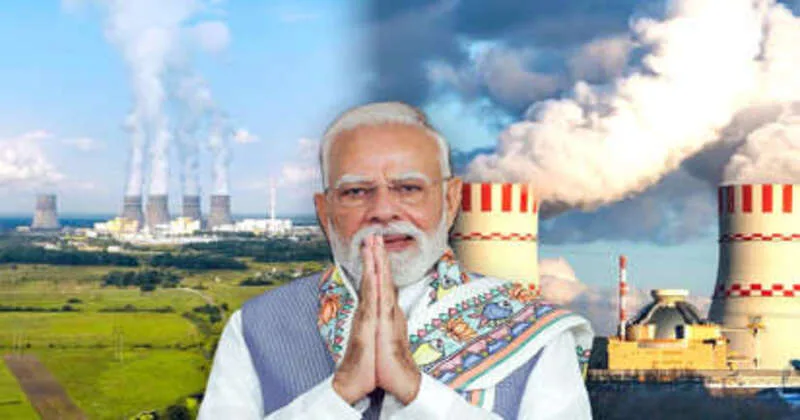
At 8:25 PM on April 6, 2026, in a control room at Kalpakkam on the Tamil Nadu coast, a small team of Indian scientists watched neutron counters climb in a way they had waited four decades to see. The 500 MWe Prototype Fast Breeder Reactor(PFBR) — designed by the Indira Gandhi Centre for Atomic Research and built by Bharatiya Nabhikiya Vidyut Nigam Ltd(BHAVINI), almost entirely with Indian hands and Indian steel — achieved first criticality. Outside the gates, the moment passed without ribbon-cuttings or televised speeches. Inside, India crossed a threshold to a closed nuclear fuel cycle that can convert the country’s vast thorium reserves into electricity for centuries. It embodies Atmanirbhar Bharat in nuclear technology and decades of indigenous R&D finally bear fruit. With this milestone, India joins an elite club capable of commercial fast-breeder operations, dramatically enhancing long-term energy security.
For more than a decade, the Modi government has pursued what is best described as strategic determination in stealth mode — a deliberate, resolute, almost understated build-out of every lever that determines whether India can not only keep its lights on, its factories running and its trucks moving when the next external shock arrives, but also push ahead with its Viksit Bharat goals. Critics have mistaken the absence of slogans for the absence of progress. The numbers say otherwise.
The renewable juggernaut, by the numbers
India’s installed power capacity crossed 520 GW by January 2026, of which non-fossil sources now account for over 275 GW — a share the country had originally promised the world only by 2030. Solar alone reached 143.6 GW by end-February 2026, wind crossed 55 GW, and total renewables(including large hydro) touched 266.7 GW. In the first ten months of FY26, India added a record 52,537 MW of capacity — the largest single-year expansion in its history — of which nearly 40GW was clean. On July 29, 2025, renewables crossed 51 per cent of India’s power generation capacity, a full five years ahead of its own target of 2030.
This is not luck. It is the cumulative payoff of the Production-Linked Incentive scheme, the Approved List of Models and Manufacturers regime, the Solar Park scheme, and PM Surya Ghar Muft Bijli Yojana, which is putting rooftop solar on a crore Indian households with a ₹75,000 crore outlay. Every megawatt installed at home is barrels of diesel that never have to be imported or financed in dollars.
Electrification, EVs and the slow curtailment of imported oil
The transport sector — India’s largest consumer of imported crude — is finally shifting. In 2025, EV sales reached 2.3 million units, making up 8 per cent of all new vehicle registrations. Electric threewheelers — the mainstay of last-mile logistics — have already achieved 32 per cent market share. The PM Electric Drive Revolution in Innovative Vehicle Enhancement(PM E-DRIVE) has incentivized India’s biggest-ever electric bus tender for 10,000 buses. Rail electrification has achieved 99.4 per cent of the broad-gauge network(over 69,000 km), slashing diesel demand in the world’s fourth-largest railway system.
Layered on top: ethanol blending in petrol has consistently exceeded 19.5 per cent since January 2025, with E100(pure ethanol) already available at over 400 retail outlets. Compressed Bio-Gas obligations increase to 5 per cent of CNG sales by FY29. Each of these is a small step — collectively, they are significant and impactful.
Domestic gas, deepwater and the oilfields act
The government has not focused solely on renewables. The Oilfields(Regulation and Development) Amendment Act 2025 has rewritten the fiscal regime for upstream E&P and the OALP-X round, opening prime deepwater acreage in the Krishna-Godavari, Bengal and Andaman basins, is the most attractive bid round India has ever floated. The target is to increase natural gas’s share of the primary energy mix from 6 per cent to 15 per cent by 2030. Even imported LNG, when it displaces coal or diesel, reduces both emissions and the import bill per unit of energy delivered.
Green hydrogen — the long game
The National Green Hydrogen Mission, with its ₹19,744 crore outlay and target of 5 million tonnes of green hydrogen per annum by 2030, is India’s bet on decarbonizing the hardest sectors: refineries, fertilizer, steel and long-haul shipping. Auctions have already discovered the world’s lowest price for green ammonia. NTPC’s green hydrogen hub in Andhra Pradesh, the AdaniTotalEnergies Kutch project, and IOC’s Panipat plant are not just pilots— they are industrialscale wagers on a post-petroleum economy.
The nuclear card India has been quietly holding
This is where Kalpakkam matters. India’s three-stage nuclear programme — heavy-water reactors, fast breeders and finally thorium — was designed by Homi Bhabha in the 1950s precisely because India has limited uranium but the world’s largest economically recoverable thorium reserves. The PFBR is the bridge between stage one and stage three. By using UraniumPlutonium MOX fuel surrounded by a Uranium-238 (and eventually Thorium-232) blanket, it produces more fissile material than it consumes. In simple language: India can now manufacture its own future fuel. No sanctions list, no shipping lane, no foreign supplier stands between Bharat and a multi-century supply of low-carbon baseload power.
What next for India’s energy security
Honesty demands acknowledging the gap. India still imports 88 per cent of its crude oil and 50 per cent of its natural gas and spent roughly $137 billion on crude alone in FY25. To truly wean India off oil and gas imports will require sustained, accelerated effort on three fronts. First, scale EVs and rail electrification to electrify road and rail mobility aggressively—targeting 30-40 per cent EV penetration in new vehicle sales by 2030 and beyond. Second, expand nuclear(including small modular reactors) and renewables with battery storage to 500 GW non-fossil by 2030. Third, push green hydrogen into hard-to-abate sectors while continuing upstream exploration and efficiency measures. The Modi government has laid the policy scaffolding—PLI schemes, viability gap funding, open access and now the SHANTI Act for nuclear. The next decade must see execution at matching speed.
The PFBR criticality is more than a technical milestone; it marks an inflection point when India quietly crossed a threshold toward energy self-reliance. That stealthy determination—patient, indigenous, resolute—defines the Modi era’s approach to energy security. The fortress is not yet impregnable, but its walls are rising faster than most realize. The foundation for India’s energy independence and energy security, however, is solid. unmistakably Swadeshi and provides a strong launchpad for Viksit Bharat.