BHUBANESWAR: Raksha Mantri Rajnath Singh on Tuesday called for a major strengthening of Bharat’s indigenous capabilities in the design, development, testing, manufacturing and maintenance of advanced aero-engines, asserting that mastery of propulsion technology is indispensable for achieving self-reliance in the aerospace and defence sector.
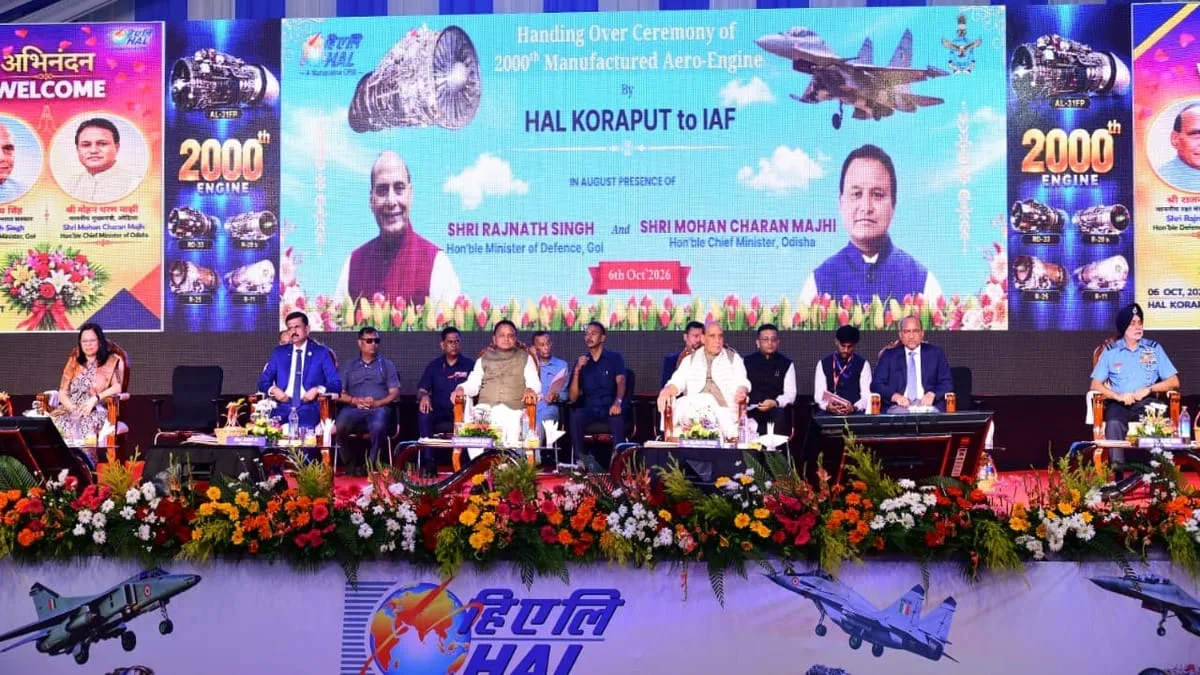
Singh made the remarks while witnessing the delivery of the 2,000th aero-engine by Hindustan Aeronautics Limited (HAL), Koraput Division, a milestone that marks six decades of propulsion manufacturing and engineering expertise at the facility. On the occasion, he also announced the establishment of a second production line for Shakti engines, underlining the government’s focus on building indigenous and scalable propulsion capabilities for India’s military aviation requirements.
Describing the achievement as a significant milestone in India’s aerospace journey, the Raksha Mantri said the country’s quest for self-reliance cannot be complete without mastery over aero-engine technology. He stressed the need to create a comprehensive indigenous ecosystem spanning the entire propulsion chain from materials and design to manufacturing, testing, maintenance and overhaul.
Singh congratulated the engineers, scientists, technicians and skilled workforce of HAL Koraput, stating that the delivery of 2,000 engines represented 2,000 significant contributions to the operational capability of the Defence Forces. He said the milestone also reflected six decades of engineering experience and technological expertise accumulated since the Koraput Division was established in 1964.
Propulsion technology at the heart of defence self-reliance
Emphasising the strategic importance of aero-engines, Singh described the engine as the “heart” of an aircraft, pointing out that reliable propulsion is essential for effectively utilising advanced airframes, radars, weapons and avionics. He said developing sophisticated aero-engines requires expertise in precision manufacturing, advanced materials, metallurgy, cooling technologies, testing and stringent quality assurance. Modern propulsion systems operate under extreme conditions and rely on advanced technologies such as superalloys, thermal-barrier coatings and sophisticated cooling systems.
According to Singh, mastery of aero-engine technology therefore represents mastery of some of the most advanced industrial capabilities. He stressed that India’s aerospace ambitions must be backed by sustained efforts to develop indigenous expertise rather than relying extensively on external sources for critical propulsion technologies.
The Raksha Mantri’s emphasis assumes added significance as India seeks to strengthen its domestic defence industrial base and expand indigenous production of increasingly sophisticated military platforms. The 2,000th engine delivered from Koraput, he indicated, should not merely be viewed as a production milestone but as a foundation for the next phase of India’s propulsion capabilities.
Indigenous Aero-engine capability crucial for AMCA
Singh underlined that aerospace self-reliance must extend to the development of indigenous aero-engine capability, particularly in the context of the Advanced Medium Combat Aircraft (AMCA) programme. He highlighted the government’s proposed investment of around Rs 5,000 crore in an indigenous high-thrust engine programme. The initiative includes efforts to indigenise critical raw materials in partnership with Mishra Dhatu Nigam Limited (MIDHANI) and establish India’s first indigenous high-thrust engine testing facility.
The Raksha Mantri stressed that a truly sovereign aerospace ecosystem would require indigenous capabilities across the complete value chain, including materials, design, manufacturing, testing and Maintenance, Repair and Overhaul (MRO). He also emphasised that developing a high-performance aero-engine is a long-term endeavour requiring sustained investment, specialised testing infrastructure, highly skilled manpower and a strong industrial ecosystem. Reliable and scalable production, he said, would have to be supported by domestic capabilities in critical materials, superalloys and other specialised technologies.
HAL expands AL-31FP and Shakti Engine production
The Raksha Mantri also highlighted HAL’s performance in meeting the requirements of the Defence Forces despite global supply-chain disruptions and challenges relating to raw materials. The government had placed an order for 240 AL-31FP engines with HAL in 2024 for the Su-30MKI fleet. Singh noted that HAL delivered the first engine ahead of schedule and had supplied 63 engines against a target of 60 by the end of the second year. To further strengthen production capability, annual manufacturing capacity for the AL-31FP engine is being increased from 30 to 50 engines, involving an investment of Rs 335 crore.
The government is also establishing a second production line for Shakti engines with an investment of Rs 218 crore. The new line will have the capacity to manufacture up to 100 engines annually and is scheduled to be fully established by 2028-29. The Shakti engines will cater to indigenous helicopters, including the Dhruv Advanced Light Helicopter (ALH) and Prachand Light Combat Helicopter (LCH). The expansion is expected to strengthen the availability of indigenous propulsion systems for India’s growing helicopter ecosystem.
From engine production facility to propulsion ecosystem
Singh called for a broader vision for HAL Koraput, saying the facility should evolve beyond being an engine production centre into a wider aerospace propulsion ecosystem. He stressed the need for greater integration of MSMEs, start-ups, private industry, academia and research institutions into the propulsion sector. HAL, he said, should nurture suppliers, mentor MSMEs, support start-ups and young engineers, collaborate with universities and research institutions, and help develop capabilities for critical engine components.
Such integration, according to the Defence Minister, would create a wider industrial base capable of supporting advanced propulsion technologies. It would also help bring new ideas, specialised skills and emerging technologies into the defence manufacturing ecosystem.
He called upon the HAL Koraput team to raise standards in quality, productivity, indigenisation, innovation and delivery timelines, and to use the 2,000th-engine milestone as the foundation for building an Indian aerospace industry capable of designing, developing, manufacturing and supporting advanced propulsion systems.
Odisha emerging as aerospace and defence hub
Highlighting Odisha’s growing significance in the national aerospace and defence ecosystem, Singh pointed to the state’s strategic location, long coastline, ports, mineral resources, industrial infrastructure and skilled manpower. He also referred to strategic facilities such as the DRDO Integrated Test Range at Chandipur, along with initiatives undertaken by the Odisha Government, as important foundations for developing a stronger aerospace and defence manufacturing ecosystem in the state.
The Raksha Mantri appreciated the Odisha Government’s approval for an Aerospace and Defence Equipment Manufacturing Complex at Gajamara in Dhenkanal. He called for HAL Koraput to serve as a nucleus for a wider propulsion ecosystem by developing suppliers, mentoring MSMEs, providing opportunities to young engineers and start-ups, collaborating with universities and research institutions, and creating opportunities for skilled local youth. He also stressed the importance of developing indigenous manufacturing capabilities for critical engine components, thereby deepening the domestic supply chain and reducing dependence on external sources.
HAL Koraput’s six decades of contribution
The 2,000th-engine milestone also highlighted the long contribution of HAL Koraput to Bharat’s military aviation capabilities.
Singh noted that engines manufactured and supported by the division have powered frontline aircraft including the MiG-21, MiG-27, MiG-29 and Su-30MKI. He pointed out that while new engine production creates additional operational capability, overhaul and maintenance extend the service life of existing platforms. HAL Koraput has so far overhauled more than 9,000 engines, strengthening its indigenous repair and overhaul capabilities. Indigenisation of components and reduction in turnaround time have also contributed to improving operational readiness and extending the service life of critical defence assets. Singh congratulated the HAL Koraput workforce for its contribution over six decades and said the 2,000 engines represented not merely a numerical achievement but a long record of service to the Defence Forces.
CM Majhi calls for another defence manufacturing unit
Speaking on the occasion, Odisha Chief Minister Mohan Charan Majhi highlighted the rapid expansion of sectors such as metal downstream industries, semiconductors and IT in the state. He said these emerging sectors would provide critical support to defence manufacturing and proposed the establishment of another defence manufacturing unit in Odisha.
Majhi said a new industrial revolution was taking shape in Odisha, creating an ecosystem ranging from metals to semiconductors. Emphasising indigenous technology and self-reliance in the defence sector, he said the state government was committed to developing Odisha as a major industrial and defence hub.
Referring to HAL Koraput’s six decades of contribution to national security, the Chief Minister described the 2,000th-engine handover and expansion of the Shakti engine manufacturing capability as significant milestones in India’s growing defence capabilities.
Rs 1,600 crore projects under implementation at Koraput
The Chief Minister said the second Shakti engine manufacturing line would have an annual capacity of 100 engines, while the AL-31FP production capacity was being increased from 30 to 50 engines annually. He also stated that HAL Koraput was currently implementing projects worth Rs 1,600 crore, describing the development as a matter of pride for Odisha.
Majhi outlined the state’s broader industrial growth, stating that Odisha had received industrial proposals worth around Rs 22.5 lakh crore since the formation of the BJP-led double-engine government, of which proposals worth Rs 12.5 lakh crore had already been approved. He further said that 152 industrial projects involving investments of more than Rs 3 lakh crore had achieved groundbreaking and generated around 2.5 lakh employment opportunities. Industrial development, he said, was no longer confined to a few districts but was expanding across the state.
Semiconductor push adds to industrial ecosystem
Majhi also highlighted Odisha’s growing semiconductor ecosystem, saying the ‘Odisha Silicon Valley’ was being developed over 870 acres at Naraj. Projects such as SiCSEM and 3DGS are under construction and are expected to contribute to strengthening India’s self-reliance in the semiconductor sector.
The Chief Minister said the growth of advanced sectors such as semiconductors, IT and metal downstream industries would complement the state’s efforts to expand defence manufacturing and establish a broader technology-driven industrial base.
A new chapter in India’s propulsion journey
The delivery of HAL Koraput’s 2,000th aero-engine thus emerged as more than a commemorative milestone. It provided the backdrop for a wider call to build a self-reliant Indian propulsion industry capable of meeting the requirements of future combat aircraft, helicopters and other advanced aerospace platforms. Rajnath Singh’s emphasis on indigenous design, development, testing and manufacturing placed aero-engine technology at the centre of India’s next phase of defence industrialisation. The expansion of AL-31FP production, the second Shakti engine line, the proposed Rs 5,000-crore high-thrust engine programme and plans for a wider propulsion ecosystem collectively point towards an effort to build capabilities across the entire aerospace value chain.
For HAL Koraput, the 2,000th engine marks six decades of achievement. For India’s aerospace sector, the milestone is being positioned as a starting point for a more ambitious phase—one in which indigenous technology, domestic materials, specialised testing, skilled manpower, private industry, MSMEs, start-ups and research institutions work together to create a globally competitive propulsion ecosystem.
Senior officials and representatives present on the occasion included Odisha Chief Minister Mohan Charan Majhi, Defence Production Secretary Sanjeev Kumar, Deputy Chief of Air Staff Air Marshal Tejpal Singh, HAL Chairman and Managing Director K. Ravi, MIDHANI Chairman and Managing Director Dr S.V.S. Narayana Murty, Joint Secretary (Aerospace Wing & DOMW) Manisha Chandra, Nabarangpur MP Balabhadra Majhi, Kotpad MLA Rupu Bhatra, Laxmipur MLA Pabitra Saunta, Koraput MLA Raghuram Machha and Koraput Collector Manoj Satyawan Mahajan, besides senior scientists, engineers, officials and employees of HAL.