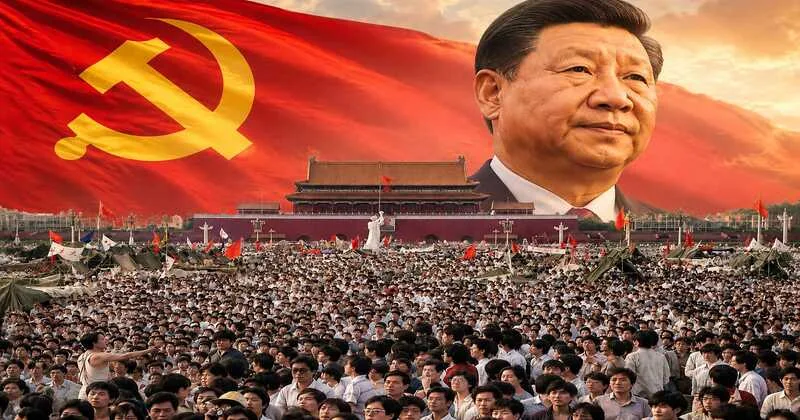
As the 37th anniversary of the 1989 Tiananmen Square massacre approaches, the Chinese Communist Party has once again tightened its grip across the country, launching a sweeping surveillance and intimidation campaign aimed at silencing dissidents, activists, and anyone linked to the memory of June 4.
From Beijing to Hunan, activists say they are being watched around the clock, confined to their homes, shadowed by plainclothes officers, and warned against speaking publicly about one of the bloodiest crackdowns in modern Chinese history. The renewed restrictions highlight the CCP’s enduring fear of the massacre’s legacy, a tragedy the regime continues to erase from public memory while aggressively suppressing any attempt at remembrance.
On June 4, 1989, Chinese troops and tanks stormed central Beijing to crush weeks of student-led pro-democracy protests centred around Tiananmen Square. Casualty figures remain heavily disputed because the Chinese government has never released an official death toll, but estimates range from hundreds to several thousands killed and injured. More than three decades later, public discussion of the massacre remains among the most tightly censored subjects in China.
Beijing expands crackdown to erase all memory of June 4
This year, according to multiple dissidents and rights activists interviewed by various media houses, the regime has intensified domestic surveillance ahead of the anniversary. Activists across several provinces described an atmosphere of fear, isolation, and constant monitoring as security agencies moved to prevent any form of commemoration. A Beijing dissident surnamed Liu revealed that authorities began increasing surveillance around his residence in late May. He described police vehicles stationed nearby and security personnel tracking his movements whenever he left home.
According to Liu, state security officials warned him against participating in gatherings connected to June 4 or posting comments on overseas websites. He said the authorities appear to have shifted tactics this year, relying less on the long-used practice of forcibly removing dissidents from cities and more on localised monitoring and house surveillance. For years, Chinese authorities have used so-called “forced travel” operations before politically sensitive anniversaries, relocating activists under the pretext of tourism or unofficial meetings until security concerns subside. Liu said that while some prominent former participants in the 1989 protests may still be taken away temporarily, many others are now being kept under direct observation inside their own neighbourhoods.
June 4, 1989, was the day when the People’s Liberation Army opened fire on its own citizens in Tiananmen Square while journalists from around the world watched……
It is estimated that between 180,000 and 350,000 troops were deployed to Tiananmen on that day.
Some people may… pic.twitter.com/nUmSI7Jtob
— 燃えたいゴミ!! (@gamu0514) June 2, 2026
Among activists, the system is commonly referred to as “being on post”, a form of constant surveillance in which police officers, neighbourhood committee members, security guards, and local officials are assigned to monitor targeted individuals around the clock. Another Beijing activist, surnamed Chen, said guards were deployed outside his apartment days before the anniversary. He described security personnel sitting in shifts in the hallway outside his home and following him whenever he stepped outside. According to Chen, authorities are especially determined to prevent people from gathering together or discussing Tiananmen publicly. Even private conversations and online interactions are being scrutinised as the regime works to eliminate any trace of collective remembrance.
Dissidents across China face restrictions and monitoring
Similar warnings have reportedly been issued in other parts of China. A rights activist in Hunan Province, surnamed Huang, said state security officers repeatedly contacted him and instructed him not to travel or meet fellow activists in neighbouring cities. Huang added that dissidents in Guangxi, Chengdu, and Chongqing had received comparable warnings and were told they could face police questioning on June 4 itself. Several activists said the new approach reflects not a softening of controls, but a more efficient and less costly system of repression. Instead of transporting dissidents elsewhere, authorities are relying on dense neighbourhood surveillance networks and digital monitoring to keep individuals isolated and silent.
In Zhejiang Province, former members of the banned China Democracy Party also remain under strict observation. A dissident from the province said authorities recently imposed movement restrictions on several prominent activists, including former student movement leader Xu Guang and veteran dissident Chen Shuqing, both of whom have already spent years behind bars for political activities. Security officials reportedly warned activists not to use virtual private networks, or VPNs, to bypass China’s internet censorship system and prohibited them from posting comments in online discussion groups. The crackdown underscores the regime’s continuing determination to suppress historical memory and control digital discourse surrounding the anniversary.
Despite the extensive restrictions, Chinese authorities have not publicly announced any special security operations related to the anniversary. Yet activists in Shanghai and Chengdu said neighbourhood officials privately informed them that movement restrictions would remain in place until after June 5. Even after 37 years, the massacre continues to haunt the CCP, which has spent decades constructing one of the world’s most sophisticated censorship and surveillance systems to bury the events of June 1989 from public consciousness.
At the same time, families of those killed in the massacre continue to demand justice. The Tiananmen Mothers, a group representing relatives of victims, released their annual commemorative statement through the New York-based advocacy organisation Human Rights in China. In the statement, the group renewed its long-standing demands for a full accounting of the massacre, compensation for victims’ families, and accountability for those responsible for ordering and carrying out the military crackdown. The statement described the events of June 3 and 4, 1989, as a national tragedy in which armed troops were unleashed against peaceful demonstrators, including students and civilians. For decades, the group has called on Chinese authorities to confront the legacy of the massacre through lawful and peaceful means. “For 37 years, we have endured suffering while seeking truth and accountability,” the statement said. While remembrance remains criminalised inside China, commemorations abroad have grown increasingly vocal.
Global protests and anti-CCP demonstrations intensify
In Washington, pro-democracy Chinese diaspora organisations gathered days before the anniversary to denounce the CCP and call for democratic change in China. Demonstrators rallied outside the Chinese Embassy, carrying banners condemning the regime’s human rights abuses and chanting slogans demanding an end to communist rule. The protest was organised by groups including the National Committee of the Democracy Party of China, the Independent Federation of Chinese Students and Scholars, and the Wei Jingsheng Foundation.
Veteran dissident Wei Jingsheng, who spent years imprisoned in China for pro-democracy activism, said attitudes among Chinese people have fundamentally changed since 1989. According to Wei, many Chinese citizens no longer believe reform within the current system is possible after the CCP responded to peaceful demonstrations with military force.
中国民主党纪念8964抗暴三十七周年曼哈顿游行集会正在进行中 pic.twitter.com/V262rrlUzD
— Jiang Xu-Freedom Voice 自由之声 (@JiangXu6489) June 2, 2026
Wang Juntao, chairman of the National Committee of the China Democracy Party, led additional demonstrations in front of the White House, the U.S. Capitol, and the Victims of Communism Memorial. He said younger generations, including many born after the massacre, are increasingly joining anti-CCP activism. Former student protest leader Li Hengqing also said public anger inside China continues to grow under authoritarian rule and predicted that widespread unrest could eventually erupt against the regime. Another major memorial event is scheduled to take place in Flushing, Queens, one of the largest Chinese communities in New York City, where activists plan to hold a large rally and march commemorating the massacre and calling for democracy in China.
Museum vandalism raises fears of transnational repression
But even outside China, the shadow of Beijing’s intimidation campaign appears to be spreading. In California, intruders vandalised the June 4th Massacre Memorial Museum in El Monte just days before the anniversary. According to museum officials, unidentified individuals broke into the premises during the early hours of May 31 and damaged exhibits connected to the 1989 democracy movement. Among the items targeted were historical newspapers, commemorative shirts, display walls, and calligraphy exhibits. Brownish-yellow paint was sprayed across parts of the museum, including walls and display cases.
Police in El Monte opened an investigation after reviewing surveillance footage collected from the site. Museum officials later said they had also contacted the FBI and relevant congressional offices regarding the attack. The museum condemned the vandalism as a case of “transnational repression,” a term used to describe attempts by authoritarian governments to intimidate dissidents and exile communities overseas.
已经到达现场,现场破坏严重。
作案者潜入纪念馆,并破坏了摄像镜头,然后才开始损毁动作。
现发布第一批照片。 pic.twitter.com/hFn5RWYf1z
— 王丹 (@wangdan1989) May 31, 2026
General Manager Jin Yan said the attack demonstrated how CCP intimidation extends beyond China’s borders, reaching Chinese dissidents even in democratic countries. Museum director Wang Dan, himself a former Tiananmen student leader, vowed the institution would continue its work despite the threats and destruction. The attack follows a series of incidents targeting anti-CCP memorial sites in Southern California in recent years. Activists say monuments and artwork connected to Tiananmen remembrance have repeatedly been vandalised, including the well-known “Tank Man” statue at Liberty Sculpture Park.
Federal prosecutors in the United States have previously announced charges in cases involving efforts linked to Chinese transnational repression, including plots to harass dissidents and destroy anti-CCP artwork. Despite decades of censorship, surveillance, imprisonment, and intimidation, the memory of Tiananmen continues to survive, not inside China’s tightly controlled public sphere, but through dissidents, victims’ families, exiled activists, and overseas Chinese communities determined to keep the history alive.
Thirty-seven years after tanks rolled through Beijing’s streets, the CCP still treats remembrance itself as a threat. And as another anniversary arrives, China’s vast surveillance apparatus once again stands fully mobilised, not against foreign enemies or violent extremists, but against its own citizens remembering the dead.