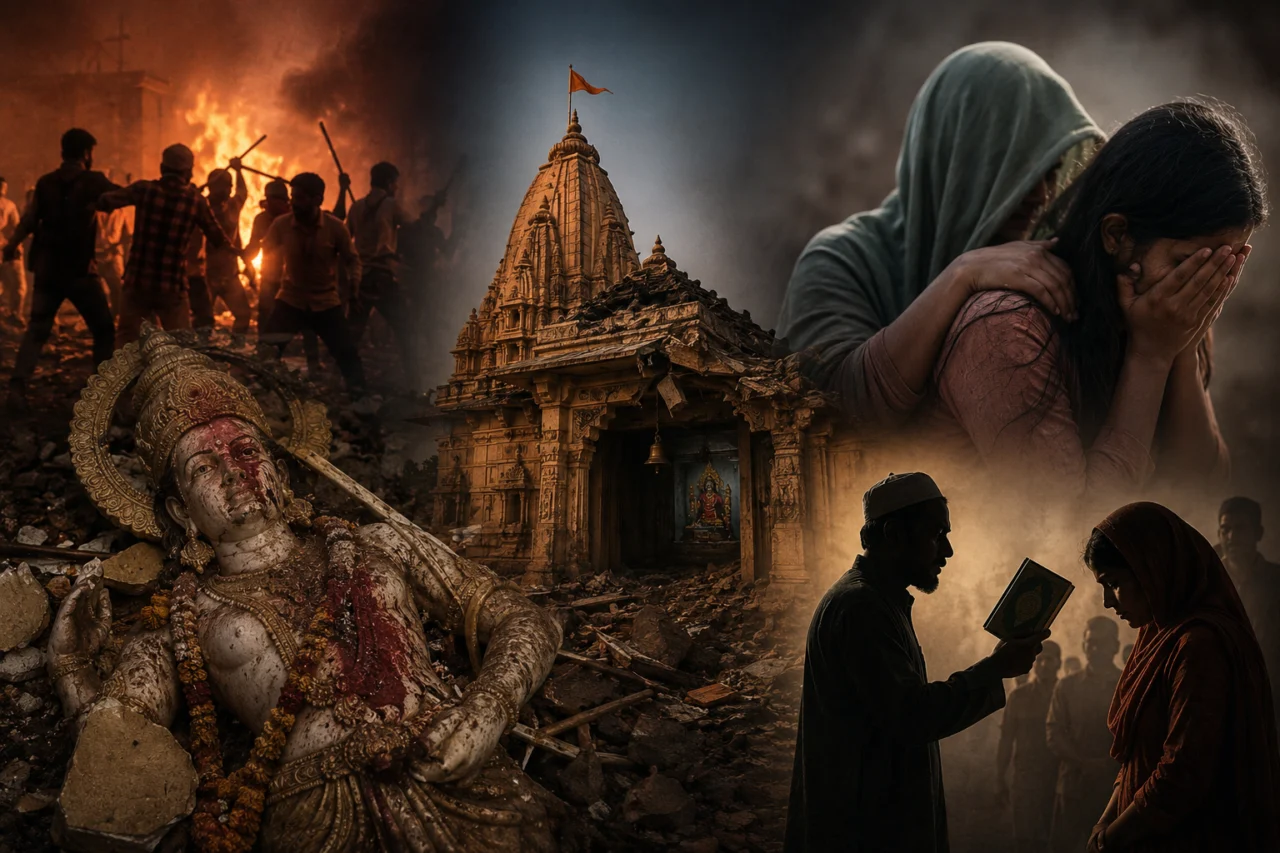
A series of incidents reported between April 20 and April 26, 2026, from multiple Indian states as well as neighbouring countries, including Bangladesh and Pakistan, once again brought national attention to issues involving alleged religious targeting, temple desecration, coercive conversion attempts, attacks on Hindu symbols, communal intimidation, social media hate content, and violence directed at Hindu individuals and institutions. The week witnessed a broad range of developments spanning criminal investigations, protests, political controversies, allegations of organised conversion networks, assaults linked to religious identity, and growing public outrage over repeated incidents affecting Hindu communities.
Several of the reported cases involved Hindu women and minor girls allegedly being lured, abducted, sexually assaulted, blackmailed, or pressured to convert under false promises of marriage or emotional manipulation. Other incidents involved allegations of forced conversion through inducements, prayer gatherings, missionary activity, or ideological pressure directed at economically vulnerable communities, tribal families, students, and patients at rehabilitation centres. These developments triggered police interventions, protests by Hindu organisations, arrests, and demands for stronger legal action.
The developments also extended beyond India’s borders. Reports from Bangladesh and Pakistan documented attacks on Hindu minorities, killings, mob assaults, temple vandalism, and allegations of forced conversions and targeted violence against Hindu individuals and families. These incidents contributed to renewed discussions regarding the safety and protection of minority Hindu communities in neighbouring countries.
The week further witnessed political and social tensions surrounding caste remarks, communal clashes, allegations of police inaction, and debates regarding religious freedom, institutional neutrality, and selective enforcement of laws. Across multiple states, Hindu organisations staged protests demanding accountability, arrests, and legal intervention, while authorities launched investigations into many of the reported incidents.
The detailed incidents from APRIL 20 to APRIL 26, 2026, are given below.
April 20, 2026
1. Hindu teenage girl raped and filmed without consent by Muslim student, footage used to blackmail her into conversion in Beed, Maharashtra
In Majalgaon, Beed district, Maharashtra, a 16‑year‑old Hindu girl studying in Class 11 was lured away from home, raped, secretly filmed and then blackmailed with the footage to pressure her into converting to Islam. The accused, a Muslim college student named Abdul, contacted the girl through a false pretext, telling her to meet near Bakers Lodge Cafe in Majalgaon on the understanding that a friend would be waiting there. Instead, Abdul was present in the friend’s place and used manufactured expressions of romantic affection to gain her trust before sexually assaulting her. The rape occurred under conditions of deception and isolation, leaving the victim emotionally and physically vulnerable from the outset.
The girl initially filed a molestation complaint, but in her subsequent statement before the court she disclosed the full extent of the abuse, including the rape and the fact that the act had been filmed without her knowledge. Police from Majalgaon seized Abdul’s mobile phone and examined its contents with the help of the local cyber cell. The examination uncovered obscene videos of the victim as well as WhatsApp chat records in which Abdul explicitly demanded that she convert to Islam, using the threat of circulating the footage if she refused. The digital evidence clearly established that the videos were not an incidental by‑product of the assault, but an integral part of a coercive strategy to extract religious compliance. Investigation sources indicate that five to six other Hindu minor girls may have been similarly targeted by the same accused, suggesting that this case may be part of a broader pattern of sexual exploitation and conversion‑linked blackmail.
2. Complaint Filed After Derogatory Vishu Poster Featuring Lord Krishna Shared by Restaurant in Kerala
A controversy erupted in Kerala’s Malappuram district after a restaurant identified as My Raydan Restaurant allegedly shared a derogatory Vishu greeting poster featuring Lord Krishna on its official social media platforms. The incident was reported from the Kottakkal area during Vishu celebrations.
The poster allegedly depicted chicken pieces placed before an image styled to resemble Lord Krishna, along with a blue-skinned hand picking food from a biryani plate against a festive Vishu-themed background. The image carried the restaurant’s branding and was reportedly circulated across its social media handles. The restaurant is stated to operate multiple outlets in Kerala and Gulf countries.
The post triggered strong reactions online, with several social media users objecting to the depiction as offensive to Hindu religious sentiments, particularly during Vishu, which holds deep cultural and spiritual significance for Hindus in Kerala. A local resident subsequently filed a complaint alleging that the visual insulted Hindu beliefs and traditions associated with the Vishu Kani ritual.
Following the complaint, police registered a case under Section 192 of the Bharatiya Nyaya Sanhita relating to intentional or malicious acts likely to provoke unrest. Officials initiated an investigation into the creation and circulation of the poster, including the individuals responsible for handling the establishment’s digital platforms.
3. Complaint Registered After Restaurant owned by Muslim Shares Allegedly Offensive Vishu Poster Featuring Lord Krishna in Kerala
A complaint was registered in Kerala’s Malappuram district after Arabian Majlis Restaurant allegedly shared a derogatory Vishu greeting poster featuring Lord Krishna on its official social media platforms. The incident was reported from the Kottakkal area during Vishu celebrations.
The poster allegedly depicted a child-like representation of Lord Krishna seated at a dining table consuming a meat-based dish, alongside a Vishu-themed arrangement containing fruits and traditional festive elements. Screenshots of the visual circulated widely on social media, triggering strong reactions from several users who termed the depiction offensive to Hindu religious sentiments.
Arabian Majlis Restaurant is reported to operate multiple outlets across Kerala, including Feroke, Koduvally, Kondotty, Kottakkal, Tanur, Tirurangadi and Cherpulassery, along with branches in Gulf cities such as Dubai, Sharjah and Abu Dhabi.
Following the circulation of the poster, a local resident filed a police complaint alleging that the depiction insulted Hindu beliefs and traditions associated with Vishu and the Vishu Kani ritual. Police subsequently registered a case under Section 192 of the Bharatiya Nyaya Sanhita relating to intentional or malicious acts likely to provoke unrest.
Officials initiated an investigation into the creation and dissemination of the poster, including the role of individuals managing the establishment’s digital platforms. Investigators were also examining digital evidence and social media activity linked to the case at the time of reporting.
4. Protest Erupts in Nashik After Temple Idols Found Altered With Religious Symbols
Tension was reported in Maharashtra’s Nashik district after Hindu devotees discovered that idols inside the Satya Baba Temple in Malegaon’s Chandanpuri area had allegedly been altered with symbols associated with Islamic religious practice.
The incident came to light when local residents and devotees visiting the temple found a green chadar placed over the idol of Aai Mauli, while a Muslim-style cap had been placed on the idol of Gramdevata Satya Baba. The alterations were reportedly made during the night by unidentified individuals who entered the temple premises.
The discovery triggered anger and distress among members of the Hindu community, with activists from Hindu organisations gathering outside the temple and staging a sit-in protest demanding action against those responsible. Protesters called for immediate identification and arrest of the accused.
Police reached the spot after receiving information about the incident and deployed additional personnel in the area to maintain law and order. A complaint was registered against unidentified persons under relevant legal provisions, and an investigation was initiated.
Officials began examining CCTV footage and other evidence to identify those involved in the alleged tampering of the idols. Senior police officers also reviewed the situation while appealing for peace. No arrests had been reported at the time of the latest update.
5. Protest in Chhattisgarh Village After Hanuman Idol Found Broken Inside Temple
Tension was reported in Chhattisgarh’s Janjgir Champa district after Hindu devotees discovered a broken Hanuman idol inside a temple in Mudpar village under the Shivrinarayan police station area.
The incident came to light when villagers visited the temple and found that unidentified individuals had allegedly entered the premises during the night and damaged the idol of Lord Hanuman. The temple served as a regular site of worship for local Hindu residents, and the damage triggered anger and distress among devotees.
Following the discovery, a large number of villagers gathered and staged a protest demanding immediate action against those responsible for the desecration. Protesters blocked the Shivrinarayan main road for several hours, raising slogans and calling for arrests in the case.
Police personnel reached the spot after receiving information about the incident. Senior officials, including Additional Superintendent of Police Umesh Kashyap, met the protesters and assured them of action. The blockade was later lifted after discussions with the administration.
A formal complaint was registered against unidentified persons, and police initiated an investigation into the incident. Authorities began examining CCTV footage and other available evidence to identify those involved. Security monitoring in the area was also intensified following the protest.
6. Clash Erupts in Uttarakhand Village Over Alleged Conversion to Christianity Activities, Several Injured in Stone Pelting
Tension was reported in Nanakmatta area of Uttarakhand after local residents and Hindu organisations alleged that vulnerable Hindu villagers were being targeted for conversion to Christianity through prayer meetings and promises of financial assistance in village Naveen Nagar.
The controversy escalated when members of the Vishwa Hindu Parishad and Bajrang Dal, along with villagers, reached the location to protest against the alleged conversion activities. A confrontation broke out between the two groups, during which stone pelting and physical assault were reported from the rooftop of the premises.
Several people sustained injuries in the violence, including Priyanshu Rana, Renuvati Devi, Sunita Devi, Sarju Vati and Kishan Singh. Police later sent the injured for medical examination.
Following the incident, villagers and members of Hindu organisations gathered at the Nanakmatta police station and staged a protest demanding strict action against those involved. The demonstration was led by VHP president Ajay Bhagat and Bajrang Dal state coordinator Puran Joshi.
A memorandum was also submitted to the Sub-Divisional Magistrate through Rajiv Dubey, alleging that economically vulnerable villagers were being influenced for conversion to Christianity through inducements and financial promises. The memorandum sought a high-level investigation into the matter.
Police confirmed receiving the complaint submitted by VHP members and stated that the matter was under investigation. Authorities also appealed for peace in the area. No FIR had been registered at the time of the latest update.
7. Ahmedabad Man Arrested Over Allegedly Offensive Social Media Posts Targeting Hindu Symbols and Brahmin Community
The Ahmedabad Crime Branch arrested a man identified as Nikhil Chavda after allegedly offensive and provocative social media posts targeting Hindu deities, sacred symbols and the Brahmin community triggered widespread outrage in Gujarat.
The controversy erupted after social media posts allegedly containing abusive remarks against Lord Parshuram and objectionable content mocking the shikha, the sacred tuft traditionally worn by Brahmin Hindu men, circulated widely online. The posts drew sharp reactions from members of the Hindu community and social media users.
Police investigation reportedly found that the accused had shared similar content over an extended period. Older posts linked to his social media accounts allegedly contained abusive language targeting Brahmin traditions, Hindu sacred symbols and women.
Following the circulation of the posts, Ahmedabad police initiated action and arrested the accused. Gujarat Minister of State for Home Harsh Sanghavi and the police department received praise on social media for the swift response in the matter.
Crime Branch officials stated that further investigation was underway to determine the motive behind the posts and whether the accused had acted independently or in coordination with any group to spread communal hostility. The accused remained in police custody while legal proceedings continued.
8. Minor Hindu girl lured into relationship under false pretext of marriage, brainwashed and abducted by Muslim man in East Champaran, Bihar
In East Champaran district, Bihar, a minor Hindu girl was lured, brainwashed and abducted by a Muslim man named Sahil Ansari under the false pretext of marriage. The incident came to light when the girl was rescued by security forces during a routine check at the Raxaul border, near the Indo‑Nepal border in East Champaran. The Anti‑Human Trafficking Unit (AHTU), personnel of the Sashastra Seema Bal’s 47th battalion and other officials at the Maitri Bridge check‑post stopped an auto‑rickshaw travelling from Nepal to India and found Ansari, a resident of Harsiddhi, East Champaran, travelling with a minor girl from the same area. The girl was identified as Hindu, and the suspicious nature of the journey prompted the authorities to take her into protective custody.
During counselling by female security staff along with members of Prayas Juvenile Aid Centre and associated organisations, the girl disclosed that Ansari had been in contact with her over the phone for the past seven to eight months, gradually building familiarity and emotional dependence under the guise of a romantic relationship. She stated that he had promised her marriage, lured her out of the family home, and taken her to Nepal three days before the interception, where they stayed in rented accommodation. On the day of the rescue, he was attempting to take her to Ahmedabad, Gujarat, presenting the journey as a continuation of the “marriage” plan. The girl also revealed that, under his influence, she had begun observing roza, indicating a clear shift in religious practice induced by sustained ideological conditioning rather than any free or informed choice.
The victim in this case is a single minor Hindu girl, recorded as under 18 years of age and belonging to the general category; her caste and exact name have not been disclosed in public reports, and authorities have treated her as a protected child survivor. A missing‑person complaint had already been lodged by her family at Harsiddhi police station under FIR number 222/26 dated 20 April 2026, and after the rescue the girl and the accused were handed over to Haraiya police station in Raxaul for further legal action. The case status is listed as “complaint filed,” with the investigation and follow‑up proceedings still underway.
9. Hindu Men and Women Allegedly Targeted Through Organised Conversion Activities in Shahjahanpur
An alleged organised conversion network targeting economically vulnerable Hindu men and women came to light in Shahjahanpur district of Uttar Pradesh after repeated prayer gatherings were reportedly conducted in Pakriya Hakim village under the Puwaiyan area. The gatherings were organised at the residence of Ahiwaranlal alias Guddu, where Hindu attendees were allegedly subjected to sustained religious influence and inducements aimed at conversion to Christianity.
The activities primarily targeted Hindu men and women belonging to economically weaker sections, including individuals from Scheduled Caste communities and uneducated backgrounds. During the gatherings, attendees were shown Christian videos, literature, and visual presentations. They were allegedly told that accepting Christianity would bring financial assistance and relief from hardship. The meetings were reportedly coordinated by individuals identified as Namdweep, Rachin, and Binderlal.
A larger gathering organised on 19 April 2026 drew attention after a large screen was installed inside the premises to display religious material before attendees. Local residents, including Saurabh Verma and others, reached the location after receiving information about the activities. The organisers allegedly ended the gathering abruptly after their arrival and attempted to disperse those present.
Information gathered during the incident also pointed to alleged coordination with individuals and organisations based in Punjab through online platforms, including Google Meet, indicating a wider network behind the activities.
Following the incident, a formal complaint was submitted to the police detailing the repeated targeting of vulnerable Hindu villagers and the inducements allegedly offered during the gatherings. Police registered a case against four individuals connected to the activities and brought several persons to the police station for questioning. Three individuals, including Namdweep, Rachin, and Bateshwar, were detained and later issued challans. Police stated that an investigation was underway into the activities and the role of those involved.
April 21, 2026
10. Allegations of Pressure to Convert to Christianity Surface at Gorakhpur Missionary College
Allegations of religious conversion pressure emerged from St. Andrew’s College in Gorakhpur, Uttar Pradesh, after Hindu teachers and staff members accused the institution’s Principal, Prof. S.D. Rajkumar, of compelling them to adopt Christianity. The complaint alleged that nearly 30 teachers and non-teaching staff members were subjected to sustained mental pressure and religious influence within the institution.
The complainants stated that an atmosphere had developed inside the college where Hindu staff members were allegedly being encouraged and pressured to change their faith. The allegations prompted concern among local residents and led to administrative intervention.
Following the complaint, district administration and police authorities initiated an inquiry into the matter. Statements of teachers and staff members were recorded, and the functioning and environment of the institution were examined as part of the investigation.
The inquiry committee later stated that no sufficient evidence supporting allegations of coercion or organised conversion activity was found during the investigation. The complaint and statements made by the alleged victims were subsequently dismissed by the committee.
However, dissatisfied with the findings, the complainants decided to escalate the matter further and submitted representations to the Governor while also seeking intervention from higher authorities.
The alleged victims included around 30 Hindu teachers and staff members associated with the college. The complaint named Principal Prof. S.D. Rajkumar as the individual accused of exerting pressure to convert them to Christianity.
11. Hindu Family Alleges Death Threats Over Their Religious Identitiy By A Members Of Muslim Commuity in Uttar Pradesh’s Saharanpur
A Hindu family in Saharanpur, Uttar Pradesh, alleged that they received death threats from members of the Muslim community after converting to Hinduism through a gharwapsi ceremony held in Haridwar on 21 April 2026.
The family, formerly practising Islam, embraced Sanatan Dharma after participating in purification rituals, bathing in the Ganges, and religious ceremonies conducted at Brahmakund on Chandi Ghat. Shahzad, the head of the family, adopted the name Shankar after the conversion, while his wife Razia changed her name to Savitri. Three other family members also embraced Hinduism during the ceremony.
A video of the ceremony surfaced on social media showing Shankar with religious leader Arun Kishan Maharaj on the banks of the Ganges. Following the conversion, Shankar stated that he had believed in Sanatan Dharma since childhood and had never been inclined towards Islamic practices such as offering namaz. He also said that his family was happy after embracing Hinduism.
Shankar further alleged that after the conversion, he began receiving threats from individuals known to him from the Muslim community. He stated that despite the threats, he did not wish to return to his former faith.
Religious leader Ram Vishal Das, who facilitated the ceremony, stated that the family had approached him on their own seeking to adopt Hinduism. The conversion rituals were conducted publicly in Haridwar.
The victims in the incident included five members of the same family who converted to Hinduism. The individuals accused of issuing threats were described as members of the local Muslim community, though no specific names were disclosed.
12. Hindu BJP Leader, Daughter and Supporters Attacked During Election Rally in Kolkata Amid Provocative Slogans
Tension erupted in Kolkata, West Bengal, after BJP leader Rakesh Singh, his daughter, and several supporters were allegedly attacked during an election campaign meeting held on Hassan Shah Road on 21 April 2026.
The meeting had reportedly been organised after obtaining permission from the Election Commission as part of the ongoing election campaign. During the programme, a group of Muslim men allegedly gathered at the site and began raising provocative slogans including “Mini Pakistan Zindabad”, “Nare Takbir”, and “Hijra Rakesh Singh ko bulao”. The situation soon escalated into violence, with physical assaults reported against Rakesh Singh, members of his team, and other Hindu participants present at the rally.
Rakesh Singh stated that he contacted IPS officer Hare Krishna Pai and the District Collector seeking immediate intervention, but alleged that police assistance did not arrive in time. As tensions intensified, he and several supporters moved towards the Iqbalpur police station for safety.
According to the complaint, individuals identified as TMC supporters were present in the area during the violence. Allegations were also made regarding police inaction during the incident. Rakesh Singh further alleged that the attackers included individuals identified as Shehbaz and Amanullah.
Several people sustained injuries during the clash, including Rakesh Singh’s daughter. Around 22 injured men and women were admitted to hospital for treatment. Allegations were also raised that no women police personnel intervened to assist female victims during the violence.
Following the incident, police registered an FIR against Rakesh Singh and his associates. A photograph showing one of the accused in proximity to an IPS officer later surfaced on social media, prompting further political reactions regarding the handling of the incident.
The victims included 22 Hindu men and women who were present during the rally and sustained injuries in the violence. The accused included a group of individuals alleged to be linked to local TMC supporters, while complaints also referenced the role of specific persons identified as Shehbaz and Amanullah. Police investigation into the incident remained ongoing at the time of reporting.
13. Hindu teenage girl abducted and forcibly converted to Islam in Sindh, given Muslim name and married against her will
In Hyderabad district of Sindh, Pakistan, a 14‑year‑old Hindu girl named Pooja, daughter of Ramsun Thakur, was abducted, raped, forcibly converted to Islam, renamed Dua Fatima and married through nikah to a Muslim man named Imran Ali without her consent or that of her family. Pooja, a ninth‑grade student living with her parents in Hyderabad, disappeared from her home under suspicious circumstances, with the family later noting that money and jewellery also went missing, suggesting prior inducement or manipulation. According to the family’s account, she was taken against her will, physically assaulted and then subjected to threats and coercion that left her in a state of terror and helplessness.
Following the abduction, Pooja was raped and then forced to convert to Islam; her Hindu name was formally replaced with the Muslim name Dua Fatima, an act that the family and human‑rights groups describe as a deliberate erasure of her Hindu identity at the level of the most immediate, personal marker. After the conversion, she was married to Imran Ali, son of Allah Wario, through nikah without the consent of either the girl or her parents. Voice of Pakistan Minority, a Pakistani minority rights organisation, strongly condemned the episode as an inhuman act that strips a minor of her faith, her name and her autonomy, presenting it as part of a broader pattern of forced conversions and nikah‑linked abductions targeting Hindu girls in Sindh. The organisation has highlighted that such incidents feed a climate of fear among Hindu families, who live under the constant threat that their daughters may be taken, forcibly converted and married away under the guise of religion or “love.”
14. Hindu Sentiments Outraged After Christian Youths From Goa Make Abusive Remarks Against Hindu Deities on Social Media
Goa witnessed controversy after abusive and derogatory remarks targeting Hindu deities were allegedly posted on social media by Christian youths, triggering protests and complaints from Hindu activists.
The incident emerged in the backdrop of controversy surrounding YouTuber and Hindu activist Gautam Khattar and his brother Madhav, who faced opposition from Christian organisations and political figures over remarks made about 16th-century missionary Francis Xavier during a Hindu cultural event held in Vasco on 18 April 2026. Complaints were subsequently filed against Khattar, and police registered cases in connection with the remarks.
Following the controversy, several objectionable posts targeting Hindu deities began circulating on social media. Hindu activists alleged that offensive comments were made against Lord Ram, Goddess Sita, and Lord Parshuram. Screenshots of the posts were later attached to a formal police complaint.
On 23 April 2026, a group of Hindu activists reached Mapusa Police Station and submitted a complaint against individuals identified as Babit Fernandes and Elesban Mark Mascarenhas. The complainants stated that the social media comments had hurt Hindu religious sentiments and could disturb communal harmony.
The complaint sought legal action under provisions related to deliberate acts intended to outrage religious feelings, promoting enmity between communities, intentional insult, and statements promoting hatred. Activists also urged the police to identify those involved and ensure removal of the offensive content from social media platforms.
No further police action had been publicly confirmed at the time of reporting.
15. Hindu Temple Vandalised and Kali Murti Desecrated During Attack on Indigenous Hindu Community in Bangladesh
A Kali temple was vandalised and members of the indigenous Hindu community were attacked in Ghorabanda village under Poltapur Union in Birganj Upazila of Bangladesh’s Dinajpur district amid an alleged attempt to seize land associated with Hindu cremation and burial grounds.
According to local sources, a mob of nearly 150 to 200 people, reportedly led by Rezaul, son of Kader, and Azad, son of Azgar Sahaji, targeted the Hindu community’s religious and community spaces. The attackers vandalised a Kali temple situated near the cremation ground and broke the Murti of Goddess Kali before throwing it into a nearby cornfield.
The violence was linked to an alleged attempt to take control of land used by the Hindu community. Following the temple attack, members of the mob also attempted to cut trees and occupy additional land belonging to local Hindus. Tensions escalated when Hindu residents resisted the encroachment.
Before the land grab attempt, the attackers allegedly entered the house of Pius Murmu, assaulted him, and set his home on fire, creating panic in the locality. During the violence, another Hindu resident, Bishwanath alias Bhonda, son of Ganesh Soren, sustained injuries after being shot in the chest with an arrow. He was later admitted to Birganj Health Complex for treatment.
Police officials led by Birganj Police Station Officer-in-Charge Saiful Islam reached the spot after receiving information and brought the situation under control. Assistant Commissioner (Land) and Executive Magistrate Dipankar Barman also visited the area, while additional police forces were deployed following the incident.
Police confirmed that at least one person was injured in the violence, and tensions continued in the area after the attack on Hindu religious and community spaces.
April 22, 2026
16. Hindu Children Allegedly Exposed to Suspected Beef in Bihar School, Five Staff Members Arrested
Tension prevailed in Rohtas district of Bihar after more than seven kilograms of suspected beef was recovered from the premises of an upgraded Urdu middle school in Ramudih village, leading to protests by Hindu parents and the arrest of multiple school staff members.
The incident came to light on 22 April 2026 when students complained about a foul smell coming from a classroom during school hours. Some children reportedly stepped out covering their noses and mouths. Hindu parents present near the school questioned the students and later inspected the classroom along with other villagers.
During the inspection, four black plastic bags containing over seven kilograms of meat were allegedly found inside the classroom. The discovery triggered concern among Hindu parents, particularly over suspicions that the meat may have been intended for the mid-day meal served to students. The school reportedly had nearly 200 students, including around 125 Hindu children.
As news spread, villagers gathered outside the school premises and protests continued for several hours, with demands for strict action against those responsible. Concerns were also raised regarding the storage of meat inside a classroom being used by children.
The school staff included Principal Mohammad Anwar, Akhtar Ali, Mohammad Imran, Anwar Khan, Sufia Khatoon, and Hina Kausar. Allegations were raised against members of the school administration regarding the presence of the meat within the premises.
Police and district administration officials later reached the spot and deployed additional personnel to control the situation. The recovered meat samples were seized and sent to the Forensic Science Laboratory for examination to determine their nature.
Following the incident, Principal Mohammad Anwar, Akhtar Ali, Mohammad Imran, Sufia Khatoon, and Hina Kausar were arrested. Authorities stated that investigations were underway to determine how the meat entered the school premises and whether it was linked to the mid-day meal served to students.
17. Hindu woman lured with false promises, sexually assaulted, confined and pressured to convert to Islam; family threatened by Muslim accused in Uttar Pradesh
A Hindu woman from Pilibhit district in Uttar Pradesh was allegedly lured away from her home by a Muslim man on the promise of land, after which she was confined, sexually assaulted, and repeatedly pressured to convert to Islam and marry him. The accused also threatened to kill her husband and children after she refused to abandon her faith.
The victim, a married Hindu woman from the Jehanabad police station area, stated in her complaint that Irshad Ansari alias Nanhe, a resident of Kukrikheda village, persuaded her to accompany him by offering three bighas of land. He then took her to a rented accommodation in Gangwar Colony of Nawabganj in Bareilly district.
Inside the rented house, the accused allegedly forcibly established physical relations with the woman and kept her confined there for several days. During this period, she was repeatedly sexually assaulted and continuously pressured to leave her husband, convert to Islam, and marry the accused.
The woman stated that the accused repeatedly demanded that she abandon both her marriage and her Hindu identity. When she refused to convert, he allegedly threatened to kill her husband and children. The victim remained under fear and intimidation before eventually managing to escape from the location.
After returning, she informed her family about the confinement, sexual violence, and sustained pressure to convert her religion. She later approached Jehanabad police station and submitted a formal complaint naming Irshad Ansari alias Nanhe as the accused.
18. Hindus and Hindu deities mocked in viral social media video in Raebareli, police launch search for accused
Religious sentiments of Hindus were hurt in Raebareli district of Uttar Pradesh after a social media video containing derogatory remarks against Hindu deities and Hindu communities went viral, triggering outrage among local residents and prompting police action against the accused.
The accused, identified as Sarwan, son of Bharat Raidas and a resident of Tola Chamarhi in Mau Garvi village under the Chandapur police station area, allegedly uploaded a video on social media in which he used abusive and insulting language against Hindu gods and goddesses along with members of the Brahmin and Kshatriya communities.
The video rapidly spread across social media platforms and sparked anger in the area. Residents alleged that the content was deliberately intended to provoke communal tensions and hurt the religious sentiments of Hindus through objectionable remarks targeting their faith and social identity.
Following the circulation of the video, Umanath Singh, son of late Anoop Singh and a resident of Mau Garvi village, submitted a formal complaint at Chandapur police station seeking action against the accused.
Based on the complaint, police registered a case against Sarwan under relevant provisions of the Bharatiya Nyaya Sanhita related to promoting enmity and hurting sentiments through objectionable content circulated online.
Station House Officer Arvind Singh confirmed that a case had been registered in connection with the viral video and stated that police teams were conducting raids to locate and arrest the accused.
19. Hindus targeted with abusive remarks against Hindu deities in viral social media video in Jharkhand
Religious sentiments of Hindus were hurt in Deoghar district of Jharkhand after a viral social media video surfaced showing youths making abusive and derogatory remarks against Hindu gods and goddesses. The incident triggered anger among local Hindu residents, following which police initiated action against the accused.
The incident occurred in the Pathrol police station area of Deoghar district, where a video circulated widely on social media showing a youth identified as Kundan Yadav using objectionable and insulting language against Hindu deities. The video also allegedly contained offensive remarks involving mothers and sisters, further intensifying outrage among Hindu devotees.
Kundan Yadav, along with Sonu Yadav and Monu Yadav, all residents of Khamarwad village in the Pathrol area, were seen in the viral clip allegedly mocking Hindu religious beliefs and using abusive language directed at sacred figures worshipped by Hindus.
As the video spread online, anger grew among local residents and members of Hindu organisations, who alleged that the content was deliberately created and circulated to insult Hindu faith and provoke communal tension.
Following the circulation of the clip, Sagar Kumar Jaiswal, Kartik Kumar, and Sudama Yadav submitted a written complaint at Pathrol police station demanding strict legal action against those involved in creating and circulating the offensive content.
Police subsequently launched an investigation into the matter. Kundan Yadav was taken into custody and later arrested in connection with the case. Officials confirmed that action was initiated following complaints received from Hindu organisations and local residents.
The investigation remained ongoing as police continued examining the role of the other individuals seen in the viral video and the circumstances surrounding the circulation of the objectionable content.
20. Hindu Man Dragged and Assaulted by Muslim Mob in Khulna Over Blasphemy Allegation
A Hindu man was brutally assaulted by a Muslim mob in Bangladesh’s Khulna district after allegations of blasphemy surfaced against him. The attack took place while he was already in police custody, triggering fear and concern among the local Hindu community.
The victim, identified as Shamol Gain of Patakhali village in Dumuria upazila, was detained by police after allegations emerged that he had made remarks concerning Prophet Muhammad. News of the allegation spread rapidly across the locality, leading to the mobilisation of a large crowd near the Mondal Jute Mill area.
Despite being handcuffed and under police control, Shamol Gain was surrounded by the mob and attacked with sticks. Eyewitness accounts from the area indicated that he was repeatedly beaten in public view while still restrained. The violence escalated further as members of the mob dragged him across muddy fields, continuing the assault while he remained unable to defend himself.
The victim sustained injuries during the attack before police managed to recover him from the crowd. He was later taken to Khulna Medical College Hospital for treatment.
Following the incident, additional police forces were deployed in the area to prevent further escalation and restore order. Authorities also initiated legal proceedings related to the allegations against the victim, while investigations into the mob assault continued.
The incident has intensified concerns among Bangladesh’s Hindu minority community regarding mob violence linked to blasphemy accusations. Cases involving allegations of religious insult have repeatedly led to attacks on Hindus in different parts of Bangladesh, often resulting in public violence, intimidation, and social fear.
April 23, 2026
21. Mamata Banerjee Faces Backlash Over Alleged Casteist Remark at Kolkata Rally
Political controversy erupted in West Bengal after Chief Minister Mamata Banerjee allegedly used a derogatory caste-based slur while addressing an election rally at Chowringhee in Kolkata, triggering outrage among sections of the Dalit Hindu community and prompting intervention by the National Commission for Scheduled Castes (NCSC).
The remarks were made during a public rally organised in support of a Trinamool Congress candidate, where Mamata Banerjee was highlighting development works undertaken by her government in the Janbazar area. During the speech, she used the term “Ch*mar” while referring to members of the Scheduled Caste community. A video clip of the speech later surfaced on social media and was broadcast by Bengali news channels, leading to widespread criticism and political reaction.
The term is widely regarded as a casteist slur historically used in a derogatory and humiliating manner against Dalit Hindu communities, particularly those associated with leather-working occupations. The video quickly drew condemnation from several quarters, with critics accusing the Chief Minister of using language offensive to Scheduled Castes in a public setting.
Following the controversy, the National Commission for Scheduled Castes took suo motu cognisance of the incident after reviewing the video footage. The Commission described the remarks as “shameful” and stated that the use of caste-based slurs amounted to an insult to the dignity of Scheduled Caste communities.
The Commission invoked provisions of the Scheduled Castes and Scheduled Tribes (Prevention of Atrocities) Act and initiated an inquiry into the matter. Notices were issued to the West Bengal Chief Secretary and the Director General of Police, directing them to submit a detailed report within three days regarding the incident and the circumstances surrounding the speech.
NCSC Chairman Kishor Makwana stated that caste-based insults against Scheduled Castes would not be tolerated and stressed that constitutional safeguards existed to protect the dignity and rights of marginalised communities. He also expressed concern over what he described as a rise in incidents involving atrocities and discrimination against Scheduled Castes in the state.
The controversy further intensified political tensions in West Bengal, with opposition groups demanding accountability and clarification from the Chief Minister over the remarks.
22. Hindu Man Allegedly Deceived Into Fraudulent Marriage by Woman Posing as Hindu in Solapur
A case of alleged identity-based marriage fraud surfaced in Maharashtra’s Solapur district after a Hindu man discovered that the woman introduced to him as a Hindu bride had concealed her religious identity and marital status. The incident later exposed what investigators described as an organised network targeting Hindu men seeking marriage alliances.
The woman had reportedly been introduced to the groom and his family as a member of the Maratha community. Trusting the identity presented to them, the family proceeded with the marriage ceremony and welcomed her into their household as a Hindu bride. According to the family, no information regarding her actual identity or previous marriage was disclosed before the wedding.
The matter came to light four days after the marriage when the woman allegedly attempted to leave the house quietly with valuables belonging to the family. The groom noticed her actions, followed her, and brought her back before she could flee.
Subsequent inquiries revealed that the woman, identified as Kusumben Bemabhai Ghatad, was allegedly Muslim and already married with children. The revelation shocked the family, who maintained that the marriage had been conducted under false pretences from the beginning.
As the investigation progressed, further details emerged suggesting the involvement of an organised group operating a systematic fraud network. According to information gathered during the inquiry, Hindu men searching for brides were allegedly being specifically targeted through false identities and fraudulent marriages. Women were reportedly presented as Hindu brides to gain access to households before attempting theft and disappearing.
The incident raised concerns within the local community regarding identity concealment in matrimonial arrangements and the alleged use of organised deception to exploit families emotionally and financially. Authorities continued examining the wider network and the extent of similar cases linked to the operation.
23. Hindu Villagers Allegedly Pressured Into Religious Conversion During Prayer Gathering in Khargone
A religious conversion racket was exposed in Madhya Pradesh’s Khargone district after police raided a prayer gathering where Hindu villagers were allegedly being pressured to abandon Hindu customs and adopt Christianity through inducements and religious messaging.
The incident surfaced in Bamnala village under the Bhikangaon police station area on 23 April 2026. According to police records, a 29-year-old Hindu man, identified as Bablu Dangode, reached a house on Selda Road around noon where a Christian prayer meeting was already in progress. Inside the room, he was allegedly handed a Bible and told that his illnesses could be cured if he gave up Hindu religious practices.
During the gathering, attendees were reportedly instructed to remove their tilak and abandon Hindu rituals. The victim was also allegedly told that he had already converted. Police later stated that the meeting involved organised religious messaging aimed at influencing Hindu villagers.
Around 20 villagers, including members of tribal Hindu communities, were present at the location. Religious content was being displayed using a projector and laptop, while the room had been arranged to create an inviting atmosphere for attendees. Authorities believe the use of digital equipment and coordinated presentations indicated a structured effort to conduct conversion-related activities.
As information about the gathering spread in the area, local residents and Hindu organisations reached the spot and protested outside the premises. Police teams were subsequently deployed to control the situation and inspect the site.
During the search operation, police seized 13 Bibles, eight pieces of missionary literature, a projector, laptop, sound system, microphone, and a register containing records linked to the organisation of the gathering.
Four individuals identified as Raju Roopsingh Badole, Pankaj Ramesh Baria, Bablu Jamre, and Setu Medha were detained and later arrested in connection with the case. Investigators alleged that the accused were involved in organising the gathering and influencing Hindu villagers to convert.
A case was registered against the accused under provisions of the Madhya Pradesh Freedom of Religion Act. All four were produced before a court and sent to judicial custody.
Police have launched a wider investigation to determine the scale of the network and identify any additional individuals linked to the alleged conversion activities operating in the region.
24. APCR Report in Nashik TCS Case Sparks Fresh Controversy Over Alleged Downplaying of Hindu Victims’ Complaints
The Nashik TCS BPO sexual exploitation and alleged forced conversion case witnessed a new controversy after a self-styled fact-finding report released by the Association for Protection of Civil Rights (APCR) questioned the credibility of complaints filed by Hindu victims and defended several accused individuals arrested in the case.
The controversy emerged after multiple Hindu employees working at the Tata Consultancy Services BPO facility in Nashik approached police with allegations of sexual harassment, coercion, religious targeting, and pressure to adopt Islamic practices within the workplace. Several FIRs filed by women employees described repeated incidents of harassment, vulgar remarks, intimidation, stalking, and derogatory comments directed at Hindu customs and deities.
Amid the ongoing investigation, a five-member APCR team released a report claiming there was no conclusive evidence of organised religious conversion activity inside the TCS facility. The report largely relied on statements made by relatives and associates of the accused, who denied the allegations and termed the complaints fabricated.
The intervention shifted public focus from the testimonies of the complainants towards questioning the credibility of the investigation and the victims themselves.
APCR national secretary Nadeem Khan, who addressed the media during the release of the report, claimed that civil society groups did not trust the Nashik police investigation and demanded an inquiry under the supervision of a retired High Court or Supreme Court judge. He also proposed narco analysis tests for both complainants and accused individuals.
Khan further alleged that the case was being used to create fear among Muslims working in corporate sectors. He questioned portions of the FIRs and stated that several allegations appeared doubtful.
Activist Teesta Setalvad also described the Nashik case as “manufactured” and claimed it would not stand judicial scrutiny. She argued that criminal cases should not be viewed through the lens of religion or caste and alleged that one of the accused women was being selectively targeted.
Former journalist and Nashik-based activist Niranjan Takle similarly questioned the complaints and suggested that narco tests should be conducted on all parties involved. He claimed that several FIRs contained allegations that would be difficult to prove in court.
The statements triggered sharp reactions because the complaints filed by Hindu victims included detailed allegations of sexual exploitation and religious coercion spanning several years.
The first FIR in the matter was registered at Deolali Camp Police Station on 23 March 2026. Following the complaint, women police personnel reportedly conducted an undercover operation within the company premises. During the probe, several women employees allegedly disclosed incidents involving sexual harassment, repeated vulgar comments, invasive questioning about personal relationships, and mocking of Hindu beliefs.
According to the FIRs, some accused employees allegedly pressured Hindu women to offer namaz, consume beef, and convert to Islam. Victims also alleged that Hindu deities including Lord Ram, Sita, Shiva, Brahma, and Lord Ganesha were mocked through derogatory remarks inside the workplace.
One complainant stated that accused employees repeatedly made sexually coloured remarks and insulted Hindu customs. Another victim alleged that comments were made linking sexual violence in Hindu society to the absence of burqa practices among Hindu women.
Victims further alleged that repeated complaints submitted internally were ignored, allowing the harassment and coercion to continue unchecked over several years.
The APCR report, however, questioned the existence of organised wrongdoing and presented the allegations as exaggerated. Critics argued that the report selectively highlighted statements favouring the accused while overlooking the consistency of complaints recorded across multiple FIRs.
The controversy intensified further after APCR and associated activists suggested that the case was being used to divert attention from unrelated political and civic controversies in Nashik, including allegations linked to civic projects and local administrative issues.
The Nashik police investigation into the TCS case remains ongoing. Multiple accused individuals named in the FIRs were arrested earlier, while authorities continue examining allegations related to workplace exploitation, sexual harassment, and religious coercion.
25. Hindu Students Forced to Remove Sacred Thread During CET Examination at Bengaluru Centre
A controversy erupted in Bengaluru after several Hindu students appearing for the Common Entrance Test (CET) were allegedly compelled to remove their sacred thread, known as Janivara or Janeu, before being permitted to enter the examination hall despite prior government directives stating that such religious symbols should not be restricted.
The incident took place on 23 April 2026 at Krupanidhi College in the Madiwala area of Bengaluru, one of the designated CET examination centres in Karnataka.
Among the affected students was Anand Sudheer Rao, who stated that he arrived at the examination centre around 9:40 am and proceeded through the routine entry process after depositing his belongings. During the security check, invigilators noticed that he was wearing a Janivara, the sacred thread traditionally worn after the Upanayana ritual and regarded as an important symbol of Hindu religious identity.
According to the student, invigilators informed him that he would not be allowed to enter the examination hall unless he removed the sacred thread. At least five to seven other Hindu students reportedly faced similar instructions at the same centre.
The students initially objected, explaining that the Janivara was part of their religious observance. However, they were allegedly told that failure to comply would result in denial of entry to the examination hall.
Faced with the possibility of missing an important competitive examination, the students eventually removed the sacred thread under pressure. Anand later stated that the incident caused severe emotional distress and affected his concentration during the examination.
The issue quickly spread among parents and students, leading to protests and formal complaints against the examination centre staff. Families questioned why a sacred religious symbol worn beneath clothing had been treated as a prohibited item despite no such restriction existing in official guidelines.
Following the complaints, police registered an FIR under provisions related to disturbing communal harmony. Authorities also initiated an inquiry into the conduct of the examination staff involved in the incident.
Three staff members associated with examination duties at the centre were subsequently suspended pending investigation.
Senior officials from the education department and local administration later visited the examination centre to assess the situation. The college management issued an apology after the controversy escalated and subsequently allowed students appearing in later examinations to retain their sacred thread while entering the premises.
The incident gained wider attention because similar controversies had surfaced in Karnataka during 2025, after which the state government had issued explicit instructions clarifying that students should not be asked to remove sacred threads during examinations, particularly because they are worn beneath clothing and pose no security concern.
Karnataka Higher Education Minister M. C. Sudhakar acknowledged that the students had been wrongly compelled to remove their Janivara despite clear government directions prohibiting such action. He described the incident as a violation of privacy and religious freedom and stated that no student should be forced to choose between education and faith.
The investigation into the matter remains ongoing.
26. Hindu Temple Desecrated in Karnataka’s Beltangady, Idol of Lord Gopalakrishna Smashed Inside Sanctum
A serious incident of temple desecration was reported from Beltangady in Karnataka after an intruder forcefully entered the Sri Panchalingeshwara Temple and damaged a sacred idol inside the sanctum, triggering outrage and distress among local Hindu devotees.
The incident occurred during the night hours of 23 April 2026 within the jurisdiction of Venur Police Station. According to details that emerged during the inquiry, a man identified as Ajay arrived near the temple premises in a vehicle and created disturbance in the surrounding area before moving towards the temple complex.
Before entering the temple, the accused reportedly approached a nearby residence adjoining the temple premises and attempted to gain entry while shouting loudly. Family members stopped him and asked him to leave the area. Instead of leaving, he proceeded towards the temple premises.
The accused then entered the temple complex and jumped into the sacred pond, known locally as Jalaka Kere. He later moved towards the main temple structure and gained access by climbing onto the building and removing roof tiles. Through this forced entry, he managed to enter the inner sections of the temple.
Inside the premises, the accused moved through multiple sections of the temple, including the Kodamanittaya Daiva shrine. Temple objects were disturbed during the intrusion. A bell placed near the deity platform was reportedly shifted towards the roof area, while another large bell near the theertha mantapa was rung before the accused entered the sanctum.
Upon entering the sanctum of Lord Gopalakrishna, the accused allegedly removed the idol and hurled it to the ground, causing visible damage. Temple items inside the sanctum were found scattered following the incident. The act led to immediate shock and anger among local devotees, who viewed the intrusion as a direct desecration of a sacred Hindu place of worship.
Personnel from Venur Police Station reached the temple after information regarding the incident spread in the locality. Police conducted a preliminary inquiry and questioned the accused regarding his actions. He was later released after reportedly submitting a written undertaking. Details regarding formal charges were not immediately confirmed.
The incident sparked concern among local Hindu residents and temple devotees, particularly over the security arrangements at religious sites and the handling of the accused following the desecration inside the sanctum area.
The Sri Panchalingeshwara Temple is regarded as a revered religious site in the region, and the damage caused to the idol inside the sanctum deeply affected devotees attached to the temple and its rituals.
27. Hindu Girl Lured on Promise of Marriage, Forcibly Converted to Islam and Sexually Assaulted By Muslim Man in Uttar Pradesh’s Balrampur
A case involving alleged forced religious conversion and sexual assault of a Hindu woman surfaced in Uttar Pradesh’s Balrampur district after police rescued the victim and arrested the accused following a complaint lodged by her family.
The case came to light after Vijay Pratap Singh approached Utraula police station on 23 April 2026 and informed police that his daughter had been taken away by an individual who had allegedly lured her on the pretext of marriage. Following the complaint, police initiated an investigation using surveillance and technical inputs to trace the victim and the accused.
During the investigation, police located the victim in Lucknow along with the accused on 24 April 2026. The accused was identified as Aliraja alias Altaf, a resident of Mohalla Rafinagar in Utraula.
According to the investigation, the accused allegedly took the Hindu woman to Lucknow after promising marriage. Police further stated that during this period, the victim was allegedly forced to convert to Islam and her name was changed before she was subjected to sexual assault.
After recovering the victim, police carried out her medical examination and recorded her statement as part of the legal proceedings. Based on the findings of the investigation, additional charges were incorporated into the FIR, including provisions under Sections 3 and 5 of the Uttar Pradesh Prohibition of Unlawful Conversion of Religion Act, along with relevant sections pertaining to rape and sexual assault.
Police later arrested the accused at the Kaiserbagh bus stand in Lucknow while he was reportedly attempting to flee towards Azamgarh. He was subsequently produced before a court and remanded to judicial custody.
The incident drew strong reactions in the locality, with residents demanding strict legal action in the matter. Police stated that further proceedings would continue based on evidence collected during the ongoing investigation.
The case has once again brought attention to incidents involving allegations of coercive religious conversion linked with exploitation and abuse of women under the pretext of relationships and marriage.
28. Hindu Businessman Shot Dead at Shop in Sindh’s Sukkur
A Hindu businessman, Vishal Kumar, was shot dead by unidentified armed men at his shop on Station Road in Sukkur, Sindh, Pakistan, triggering fear and concern within the local Hindu community.
The attackers reportedly entered the shop in broad daylight and opened fire at point-blank range before fleeing the scene immediately. Vishal Kumar sustained critical injuries and died shortly afterwards. Authorities initially described the incident as a robbery attempt; however, the victim’s family rejected the claim, stating that no valuables or cash were taken from the shop. Family members maintained that the manner of the attack indicated a targeted killing rather than a robbery.
The incident led to heightened anxiety among Hindu residents in Sukkur. Local traders and residents expressed concern over the safety of the minority community following the killing. Several Hindu shopkeepers reportedly began shutting their establishments earlier than usual amid fears of further attacks.
Voice of Pakistan Minority (VOPM), a minority rights organisation, raised the matter publicly and called for a transparent investigation into the killing. The organisation demanded the identification and arrest of those responsible and urged authorities to ensure protection for the Hindu minority community in the region.
The deceased was an adult Hindu male. The perpetrators remain unidentified, and the status of the investigation was not confirmed at the time of reporting.
April 24, 2026
29. Hanuman Temple Land Encroached Upon in Bihar’s Muzaffarpur
A dispute over alleged encroachment on land belonging to a Hanuman temple has surfaced in Muzaffarpur, Bihar, after temple priest Kumendra Das, also known as Behru Baba, appealed to the Prime Minister seeking intervention in the matter.
According to the complaint submitted by the priest, portions of the temple land had allegedly been occupied illegally and shops were being operated from the premises. He stated that repeated representations had been made before local administrative authorities, including the Sub-Divisional Magistrate (SDM), Deputy Collector Land Reforms (DCLR), and Circle Officer (CO), but no action was taken to remove the encroachment.
Kumendra Das further stated that he had been visiting government offices for several years in an attempt to secure restoration of the temple land and removal of the alleged encroachers. Following the lack of action at the local level, he escalated the matter through a formal appeal to the Prime Minister.
The case currently remains at the complaint stage. The identities and number of the alleged encroachers were not confirmed at the time of reporting.
30. Hindu Patients Allegedly Forced to Convert to Islam, Assaulted at Illegal Rehabilitation Centre in Assam
A major controversy surfaced in Assam’s Dhubri district after several Hindu patients at an allegedly illegal rehabilitation centre accused the management and staff of physical torture, forced religious conversion, and coercion to consume beef. The incident came to light after five inmates reportedly jumped from the top floor of the Nibaran rehabilitation centre in Gauripur on 24 April 2026 in an attempt to escape the alleged abuse.
Three of the patients sustained serious injuries in the fall. Following information about the incident, police conducted a late-night raid at the facility and rescued nine patients. Six employees of the centre were detained, while the prime accused, identified as Zahirul Sheikh, reportedly fled the spot and remained absconding at the time of reporting.
Victims alleged that the staff members pressured Hindu inmates to convert to Islam by offering promises of better treatment and employment opportunities at the rehabilitation centre. Patients further alleged that those who refused to convert were subjected to severe beatings using iron rods and motor pipes, particularly on the soles of their feet.
The inmates also alleged that they were forced to consume beef against their religious beliefs, and refusal led to further physical assault. Alongside the alleged religious coercion, patients claimed they were made to perform manual labour, including cleaning toilets and washing clothes of the staff and management.
According to the complaints, families of the patients were charged around ₹12,000 per month, while only limited resources were allegedly spent on their care. Patients suffering from skin infections and other medical issues reportedly did not receive proper treatment.
Authorities later revealed that the rehabilitation centre had allegedly been operating without valid registration for nearly three years. Police initiated further investigation following the rescue operation and detention of the staff members.
31. IndiGo Faces Backlash Over Alleged Restrictions on Hindu Religious Symbols for Employees
A controversy erupted after alleged internal grooming policy documents of IndiGo circulated widely on social media, claiming that Hindu employees were prohibited from wearing visible religious symbols such as tilak, kalava, sindoor, mangalsutra, and bindi while on duty.
The documents, titled “Male Poise” and “Female Poise,” surfaced online on 24 April 2026 and quickly triggered criticism from several social media users, who questioned why restrictions appeared to apply specifically to Hindu religious markers while no similar limitations were allegedly imposed on symbols associated with other faiths.
The issue gained traction across social media platforms, particularly on X, where users accused the airline of discriminatory treatment toward Hindu employees and raised concerns regarding selective enforcement of workplace grooming policies. Calls for boycott campaigns were also seen online following the circulation of the documents.
In response to the controversy, IndiGo issued a statement denying the authenticity of the viral documents. The airline stated that the circulated material was fabricated and inaccurate, and urged people not to share unverified information. The company further maintained that its workplace policies were inclusive and aligned with global operational and safety standards.
The controversy also revived discussion around similar allegations previously raised against airline grooming policies in India concerning restrictions on visible Hindu religious symbols in professional settings.
No official confirmation regarding the implementation of the alleged policy was available at the time of reporting.
32. Hindu minor girl lured from school, drugged, raped and forcibly converted before attempted marriage by Muslim man in Varanasi
In Varanasi, Uttar Pradesh, a Hindu minor girl was lured from outside her school, taken to Ambedkar Nagar, drugged, raped and subjected to forced conversion to Islam before an attempted court marriage. The incident began on 21 April 2026, when the girl, a student in the Sigra area, was dropped at her school by her brother. Soon after he left, a Muslim man named Mohammad Rustam, a resident of Nadesar, arrived at the spot having prior acquaintance with her and persuaded her to accompany him on the pretext of going for a walk. He then took her out of Varanasi towards Ambedkar Nagar, assuring her of marriage and gradually drawing her into a situation of complete dependence.
During the journey, Rustam continued to build emotional trust and portrayed himself as a future husband, leading the girl to leave the city with him. Upon reaching Ambedkar Nagar he took her to a shrine, where, under the pretence of offering her water, he administered intoxicants that rendered her mentally and physically incapacitated. In that state, he proceeded to push through a forced conversion of her religion against her will, gave her the Muslim name Afreen Bano and arranged for the creation of a forged Aadhaar card in that name. He then booked a hotel room and raped her while she was unconscious and unable to resist, using her drugged condition to ensure total control. The next day he attempted to formalise the conversion and his possessive claim over her by taking her to the Ambedkar Nagar district court along with associates, where he sought to conduct a court marriage using fabricated documents reflecting her coerced identity. It was at the court that a lawyer present became suspicious, raised questions and forced the man to flee, enabling the girl to raise an alarm.
The victim in this case is a single minor Hindu girl, recorded as under 18 years of age and belonging to the general category; her caste and exact name have not been disclosed in public reports, and authorities have treated her as a protected child survivor. After her family filed a missing‑person complaint at Sigra police station on 21 April 2026, she was located by police on 22 April and returned home, where she disclosed the full chain of events: being taken to Ambedkar Nagar, drugged at the shrine, forcibly converted and renamed, raped in the hotel room and taken to court to be married under false documents. On 23 April her family filed a fresh written complaint outlining the coercion, sexual assault and forced religious conversion, naming Mohammad Rustam as the sole clearly identified accused. The police registered a case under Sections 64(1), 87 and 123 of the Bharatiya Nyaya Sanhita, along with Sections 3 and 5(1) of the Uttar Pradesh Prohibition of Unlawful Religious Conversion Act, 2021, and arrested Rustam from Varanasi; he was sent to judicial custody and the investigation continued into the forged documents and the broader pattern of grooming and deception.
33. Hindu Religious Sentiments Hurt After Mumbai Muslim Influencer’s Derogatory Remarks Against Hindu Leader and Scriptures
A Muslim social media influencer identified as Abu Jabir Hussain Ghyasuddin Talukdar alias Javed was arrested in Mumbai, Maharashtra, after allegedly posting derogatory content targeting a Hindu religious leader and Hindu scriptures on social media.
The accused, who operated an Instagram account with more than one lakh followers, allegedly uploaded videos mocking Jagadguru Swami Rambhadracharya, particularly over his views regarding the concept of a Hindu Rashtra. The videos also reportedly contained objectionable remarks about Hindu religious texts, drawing criticism from members of the Hindu community.
The matter came to light after Bajrang Dal worker Ajit Yadav viewed the videos and approached the police with a complaint. Acting on the complaint, police registered a case under Section 299 of the Bharatiya Nyaya Sanhita relating to deliberate and malicious acts intended to outrage religious feelings.
Following the registration of the FIR, Mumbai Police traced the accused to the Oshiwara area and arrested him on 24 April 2026. He was subsequently taken into custody for further legal proceedings.
The incident triggered reactions on social media, where several users criticised the alleged remarks and demanded strict action over content perceived as insulting to Hindu religious beliefs and leaders.
34. Hindu Girls Allegedly Misled by Muslim Youths Using Fake Hindu Identities in Dehradun
Two Hindu girls from Pauri and Tehri Garhwal were allegedly deceived and harassed by four Muslim youths in Dehradun’s Paltan Bazaar after the accused reportedly concealed their identities using Hindu names.
The incident occurred during a gathering organised at a restaurant under the pretext of a birthday celebration. According to reports, the youths invited the girls to the venue and during the gathering allegedly engaged in inappropriate behaviour after applying cake on their faces. Families seated nearby objected to the conduct and informed Bajrang Dal worker Vikas Verma.
Following the information, Bajrang Dal members reached the spot and questioned the youths. The accused initially introduced themselves using Hindu names such as “Saurabh” and “Ramesh”, which raised suspicion among those present. Police were subsequently informed about the matter.
During verification, police found that all four accused were Muslims who had allegedly used false Hindu identities while interacting with the girls. The police then took all four accused into custody for further investigation.
The two victims were identified as Hindu girls studying away from their homes in Uttarakhand. Police initiated legal proceedings following the incident and continued further inquiry into the matter.
April 25, 2026
35. Hindu Priest’s Family Alleges Months of Religious Harassment and Conversion Pressure By Muslim in Deoria
A Brahmin Hindu family from Grampurpur-Sahadpur village in Uttar Pradesh’s Deoria district alleged that they were subjected to sustained harassment, abuse of Hindu deities, and pressure to convert to Islam by a Muslim neighbour identified as Hasnain Khan, son of Kitab Mian.
The family, residing under the Bariyarpur police station area, stated that the harassment had continued for several months. The head of the family was a Hindu priest, and a temple was located within their house. Sushma Devi, a member of the family, alleged in a viral video that Hasnain Khan repeatedly abused Hindu deities and pressured the family to accept Islam.
According to the family, attempts were made to lodge a complaint at Bariyarpur police station, but police allegedly refused to register their FIR. The family further claimed that instead of acting on their complaint, police registered a case against members of their own family.
The situation escalated on 25 April 2026 around 8 pm after an altercation near the family’s residence. Hasnain Khan sustained injuries, including a fractured leg, and was admitted to Deoria District Hospital where he underwent surgery.
Following the incident, a case was registered against Sushma Tiwari’s son Sunny Kumar and his associates Adarsh and Deepak based on a complaint filed by Hasnain’s brother, Nijamuddin. Meanwhile, Deoria Police issued a statement describing the family’s allegations of religious harassment and conversion pressure as fabricated and baseless.
At the time of reporting, the Hindu family’s allegations regarding sustained abuse of Hindu deities and pressure to convert remained unresolved.
36. Hindu Dalit Man Beaten to Death After Dispute With Muslim Men in Ghaziabad, Two Arrested
A Hindu Dalit man, identified as Sonu Jatav, died after being assaulted with sticks and rods in Bagranp village of Loni area in Ghaziabad district of Uttar Pradesh on 25 April 2026. The incident reportedly followed a dispute over housecleaning work outside a warehouse where the victim was present with his friends.
During the confrontation, two Muslim men, identified as Aamir and his father Zaheer, allegedly used caste-based slurs before attacking the victim in full public view. The assault left him critically injured. He was first taken for treatment locally and later referred to Guru Teg Bahadur Hospital due to the seriousness of his condition, where he died during treatment.
Family members of the deceased stated that the victim was specifically targeted during the dispute and subjected to casteist abuse prior to the assault. After his death, the incident triggered local protests and calls for strict action against those involved.
Following the incident, the victim’s family met Uttar Pradesh Chief Minister Yogi Adityanath along with public representatives, seeking swift justice. The Chief Minister assured the family of strict action, financial assistance, and directed officials to expedite the investigation.
Police registered a case under provisions of the Scheduled Castes and Scheduled Tribes Act. Both accused were arrested in connection with the assault and subsequent death. The investigation in the case is ongoing.
37. Bhagwan Vishnu Depicted in Derogatory Form in Online Post Shared by Former Supreme Court Judge
A controversy emerged in Delhi after a former Supreme Court judge, Markandey Katju, shared a digitally altered image on his verified social media account on 25 April 2026 at around 11:23 PM, depicting Bhagwan Vishnu in a distorted and derogatory manner.
The post reportedly showed the sacred iconography of Bhagwan Vishnu with the face of a contemporary political figure superimposed on it, along with divine attributes such as Sheshnag, Shankha, Chakra, Lotus, Gada, peacock feather crown, and blue complexion. The image was circulated widely after being posted and later reshared by the same account, further amplifying public reaction.
The post drew strong criticism from sections of social media users who described it as offensive to Hindu religious sentiments. A legal notice was subsequently issued by an advocate, alleging that the content amounted to an insult to Hindu religious beliefs and seeking its removal, a public apology, and an undertaking against similar future posts. The notice also referred to legal provisions under the Bharatiya Nyaya Sanhita and the Information Technology Act.
Following the escalation of the controversy, the post was deleted and a public apology was issued by the account holder.
The individual involved is a former judge of the Supreme Court of India, and the content was shared from his verified social media handle, which significantly amplified its reach and public visibility. The incident triggered widespread debate online regarding respect for religious symbols and boundaries of expression on digital platforms.
The matter remains documented as a case involving alleged derogatory representation of a Hindu deity through online content.
38. Hindu woman hounded, pressured to convert to Islam and assaulted at home and workplace after refusal by Muslim ex-partner in Barwani
In Barwani, Madhya Pradesh, a Hindu woman was allegedly subjected to repeated harassment, assault, and coercion to convert to Islam by her former partner, identified as Aslam Khan. The incidents were reported from both her residence and workplace, where she was repeatedly confronted and pressured to abandon her religion.
The woman had been in a relationship with the accused since 2016, and the couple had lived together for several years and have a child. In 2024, they separated following a dispute. After the separation, the woman continued her job at a hospital in Barwani and resumed her independent life. However, she alleged that the accused continued to approach her even after the separation.
According to the complaint, the accused repeatedly visited her home and workplace, pressuring her to convert to Islam. The situation escalated on two separate occasions. On 19 April 2026, he allegedly entered her residence, abused her, assaulted her, and issued death threats while demanding conversion. On a later occasion, 24 April 2026, he confronted her at her workplace and again threatened her while insisting she convert.
During the workplace incident, the woman contacted acquaintances for help. When they arrived, the accused allegedly assaulted them as well and issued threats of killing them. The victim later approached Kotwali Police Station, Barwani, and submitted a written complaint. Police confirmed receipt of the complaint and initiated an investigation. Statements have been recorded, and the matter remains under inquiry.
The victim is a Hindu woman employed at a hospital in Barwani district. She is an adult and resides in Madhya Pradesh. She has a child from the previous relationship.
The accused is identified as Aslam Khan, a male resident of Silawad village, Barwani district. He is a former partner of the victim and is alleged to have repeatedly pressured her to convert to Islam and used threats and physical violence when she refused. Investigation is ongoing.
April 26, 2026
39. Police officer faces protest after objectionable remarks on Gau Mata and Hindu organisations during cow slaughter probe in Saharanpur
A police officer in Saharanpur, Uttar Pradesh, faced protests from Hindu organisations after allegedly making objectionable remarks about Gau Mata and Hindu groups while investigating a cow slaughter case in the Behat police station area.
The incident was linked to a cow slaughter case reported from Ratanpura village. A cow belonging to Rahul Kashyap was allegedly stolen by unidentified individuals, slaughtered in the jungle area near Toli village, and its remains abandoned at the spot. Police registered a case in connection with the incident and arrested one accused.
During a visit to the site, Sub-Inspector Karan Nagar allegedly made disparaging remarks about Gau Mata and also passed comments regarding Bajrang Dal in the presence of Hindu organisation workers and local residents. A video of the interaction later circulated widely on social media, triggering strong reactions from Hindu groups.
Following the controversy, members of Bajrang Dal and Vishwa Hindu Parishad gathered on Shakambhari Marg and marched to the Kotwali police station, where they staged a sit-in protest demanding the transfer of the officer and strict action in the cow slaughter case. Protesters raised slogans and accused the officer of insulting Hindu religious sentiments.
VHP functionary Manish addressed the gathering and outlined the organisations’ objections over the remarks. Circle Officer Priti Yadav later reached the protest site and assured demonstrators that action would be taken and that the officer would be transferred within two days. She also stated that the cow slaughter case would be properly investigated.
Following the assurance, the protest concluded peacefully. Hindu organisations warned that a larger agitation would be launched if no action was taken within the stipulated time.
The accused in the controversy is Sub-Inspector Karan Nagar, posted in Saharanpur district. He was present at the cow slaughter investigation site when the alleged remarks were made. One accused in the cow slaughter case had already been arrested by police at the time of the protest.
40. Hindu Physician’s Pharmacy Attacked and Looted in Broad Daylight in Bangladesh by Muslim Men
A Hindu rural physician, Utpal Chandra Majumdar, was attacked and allegedly targeted in a land grab attempt at Ochkhali Puratan Bazar in Hatiya, Noakhali district of Bangladesh on 26 April 2026. The incident took place at his establishment, Rubel Pharmacy, where a group led by Abdul Aziz reportedly arrived with weapons, vandalised the shop, and looted cash from the premises.
Utpal Chandra Majumdar and his family had reportedly been living and working on the same land for more than a century. A court dispute regarding ownership of the land was already underway when Abdul Aziz, along with his sons Ahmed Ullah Meraj and Mohammad Ullah Didar, allegedly entered the premises claiming that a court verdict had been delivered in their favour. The accused then allegedly launched an attack on the pharmacy in an attempt to seize the property.
The attackers damaged the pharmacy and took cash during the incident. Local residents intervened following the attack and attempted to control the situation. Police later reached the spot and detained Abdul Aziz and his two sons for questioning.
Utpal Chandra Majumdar, who had returned from India after medical treatment earlier that day, described the attack and questioned whether justice would be denied to him because of his Hindu identity. Ochkhali Puratan Bazar Market Committee president Master Faruk condemned the incident and stated that ownership disputes should be resolved through legal proceedings rather than violence. Hatiya police station officer-in-charge Kobir Hossain confirmed that the matter appeared linked to an ongoing land dispute and stated that further legal action would follow upon receipt of a written complaint.
The victim in the case was an adult Hindu male. The accused included Abdul Aziz and his two sons, all identified as Muslim men. Police detained three individuals, and the matter remained under investigation.
41. Vulnerable Hindu Tribal Families Allegedly Targeted for Conversion by Christian Pastor in Bastar, Chhattisgarh
A dispute linked to alleged religious conversion activities surfaced in Retavand village of Bastar district, Chhattisgarh, after villagers accused a Christian pastor of targeting vulnerable Hindu tribal families for conversion to Christianity. The pastor, originally from the Nabarangpur region of Odisha, had reportedly been living in the village with his family for nearly one and a half years.
According to villagers, the pastor had been engaging with poor local tribal families and encouraging them to convert to Christianity, which had become a matter of concern within the village. Tensions escalated after a village meeting was organised on 26 April 2026, where residents, including members of families who had already converted, gathered to discuss the issue.
During the meeting, villagers asked the pastor to leave the village along with his family. However, the pastor reportedly refused to comply, following which an argument broke out and he was physically assaulted by locals. Several converted villagers were also caught in the confrontation.
After receiving information about the incident, police and local administration officials reached the village and brought the situation under control. According to police officials, the pastor later assured villagers that he would leave the area soon.
The incident also drew attention due to earlier allegations of similar conversion-related activities in Bastar and nearby regions involving tribal Hindu families. Local residents stated that repeated instances of conversion efforts among economically vulnerable tribal communities had created unrest in the area.
The accused in the case was identified as a male Christian pastor, while the affected individuals were Hindu tribal families from the village. The case status remained unclear at the time of reporting.
42. Hindus Targeted for Religious Conversion by Christian Missionary Members in Pune, Maharashtra
Three American nationals linked to a Christian missionary group were detained in Pune, Maharashtra, after they were found allegedly targeting Hindus for religious conversion activities while staying in India on tourist visas.
The accused were identified as James Hudson (65), Frantz Thomas (53), and Gary Jean (64). According to officials, the three arrived in India between 19 April and 21 April 2026 on tourist visas. On 26 April 2026, they were reportedly distributing Christian religious pamphlets carrying content in English, Hindi, and Marathi in the Sadashiv Peth and Shukrawar Peth areas of Pune.
The matter surfaced after the trio approached a Hindu cab driver and handed him religious pamphlets. Suspicious of their activities, the driver informed nearby police personnel, following which the three foreigners were taken to a local police station for questioning. During a search, police recovered a large quantity of printed religious material from their possession.
Subsequently, the Foreigners Registration Office of Pune Police conducted an inquiry and concluded that the three had violated visa conditions by engaging in religious activities not permitted under tourist visas. Authorities later issued a “Leave India Notice” under provisions of the Immigration and Foreigners Act, directing them to leave the country by 10 May 2026.
Deputy Commissioner of Police Sandeep Bhajibhakare stated that the action was taken in accordance with legal provisions related to visa violations.
The case involved one Hindu male who was approached by the accused. The three accused were male foreign nationals associated with Christian missionary activities. Police initiated action under immigration and visa regulations, and the matter was taken up by the Foreigners Registration Office in Pune.
43. Ambedkarite Activist Accused of Spreading False Caste Discrimination Narrative Against Hindu Community
A controversy emerged in Khargone district of Madhya Pradesh after claims surfaced that a newly married Dalit couple was prevented from entering a Hanuman temple due to caste identity. The issue later escalated on social media after Ambedkarite Buddhist activist Suraj Kumar Baudh circulated posts accusing Hindu society and “upper caste” Hindus of caste discrimination and oppression.
The dispute began when Nirmal Kanade and his wife visited a Hanuman temple to offer prayers. Kanade later stated in a video that the temple was locked and that they were asked to pray from outside by members of other communities. Following the incident, a local panchayat involving members of Banjara and Patel communities announced a social boycott against the couple’s family and two other Scheduled Caste families associated with them. The panchayat also reportedly warned villagers against maintaining transactions with the affected families and imposed a proposed fine of ₹11,000 for violations.
Police intervened in the matter and held discussions with all sides. A senior police official later stated that the restrictions imposed on the three families had been withdrawn and the situation had returned to normal.
As the issue gained attention online, Suraj Kumar Baudh posted messages alleging that Dalits were not allowed to enter Hindu temples and questioned why Dalits should visit temples “for humiliation.” His remarks triggered sharp reactions on social media and intensified debate around the incident.
Local villagers, however, maintained that the Hanuman temple generally remained closed during afternoon hours due to past theft incidents and to prevent stray animals from entering the premises. Residents also alleged that the dispute escalated after some members linked to the affected families used abusive language during the confrontation. Villagers further stated that another Dalit couple had previously offered prayers at the same temple without objection during regular open hours.
Some local Dalit families also reportedly supported the panchayat’s action, claiming the conflict arose from verbal altercations rather than caste identity. Police subsequently mediated the issue and restored normalcy in the village.
The incident involved one male accused identified as Suraj Kumar Baudh, while the dispute centred around a Dalit Hindu couple and their associated families in Khargone district. The case status remained unclear at the time of reporting.
44. Hindu Security Guards Stabbed After Religious Identity Was Questioned in Mumbai
A violent attack on two Hindu security guards was reported from the Mira Road East area near Mumbai, Maharashtra, after a Muslim man allegedly targeted them based on their religious identity and asked them to recite the Islamic Kalma before stabbing them.
The incident took place in the early hours of 26 April 2026 at an under-construction building where Rajkumar Mishra and Subroto Ramesh Sen were on duty. A 31-year-old man identified as Jaib Zubair Ansari approached the guards and began questioning them about their names and religion. According to the victims, the accused asked whether they were Hindus and demanded that they recite the Kalma. When they stated that they could not, he allegedly attacked them with a knife.
Subroto Sen stated that the accused had initially approached him asking for the location of a mosque before later returning and questioning his religious identity again. Sen said the attacker grabbed him and stabbed him in the back, after which he managed to escape and hide inside a supervisor’s cabin. The accused then allegedly confronted supervisor Rajkumar Mishra and asked him to recite the Kalma. When Mishra failed to do so, he too was attacked with a knife.
Rajkumar Mishra sustained serious injuries, including intestinal damage, while Sen suffered a minor injury to his back. Both injured guards were taken to Wockhardt Hospital for treatment and were reported to be in stable condition.
Following the attack, the accused fled the spot. Police used CCTV footage and traced Jaib Zubair Ansari to his rented residence in the Naya Nagar area of Mira Road East, where he was arrested within around 90 minutes of the incident.
During the investigation, police examined the accused’s digital activity and recovered several materials from his residence, including alleged ISIS-related propaganda content, a document associated with lone wolf attacks and Khilafat-related literature, along with other religious material. Authorities stated that the accused had previously studied in the United States until 2019 and had recently been working as a teacher at a coaching institute.
The Maharashtra Anti-Terrorism Squad later joined the investigation alongside the Naya Nagar Police to examine possible extremist links and determine whether the attack was ideologically motivated.
A case was registered at Naya Nagar Police Station under relevant provisions of the Bharatiya Nyaya Sanhita. The accused was remanded to police custody till 4 May 2026.
The victims in the case were two adult Hindu men working as security guards at the construction site. The accused was identified as a lone male perpetrator. Police confirmed that he had been arrested and the investigation remained ongoing.
45. Hindu Residents Allegedly Lured for Religious Conversion During Prayer Meetings in Jabalpur
An alleged religious conversion activity targeting Hindu residents was reported from Durga Nagar in Jabalpur, Madhya Pradesh, where Christian prayer meetings were accused of being used to induce economically vulnerable Hindus to convert to Christianity.
The incident came to light on 26 April 2026 when a prayer meeting was being conducted at a house in the locality. Residents informed members of Hindu organisations about the gathering, alleging that conversion activities were taking place under the cover of religious prayers. Following the information, members of Bajrang Dal and Vishwa Hindu Parishad reached the spot, where tensions escalated during a confrontation at the premises.
At the site, a Christian man identified as Saurabh David was found conducting the gathering. Deepak Thakur, who was present during the meeting, stated that he had been brought there through inducements and was being encouraged to change his religion. He further alleged that objectionable remarks were made about Hindu deities during the interaction.
Local residents alleged that similar prayer meetings had been taking place regularly at the same house and that economically vulnerable Hindus were being offered clothes, money and other material benefits to influence them towards conversion. Residents also claimed that several local Hindus had started visiting churches after attending such gatherings.
Following the incident, protests were held by members of Hindu organisations both at the site and later at the police station, where slogan-raising demonstrations were carried out. Police personnel reached the area after receiving information about the disturbance and brought the situation under control.
Based on the complaint received, police registered a case against Saurabh David and a woman identified as Chhaya Chaudhary under provisions of the Madhya Pradesh Freedom of Religion Act.
Vishwa Hindu Parishad representative Sumit Singh stated that several individuals, including Rameshwar Patel, Deepak Sonkar, Rakesh Singh and Ramesh Tiwari, were present during the protest.
The victim identified in the complaint was Deepak Thakur, an adult Hindu male resident of the locality. The accused included Saurabh David and Chhaya Chaudhary, against whom a complaint was registered. Police investigation into the matter remained ongoing.
46. Hindu Individuals Allegedly Targeted Through Illegal Christian Prayer Gathering and Assaulted During Protest in Pune
An alleged illegal Christian prayer gathering linked to claims of miraculous healing and conversion activities triggered tension in Pune’s Kalewadi area after a social worker and his associates were assaulted while documenting the event.
The incident occurred on 26 April 2026 at Jesus Is Lord Church in Rajwade Nagar, Kalewadi, where a prayer meeting attended by nearly 400 to 500 people was underway. Sindhdat Shahuraj Chavan, a social worker associated with Andhashraddha Mukti Mission Maharashtra, had attended the gathering after noticing social media posts from an account named “kennethsilwayministries” claiming incurable diseases could be healed through prayer.
During the programme, Pastor Kenneth Silvey addressed the gathering and individuals were invited to share testimonies regarding alleged miraculous recoveries after attending earlier prayer sessions. Those suffering from illnesses were then asked to come near the stage for prayers and healing rituals.
Chavan began recording the proceedings on his mobile phone. According to the complaint, Pastor Kenneth Silvey noticed the filming and instructed that the lights be switched off. Shortly afterwards, seven to eight unidentified individuals allegedly assaulted Chavan, kicked and abused him, and forcibly dragged him out of the premises. Two of his associates, Vilas Kharade and Vaibhav Santosh Sawant, who attempted to intervene, were also allegedly beaten outside the venue.
Chavan later contacted police emergency services and was taken to Kalewadi police station, where his statement was recorded. He alleged that vulnerable Hindu individuals were being influenced towards conversion to Christianity through claims of divine healing and sustained religious gatherings. He further claimed that several women attending such gatherings had gradually stopped following visible Hindu religious customs and symbols while adopting Christian practices.
Police subsequently registered FIR No. 179/2026 against Pastor Kenneth Silvey and five to six unidentified persons. The accused were booked under provisions of the Maharashtra Prevention and Eradication of Human Sacrifice and other Inhuman, Evil and Aghori Practices and Black Magic Act, Bharatiya Nyaya Sanhita, and Maharashtra Police Act. The FIR also stated that the gathering was allegedly conducted without a licence.
The victims in the case included social worker Sindhdat Shahuraj Chavan and his two associates who were allegedly assaulted during the incident. The wider gathering reportedly involved hundreds of attendees present at the venue during the prayer meeting.
The accused included Pastor Kenneth Silvey along with several unidentified individuals who were alleged to have participated in the assault inside and outside the premises. The case remains under police investigation.
47. Hindu Woman Found Murdered in Satkhira Amid Continued Violence Against Minority Community in Bangladesh
A 50-year-old Hindu woman was found murdered in Bangladesh’s Satkhira district, with police launching an investigation into the incident amid continuing reports of violence targeting minority Hindu communities in the country.
The deceased, identified as Bithika Sadhu, was the wife of Biswanath Sadhu and belonged to the Boubazar area of Thanaghata in Satkhira. The family operated a grocery shop in the locality. On the night of 26 April 2026, Bithika Sadhu was expected to return home after closing the shop at around 10 pm. When she failed to return, family members began searching nearby areas.
At around 12:30 am, her body was discovered in a pond nearly 100 yards from her residence. Family members informed police, who reached the spot and recovered the body. Relatives stated that her face and head had been severely crushed with a heavy object before the body was dumped in the pond. Her gold chain and earrings were reportedly missing, leading family members to suspect robbery as a possible motive behind the killing.
Satkhira Sadar Police Station Officer-in-Charge Masudur Rahman stated that police had sent the body to Satkhira Sadar Hospital for post-mortem examination and initiated an investigation to identify those involved and determine the circumstances surrounding the murder.
Local residents also pointed to the presence of drug addicts in the area and expressed concern over rising insecurity. The incident comes amid continuing reports of attacks, intimidation, arson, vandalism, and violence affecting Hindu minority communities across Bangladesh since 2024.
The victim in the case was Bithika Sadhu, a Hindu woman and local shopkeeper from Satkhira district. The perpetrators have not yet been identified, and the case status remains under investigation by Bangladesh police authorities.
48. Hindu Students Forced to Remove Sacred Kalava Before Entry at Gurugram Exam Centres
An incident involving the removal of Hindu religious symbols was reported at examination centres in Gurugram, Haryana, during an examination conducted by the Haryana Public Service Commission on 26 April 2026. Hindu students appearing for the examination were allegedly instructed to remove their sacred wrist threads, commonly known as Kalava, before being allowed to enter the examination halls. In several instances, the threads were reportedly cut on the spot by examination staff during the entry checking process.
Videos from the centres showed a female staff member holding scissors, with multiple cut sacred threads visible near the checking area. Students stated that the removal of the Kalava was treated as a mandatory condition for entry into the examination hall. No specific written order or official guideline authorising such action was cited at the centres.
Candidates were required to comply with the instructions in order to appear for the examination. The process took place during routine security checks conducted before entry. Several students and social media users questioned the basis of the action and sought clarification regarding whether such restrictions were part of the official examination protocol.
The incident also drew comparisons with a similar case reported in Bengaluru during the Common Entrance Test held earlier in April 2026, where Hindu students were allegedly asked to remove sacred religious threads before entering examination halls despite government instructions stating otherwise.
The case triggered demands for an inquiry into the conduct of the examination staff and for clarification from the authorities responsible for organising the examination. Appeals were also made to the administration to examine whether the actions taken at the centres were in line with official rules and procedures.
The affected individuals were Hindu students appearing for the examination, while the actions were reportedly carried out by examination centre staff involved in the security and entry process. No official statement identifying individual staff members or clarifying accountability had been issued at the time of reporting.
50. Hindu Student Assaulted After Opposing Derogatory Remarks Against Hindu Deities at Bilaspur University
Tension was reported at Guru Ghasidas Central University in Bilaspur, Chhattisgarh, after a Hindu student was allegedly targeted and attacked for opposing objectionable remarks made against Hindu deities by another student.
The incident involved Priyanshu Singh, a law student at the university, who objected to remarks allegedly made by fellow student Toofan Chandra Nayak against Hindu deities including Lord Shri Ram and Lord Parshuram. The comments were reportedly circulated through verbal exchanges and Instagram chats, screenshots of which later spread on social media and triggered unrest among students on campus.
According to information that emerged during the controversy, Priyanshu Singh confronted the accused over the remarks, following which the situation escalated. It was alleged that Toofan Chandra Nayak, along with a group of 20 to 25 associates, attempted to physically assault him inside the university premises, creating tension and fear among students.
The matter intensified further when administrative action was reportedly taken against Priyanshu Singh and other students involved in protesting the remarks. The students were removed from hostel premises late at night shortly before examinations scheduled from 27 April 2026. The affected students alleged that they were denied access to their accommodation and belongings, causing disruption to their academic preparations.
The university administration stated that an internal inquiry committee had been formed to examine the sequence of events and determine responsibility. However, the handling of the matter drew criticism from several students who questioned the timing and fairness of the action taken.
The incident also led to protests outside the university campus, where members of Bajrang Dal gathered and demanded strict action against the accused student. Protesters called for the registration of a police complaint and disciplinary action, including expulsion. Demonstrators also staged protests at the university gate, temporarily affecting normal functioning on campus.
The victim in the case was identified as Priyanshu Singh, a Hindu law student at Guru Ghasidas Central University. The accused was identified as fellow student Toofan Chandra Nayak, while several unidentified associates were also alleged to have been involved in the attempted assault. No official confirmation regarding police action or arrests had been issued at the time of reporting.
51. Hindu Temple Idols Desecrated, Conversion Allegations Surface in Barwani Village
Idols of Hindu deities were found desecrated and thrown outside temples in Rajangaon village under the Varla police station area of Barwani district, Madhya Pradesh. The incident came to light on 26 April 2026 after villagers discovered damaged idols at the ancient Mari Mata and Bhairav temples, triggering anger among local residents.
Villagers stated that the idols inside the temple had been vandalised and that the clothes adorning the deity had also been torn. As news of the desecration spread, a large number of villagers gathered near the temple premises. Police officials, along with Tehsildar and Station House Officer Narayan Rawal, reached the spot and initiated an investigation into the matter.
Residents submitted a written complaint at Varla police station alleging that certain individuals in the village linked to Christian missionary activity were targeting tribal Hindu families for religious conversion. Villagers further claimed that similar incidents targeting temples had occurred in the past as well, but insufficient action had encouraged repeated acts of vandalism.
Police registered a case against four accused identified as Lachcha, Sanjay, Neeraj, and Sevda under relevant sections of the Bharatiya Nyaya Sanhita. Authorities stated that a detailed investigation was underway and assured villagers that appropriate action would be taken. Police deployment in the village was also increased as a precautionary measure.
The incident drew significant concern in the area due to the alleged connection between temple desecration and ongoing conversion-related activities among tribal communities.
52. Bihar Police Directive on Hindu Religious Symbols Sparks Controversy
A directive issued by the Bihar Police triggered controversy after Hindu police personnel were instructed not to wear religious symbols such as chandan tilak, mangalsutra, churis, kangans, and other visible accessories while in uniform. The matter came into public discussion on 26 April 2026 following directions issued by Director General of Police Vinay Kumar as part of a broader drive to enforce discipline within the police force.
The police headquarters had initiated action against misuse of social media by personnel in uniform, resulting in the suspension of around 40 to 50 police staff members. Alongside this, fresh instructions regarding dress code compliance during duty hours were circulated across the department.
Under the directive, Hindu personnel were told not to display religious symbols while on duty. Female personnel were also instructed not to wear visible jewellery or make-up over the uniform, including mangalsutras, bangles, nose rings, and earrings. The order further stressed proper use of official police uniform items such as belts and caps during duty hours.
The move drew criticism from several Hindu organisations and political figures, who questioned why restrictions appeared focused on Hindu religious expressions while no similar publicly stated restrictions were highlighted regarding symbols associated with other faiths. BJP leader and former MLA Haribhushan Thakur Bachaul objected to the directive and demanded equal application of rules across all communities if discipline was the objective.
Vishwamitra Sena also opposed the order, stating that symbols such as chandan tilak were closely linked to Hindu religious and cultural identity. The organisation called upon the state government to clarify the policy and address concerns raised by police personnel and members of the public.
The Bihar Police had not publicly released detailed written guidelines regarding the order at the time the controversy intensified, leading to further debate over the scope and implementation of the directive.
The incidents reported between April 20 and April 26, 2026, collectively reveal a deeply concerning pattern involving allegations of religious coercion, targeted violence, temple desecration, attacks on Hindu symbols, pressure on vulnerable communities, and repeated controversies surrounding Hindu identity across different regions of India and neighbouring countries. From Uttar Pradesh, Maharashtra, Karnataka, Bihar, Madhya Pradesh, Chhattisgarh and West Bengal to Bangladesh and Pakistan, the week witnessed a continuous stream of incidents that triggered protests, police action, political debate, and widespread public concern.