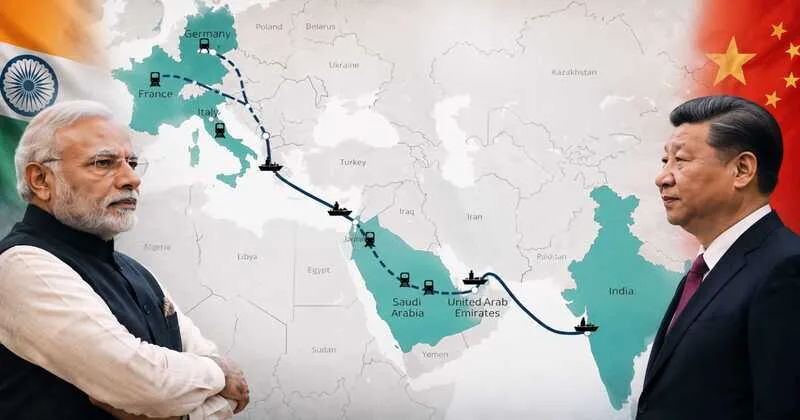
Prime Minister Narendra Modi’s recent diplomatic outreach to West Asia and Europe, spanning the UAE, Italy, the Netherlands, Sweden and Norway, comes at a time when China’s economic and geopolitical ambitions are increasingly facing distrust across Europe. Concerns over Beijing’s use of economic coercion, opaque infrastructure financing models, growing dependence on Chinese supply chains and its increasingly assertive geopolitical posture have pushed several European capitals to reassess their engagement with China. In this changing strategic environment, China’s ambitious Belt and Road Initiative (BRI), once projected as the defining infrastructure project of the century, has come under deeper scrutiny over issues of debt dependency, strategic leverage and lack of transparency.
European anxieties have further intensified amid fears that critical infrastructure, ports and trade corridors financed under the BRI could eventually translate into long-term Chinese political and economic influence. It is against this backdrop that the India-Middle East-Europe Economic Corridor (IMEC), unveiled during the 2023 G20 Summit in New Delhi, is emerging not merely as another connectivity project, but as a broader geopolitical alternative to China’s expanding infrastructure empire, one that seeks to build regional integration through collective partnerships rather than unilateral dominance.
The IMEC agreement, signed by India, the United States, Saudi Arabia, the UAE, the European Union, France, Germany and Italy, represents one of the most ambitious connectivity projects of the 21st century. Unlike the BRI, which was launched unilaterally by China in 2013 and later expanded across continents, IMEC is a collective strategic framework involving multiple stakeholders with shared economic and geopolitical interests. Its purpose extends beyond infrastructure creation. It seeks to reshape trade, energy and digital connectivity between India, West Asia and Europe while reducing dependence on routes and systems increasingly dominated by China.
اختُتمت زيارة قصيرة، إلا أنها كانت مثمرة للغاية، إلى دولة الإمارات العربية المتحدة؛ حيث أجريت مباحثات مستفيضة مع أخي، صاحب السمو الشيخ محمد بن زايد آل نهيان، حول سبل تعميق الشراكة الاستراتيجية الشاملة بين الهند والإمارات. وإنني على ثقة بأن مخرجات هذه الزيارة ستزيد من رسوخ أواصر… pic.twitter.com/ifMhRnGCX1
— Narendra Modi (@narendramodi) May 15, 2026
The contrast between the two projects is striking
China’s BRI was built around Beijing’s geopolitical expansion. Through ports, railways, highways and industrial corridors, China sought to consolidate economic dependence and strategic influence across Asia, Africa and Europe. The initiative became deeply tied to Beijing’s larger geopolitical ambitions, including securing maritime dominance, expanding strategic leverage and creating economic dependency through debt-financed infrastructure. While China projected the BRI as a development initiative, many countries now increasingly viewed it as an instrument of political influence. The Hambantota Port case in Sri Lanka became the defining symbol of these concerns. Unable to repay Chinese loans, Sri Lanka handed over control of the strategically located port to China on a 99-year lease. Similar concerns emerged in several developing countries where large Chinese loans created fears of long-term debt dependency and erosion of sovereignty. Critics argued that the BRI often prioritised Chinese geopolitical interests over the developmental needs of partner countries.
The structure of BRI financing reinforced these concerns. Chinese state-owned banks and firms dominated project implementation, while Chinese companies and labour frequently captured the most lucrative contracts. Local populations in participating countries often received low-wage or unskilled employment, limiting broader economic benefits. Even the much-publicised “Green BRI” introduced in 2019 failed to fundamentally alter China’s heavy investments in non-renewable energy infrastructure across partner nations.
Rome, Italy: Ambassador of India to Italy Vani Rao says, "IMEC is an initiative which India had launched in 2023. Italy is a key member and in Italy I see a lot of interest in taking forward the IMEC initiative. So, IMEC is a multi-modal initiative which has focus on different… pic.twitter.com/xX0MKsbseI
— IANS (@ians_india) May 18, 2026
IMEC, by comparison, is designed as a decentralised and cooperative connectivity model. Rather than serving the strategic ambitions of a single power, it seeks to integrate the economic interests of India, Europe and the Gulf region. The project consists of two corridors, an eastern corridor linking India to the Gulf and a northern corridor connecting the Gulf to Europe through rail and maritime networks. The route integrates ports, railways, digital infrastructure, undersea fibre-optic cables and energy pipelines. Its geopolitical significance lies precisely in this collective structure. The corridor directly challenges China’s attempt to dominate Eurasian connectivity by creating a non-China trade and infrastructure route linking India and Europe. In an era where nearly 90 per cent of the world’s active trade corridors pass through China, IMEC seeks to break Beijing’s centrality in global commerce. For India, it provides a strategic gateway into Europe and the Mediterranean. For Europe, it offers an alternative supply and trade architecture less dependent on China and vulnerable chokepoints like the Suez Canal. For Gulf countries, it opens opportunities for economic diversification beyond oil and positions them as central hubs in a new transcontinental economic system.
The strategic implications are immense
At the heart of IMEC lies a broader geopolitical realignment involving India, the United States, Europe and key Arab powers. The corridor is deeply linked to the Abraham Accords and the I2U2 grouping involving India, Israel, the UAE and the US. Washington has described IMEC as an “infrastructure for peace”, reflecting its wider objective of using economic integration to reshape the political geography of West Asia.
A critical dimension of the project is the proposed Saudi-Israel rapprochement. The railway link connecting the UAE to Israel through Saudi Arabia and Jordan reflects a new regional strategic architecture built around economic cooperation rather than ideological conflict. Saudi Arabia’s Vision 2030, aimed at reducing dependence on oil revenues, aligns closely with IMEC’s objectives of regional integration, logistics expansion and technological modernisation. This is precisely where IMEC differs fundamentally from the BRI. China’s model largely revolves around bilateral dependency centred on Beijing. IMEC instead attempts to build horizontal regional integration involving shared infrastructure, diversified investment and interconnected supply chains.
The economic logic behind IMEC is equally significant
The corridor integrates major ports including Mundra, Kandla and Jawaharlal Nehru Port in India; Fujairah, Jebel Ali and Abu Dhabi in the UAE; Dammam and Ras Al Khair in Saudi Arabia; and Haifa in Israel. From Haifa, the European leg extends toward Piraeus in Greece, Messina in Italy and Marseille in France. This integrated ship-rail transport system aims to reduce logistics costs, accelerate cargo movement and create a reliable alternative to existing maritime trade routes. Unlike the BRI’s emphasis on roads and large-scale state-controlled infrastructure, IMEC focuses on rail connectivity, digital integration and clean energy infrastructure. Undersea fibre-optic cables and energy pipelines are central to the project. The corridor also aligns with India’s “One Sun, One World, One Grid” initiative, which seeks to create transnational energy connectivity through renewable power integration and real-time energy distribution systems.
In strategic terms, IMEC is not just a transport corridor. It is an attempt to shape the future architecture of energy, technology and supply chains. The timing is important because China’s economic model is increasingly under pressure. Beijing’s post-pandemic slowdown, industrial overcapacity and declining returns from BRI investments have triggered reassessments across several participating countries. Europe’s growing concerns over economic dependence on China have further weakened Beijing’s narrative of inevitable global centrality.
The trust deficit facing China in Europe has become particularly significant. European governments are increasingly wary of Chinese investments in critical infrastructure, digital systems and ports. IMEC therefore, offers Europe not merely another trade route, but a strategic diversification mechanism.
For India, the corridor represents a historic geopolitical opportunity.
For decades, India remained constrained by geography and limited continental connectivity. IMEC changes that equation by positioning India as a central node connecting the Indian Ocean, Gulf region and Europe. It also strengthens India’s role in global value chains and enhances its strategic influence across West Asia.
The United States views the project through a broader strategic lens. As China expands its influence across Eurasia, Washington sees IMEC as part of a larger effort to prevent Beijing from monopolising critical trade and infrastructure networks. The corridor complements American efforts to create alternative supply chains and strengthen strategic partnerships across the Indo-Pacific and West Asia.
The rise of an alternative connectivity network
The biggest obstacle is geopolitical instability in West Asia. The Israel-Hamas war and the wider regional tensions involving Iran have already slowed momentum behind the project. The spillover risks from the conflict have complicated efforts toward Saudi-Israel normalisation, a key pillar of IMEC’s strategic architecture. Without long-term regional stability, the corridor’s operational viability could face delays.
Financing also remains uncertain. Unlike the BRI, which relied heavily on centralised Chinese state funding, IMEC depends on diversified investments, public-private partnerships and coordinated political commitment among multiple countries. While India and the UAE have signed initial agreements, several European partners and the US have yet to translate political announcements into substantial on-ground implementation.
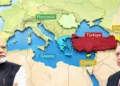
There are also regional geopolitical sensitivities. Countries such as Turkey, Egypt, Iraq and Oman remain outside the framework. Egypt fears competition with the Suez Canal, while Turkey advocates alternative transit routes through Iraq and Basra. Managing these regional anxieties will be critical for sustaining long-term political support. Still, despite these uncertainties, IMEC represents the most serious challenge yet to China’s Belt and Road dominance. The contest between the two corridors reflects a deeper struggle over the future global order. China’s BRI is built around centralised power projection and strategic dependency. IMEC seeks to construct a more distributed framework based on regional cooperation, technological integration and shared economic interests.
The geopolitical significance of this shift cannot be understated. Infrastructure is no longer merely about roads, ports or railways. It has become the primary instrument through which nations compete for influence, shape trade flows, secure energy routes and define global alignments. In that contest, IMEC represents more than a corridor. It is an emerging geopolitical counterweight to China’s expanding infrastructure empire, one built not around unilateral dominance, but around strategic partnerships stretching from India to Europe through the heart of West Asia.