The global debate surrounding media freedom, international press rankings, and the credibility of comparative journalism assessments resurfaced sharply during Prime Minister Narendra Modi’s official visit to Norway on May 18, 2026. What began as a press interaction soon evolved into a wider international discussion after questions were raised regarding India’s position in the World Press Freedom Index prepared by Reporters Without Borders (RSF). The exchange rapidly attracted attention across diplomatic, media, and political circles, reigniting scrutiny over how global press freedom standards are measured and interpreted.
The controversy emerged at a time when the 2026 World Press Freedom Index reported one of the sharpest global declines in media freedom conditions since the rankings were first introduced in 2002. With more than half of the world’s countries now classified under “difficult” or “very serious” press freedom conditions, concerns surrounding journalist safety, censorship, political pressure, violence against reporters, and the role of perception-based international evaluations have intensified worldwide.
India’s ranking in the RSF index became central to the renewed debate, particularly because the country continues to maintain one of the world’s largest multilingual media ecosystems alongside a rapidly expanding digital news environment. Questions were increasingly raised over whether international ranking systems adequately account for scale, diversity, demographic realities, digital expansion, and varying geopolitical conditions while assessing media freedom across nations.
Simultaneously, comparisons involving countries such as Mexico, Pakistan, Bangladesh, Türkiye, Brazil, and the Philippines further amplified discussions regarding the methodology adopted in preparing global press freedom rankings. Many pointed toward cases where nations experiencing journalist killings, cartel violence, political instability, media crackdowns, or legal harassment ranked above India, leading to wider debate over transparency, consistency, objectivity, and the possible influence of Western-centric evaluative frameworks in international media studies.
The developments have transformed the World Press Freedom Index from a routine annual ranking into a broader geopolitical conversation involving democracy, media ecosystems, journalistic accountability, digital transformation, international perception, and the future of global press freedom measurement standards.
During the visit of Prime Minister Narendra Modi to Norway on May 18, 2026, journalist Helle Lyng raised questions regarding press freedom in India and the Prime Minister’s approach towards media interactions. Referring to the World Press Freedom Index, the journalist pointed out that Norway holds the top position in the rankings, while India has been placed at 157 alongside Palestine, the UAE, and Cuba.
The exchange drew attention after the journalist stated that questioning powerful political leaders remains an essential responsibility of the media. The remarks triggered renewed discussion around media freedom in India and intensified public scrutiny of the methodology and credibility of the World Press Freedom Index.
The incident also revived wider debate over how international press freedom rankings are prepared, the criteria used in evaluating different countries, and whether political, cultural, and geopolitical factors influence global assessments of media environments.
Questions Raised Over Transparency and Methodology of Global Media Rankings
A report examining the World Press Freedom Index has raised questions over whether the global ranking system accurately reflects media conditions across different countries. Covering the period from 2024 to 2026, the study analyses the methodology adopted by Reporters Without Borders in preparing the index and compares India’s ranking with that of several other nations.
The report states that the RSF Press Freedom Index remains structurally contested because of its reliance on perception-based assessments and scoring models, which critics argue reduce objectivity and limit consistency in cross-country comparisons. It notes that India’s repeated low ranking stands in contrast to the country’s large, multilingual, and expanding media ecosystem, raising concerns about whether the index fully captures ground realities.
The study further argues that certain countries experiencing journalist killings, cartel-linked violence, or extensive state control over media continue to rank above India in the index. According to the report, these disparities reflect possible inconsistencies in the evaluation process and raise concerns regarding the influence of subjective or Western-centric frameworks in determining global press freedom standards.
The report concludes that the broader decline in press freedom worldwide, reflected in the placement of more than half of the world’s countries in severe or problematic categories, indicates that the issue extends beyond individual nations and reflects wider geopolitical and structural challenges. It calls for greater transparency, balanced assessment mechanisms, and context-sensitive evaluation standards in measuring media freedom globally.
How RSF’s Methodology Shapes Global Press Freedom Rankings
The World Press Freedom Index prepared by Reporters Without Borders evaluates the extent to which journalists and media institutions are able to function freely within a country rather than assessing the overall quality of journalism or the total level of violence in society. Since 2022, the index has been based on five indicators: political context, legal framework, economic conditions, socio-cultural environment, and the safety of journalists.
Among the most debated elements of the methodology is the “abuses score,” which assesses threats, attacks, and violence directed at journalists. Instead of relying on a direct per-capita calculation, the index applies a logarithmic population-based formula while measuring safety conditions. Critics argue that this framework can disproportionately affect highly populated countries such as India, where even a comparatively limited rise in incidents may sharply reduce the overall safety score.
Many about the index further contend that the scoring model can place large democracies below smaller nations despite those countries experiencing comparable or even higher levels of violence against journalists on a per-capita basis. According to these arguments, the methodology creates inconsistencies in international comparisons and raises wider concerns regarding the objectivity, balance, and comparability of global press freedom rankings.
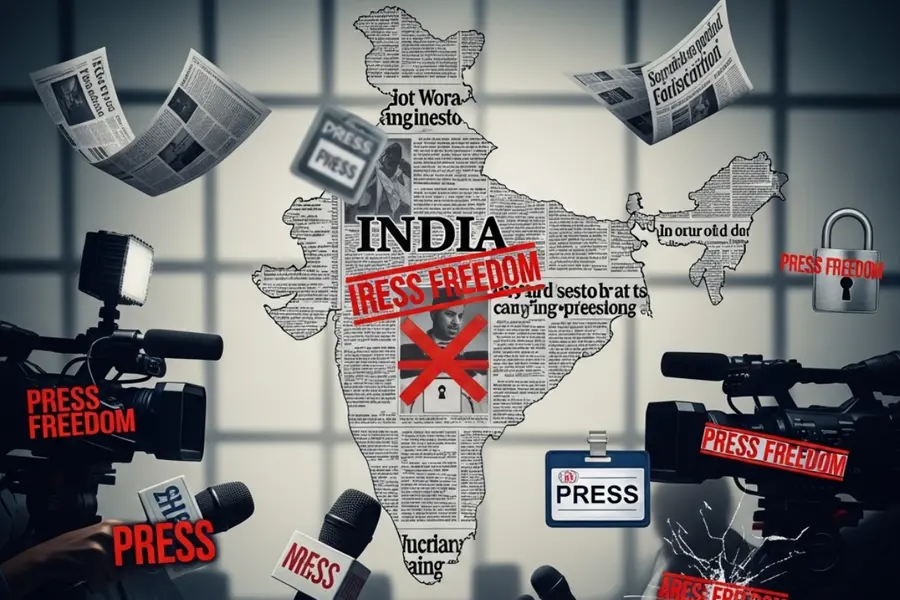
India’s Position in the RSF Press Freedom Index and Debate Over Global Comparisons
In the World Press Freedom Index prepared by Reporters Without Borders, India ranked 159th in 2024, improved to 151st in 2025, and declined to 157th in 2026, remaining within the lower tier of the global rankings during the three-year period.
Several countries facing concerns related to journalist killings, cartel violence, political instability, or extensive state control over media ranked either close to or above India during the same period. According to RSF rankings, Mexico was placed at 121st in 2024, 124th in 2025, and 122nd in 2026. Pakistan ranked 152nd, 158th, and 153rd respectively, while Bangladesh stood at 165th, 149th, and 152nd. Türkiye ranked 158th in 2024, 159th in 2025, and 163rd in 2026. Brazil improved from 82nd to 63rd and then 52nd, while the Philippines ranked 134th, 116th, and 114th across the three years.
Analyses examining the index argue that the methodology depends heavily on expert assessments and perception-based inputs, which critics say may introduce subjectivity into the rankings. Some commentators have also argued that Western-centric evaluative frameworks may influence how countries are assessed within global media freedom studies.
India, meanwhile, continues to maintain one of the world’s largest and fastest-expanding media ecosystems. During 2024-25, the country had nearly 1.55 lakh registered publications compared to around 1.05 lakh in 2014–15, along with 908 private television channels. India’s digital media landscape has also expanded rapidly, supported by an estimated 491 million social media users and a digital advertising market projected to reach INR 345,000 crore by 2028.
Many about the World Press Freedom Index argue that indicators such as media scale, accessibility, linguistic diversity, and rapid digital expansion are not always adequately reflected in the rankings. A 2020 report by NITI Aayog also questioned the transparency of the RSF methodology and highlighted what it described as inconsistencies in rankings, including cases where countries reporting higher levels of journalist killings were placed above India.
Mexico Ranked Above India in RSF Index Amid Continuing Violence Against Journalists
In the World Press Freedom Index published by Reporters Without Borders, Mexico ranked above India throughout the 2024-2026 period. Mexico was placed at 121st in 2024, 124th in 2025, and 122nd in 2026, while India ranked 159th, 151st, and 157th respectively during the same years.
Despite its higher ranking, Mexico continues to be regarded as one of the most dangerous countries in the world for journalists. Reports over the past two decades have documented the killing of more than 150 journalists in the country, while several cases involving murders and disappearances remain unresolved.
In March 2026, journalist Juan David Gámez was killed, while reporter Oscar Merino sustained critical injuries in separate shooting incidents that occurred within a short span of time. The attacks renewed concerns regarding the safety and working conditions of media professionals in the country.
Various reports and media analyses have also highlighted instances of journalists facing threats from criminal cartels and corrupt local networks. These conditions have reportedly forced some reporters to flee their regions, while others have resorted to self-censorship because of persistent security risks and fear of retaliation.
Pakistan Ranked Above India in RSF Index Despite Continuing Press Freedom Concerns
In the World Press Freedom Index released by Reporters Without Borders, Pakistan ranked above India in both 2024 and 2026. Pakistan was placed at 152nd in 2024 and 153rd in 2026, while India ranked 159th and 157th respectively during the same period.
Despite these rankings, Pakistan has continued to face significant concerns related to press freedom and journalist safety. RSF has described the country as one of the world’s most dangerous places for journalists, citing issues including targeted killings, censorship, intimidation, and surveillance. Reports stated that at least seven journalists were killed in targeted attacks during 2024.
Journalists in Pakistan have also faced allegations of enforced disappearances, legal harassment, and criminal proceedings under laws such as the Prevention of Electronic Crimes Act (PECA). Rights groups and media watchdogs have documented cases involving journalists and activists who were reportedly subjected to detention, surveillance, exile, or prosecution.
According to reports by rights organisations, the wider climate of pressure and insecurity has contributed to growing self-censorship and persistent concerns regarding impunity in attacks against media professionals operating in the country.
Bangladesh Ranked Above India in RSF Index Amid Concerns Over Arrests, Censorship and Violence Against Journalists
In the World Press Freedom Index published by Reporters Without Borders, Bangladesh ranked below India in 2024 but moved ahead in both 2025 and 2026. Bangladesh was placed at 149th in 2025 and 152nd in 2026, while India ranked 151st and 157th respectively during the same period.
Despite the improved rankings, journalists in Bangladesh continued to face concerns related to arrests, prosecutions, censorship, and violence. RSF cited reports stating that between 2018 and 2023, 97 journalists were arrested and 255 were prosecuted under the Digital Security Act.
Media organisations and rights groups also reported journalist casualties and injuries during the 2024 student protests in Bangladesh. According to these reports, several journalists were killed while many others sustained injuries during coverage of demonstrations and related unrest.
The developments have further contributed to debate surrounding how press freedom conditions are comparatively evaluated across countries within the RSF ranking system, particularly in cases involving legal restrictions, political unrest, and violence against media professionals.
Türkiye Ranked Above India in RSF Index Amid Continuing Concerns Over Media Crackdowns
In the 2024 World Press Freedom Index released by Reporters Without Borders, Türkiye was placed at 158th, ranking just above India, which stood at 159th.
Despite the ranking, Türkiye continued to face international criticism over media freedom under President Recep Tayyip Erdoğan. According to RSF, 131 journalists had reportedly been detained since Erdoğan assumed office in 2014.
Reports from 2024 stated that 89 journalists, media workers, and one newspaper faced trial in at least 70 separate cases across the country. Courts reportedly delivered verdicts in 17 of these cases, acquitting 16 journalists while sentencing nine others to prison terms totaling more than 50 years. Two journalists were also reportedly fined 33,320 Turkish lira.
Media rights organisations further documented a rise in threats and physical attacks targeting journalists and media institutions. According to these reports, at least 25 journalists and five media outlets faced physical assaults during the year, while 82 journalists reportedly received threats, some allegedly linked to pro-government and far-right nationalist circles.
Brazil Ranked Far Above India in RSF Index Amid Continuing Threats to Journalists
In the World Press Freedom Index published by Reporters Without Borders, Brazil ranked significantly above India throughout the 2024–2026 period. Brazil was placed at 82nd in 2024, improved to 63rd in 2025, and further rose to 52nd in 2026, while India ranked 159th, 151st, and 157th respectively during the same years.
Despite these rankings, Brazil has continued to face concerns related to journalist safety and pressure on media professionals. Reports indicate that at least 30 journalists have been killed in the country over the past decade, with several cases allegedly linked to organised criminal networks and land-related conflicts.
Among the widely reported incidents was the 2022 killing of British journalist Dom Phillips in the Amazon region. Media watchdogs and rights organisations have also expressed concerns regarding media concentration, disinformation campaigns, political pressure on journalists, and what they describe as high levels of impunity in crimes committed against media professionals.
The developments have continued to feature in wider discussions regarding how global press freedom conditions are comparatively measured across countries within international ranking systems.
Philippines Ranked Above India in RSF Index Amid Continuing Concerns Over Journalist Safety
The Philippines ranked above India in the World Press Freedom Index published by Reporters Without Borders throughout the 2024–2026 period. The Philippines was placed at 134th in 2024, improved to 116th in 2025, and further to 114th in 2026, while India ranked 159th, 151st, and 157th respectively during the same years.
Despite the higher rankings, the Philippines has continued to face concerns regarding journalist safety and media freedom. RSF has described the country as one of Asia’s most dangerous places for journalists and noted that at least 20 journalists were killed during the presidency of Rodrigo Duterte.
The 2009 Maguindanao massacre, in which 32 reporters were killed, continues to be cited internationally as one of the most serious cases of impunity involving crimes against journalists.
In recent years, media organisations and rights groups have continued to report concerns related to killings, “red-tagging,” cyber-libel cases, and anti-terror allegations targeting journalists. In 2026, RSF condemned the killing of crime reporter RJ Nichole Ledesma and called for an independent investigation into the incident.
Press freedom organisations have also stated that legal harassment, online abuse, and violence continue to contribute to an atmosphere of fear for sections of the Philippine media despite the country’s improved position in international rankings.
Global Decline in Press Freedom Fuels Debate Over RSF Ranking Methodology
According to the 2026 World Press Freedom Index published by Reporters Without Borders, the global average score across 180 countries and territories declined to its lowest level since the index was launched in 2002. The report stated that, for the first time, more than half of the countries assessed – 52.2 per cent – were placed in the “difficult” or “very serious” categories for press freedom conditions.
Within this wider global context, India remained in the “very serious” category throughout the 2024–2026 period. Critics of the rankings have argued that India is frequently placed below countries that continue to experience significantly higher levels of lethal violence against journalists, organised criminal threats, or prolonged political repression, including nations such as Mexico and others emerging from military or authoritarian control.
The contrast has continued to fuel debate surrounding the methodology and comparative assessment standards adopted in the World Press Freedom Index, particularly regarding the balance between perception-based evaluations, safety indicators, and broader media ecosystem realities across different countries.
Conclusion
The continuing global debate surrounding the World Press Freedom Index has transformed the annual rankings into a much larger discussion about transparency, methodology, comparative standards, and the future of international media evaluation systems. As concerns regarding journalist safety, censorship, political pressure, digital surveillance, violence, and legal intimidation continue to rise across multiple regions, scrutiny over how global press freedom is measured has intensified significantly.
The incidents highlighted across countries including Mexico, Pakistan, Bangladesh, Türkiye, Brazil, and the Philippines have further amplified questions regarding consistency and balance in comparative international rankings. Critics continue to argue that differences in population size, media scale, linguistic diversity, digital growth, geopolitical realities, and democratic structures may not always be adequately reflected within existing evaluation frameworks.
At the same time, the broader decline in global press freedom conditions reflected in the 2026 rankings demonstrates that the issue extends far beyond individual countries. The growing number of nations placed in “difficult” and “very serious” categories indicates deep structural challenges confronting journalism worldwide, including violence against reporters, criminal intimidation, legal restrictions, economic pressure, political polarisation, and expanding digital information conflicts.
The renewed debate generated during Prime Minister Narendra Modi’s Norway visit has once again brought international attention to the larger question of how global media freedom standards should be assessed in an increasingly complex geopolitical environment. As discussions continue, demands for greater transparency, context-sensitive evaluation mechanisms, methodological clarity, and balanced international comparisons are expected to remain central to future discourse surrounding global press freedom rankings.