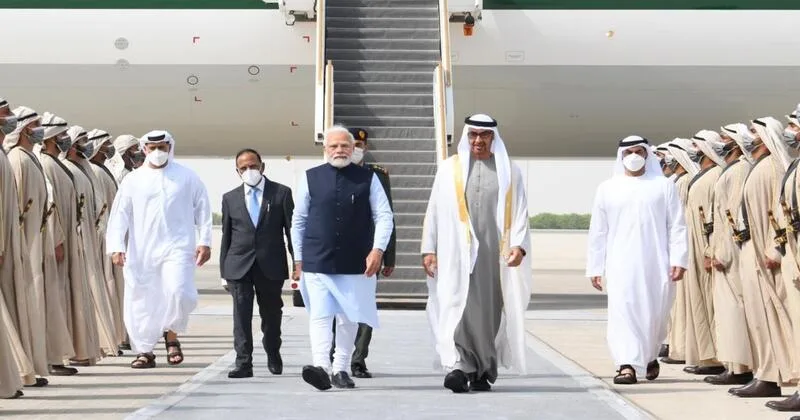
Prime Minister Narendra Modi’s recent visit to the United Arab Emirates was not merely another diplomatic engagement in India’s increasingly active foreign policy calendar. It reflected something far more significant — the emergence of an India that no longer approaches West Asia with hesitation, defensiveness or postcolonial anxiety. In a rapidly changing world marked by geopolitical instability, economic fragmentation and strategic competition, India’s expanding partnership with the UAE represents not symbolism, but the assertion of a more confident national vision.
For decades after Independence, India approached West Asia with excessive caution. The region supplied oil, hosted Indian workers and contributed remittances, yet New Delhi rarely engaged it with long-term strategic clarity. Foreign policy was often constrained by ideological rigidity, bureaucratic caution and the compulsive need to maintain rhetorical neutrality at all costs. India behaved less like a rising civilisation-state and more like a hesitant postcolonial power afraid of offending competing blocs. That era is steadily ending.
India today is increasingly engaging the world with greater strategic realism and civilisational self-confidence. The UAE visit reflected this transformation clearly. It demonstrated that New Delhi now recognises West Asia not merely as an energy source, but as a vital strategic theatre central to India’s economic growth, maritime security, connectivity ambitions and global influence.
The scale of the India-UAE relationship itself explains why the partnership matters so deeply. The UAE is India’s third-largest trading partner after the United States and China. Bilateral trade crossed nearly 85 billion dollars in 2024-25 following the India-UAE Comprehensive Economic Partnership Agreement (CEPA). The UAE has also emerged as one of the most significant investors in Indian infrastructure, logistics, renewable energy and digital sectors.
Equally important is the Indian diaspora. Nearly 3.5 million Indians live and work in the UAE, making it one of the largest Indian communities abroad. Their contribution to the Indian economy remains immense. India received more than 125 billion dollars in remittances in 2023, according to World Bank estimates, with Gulf nations accounting for a major share.
Yet the true significance of Modi’s UAE visit lies beyond economics alone. West Asia today stands at the centre of global instability. Maritime insecurity, attacks on shipping corridors, regional conflicts and growing tensions involving Iran have once again exposed how fragile international energy systems remain. For India, such instability is not an abstract geopolitical concern. It directly affects inflation, transportation costs, industrial production and economic stability.
India imports nearly 87 per cent of its crude oil requirements. Any major disruption in Gulf shipping routes immediately impacts the Indian economy. This is precisely why the energy cooperation agreements reached during the UAE visit carry immense strategic importance. Expanding strategic petroleum reserves, strengthening long-term supply arrangements and deepening energy partnerships increase India’s resilience in an uncertain global environment.
Predictably, sections of the opposition have dismissed such diplomatic engagements as exercises in political spectacle. Modi’s critics frequently argue that his foreign policy prioritises optics over substance.
The criticism is politically convenient, but strategically shallow.
Foreign policy cannot be judged merely through ideological prejudice or television optics. It must be evaluated through outcomes. Has India strengthened its energy security? Has it attracted investment? Has it expanded geopolitical influence? Has it secured maritime interests and trade routes? By those standards, India’s engagement with the UAE has delivered substantial strategic gains.
More importantly, much of the criticism itself reflects an outdated worldview rooted in the assumptions of an earlier era. The world today is no longer governed by moral posturing, non-aligned nostalgia or rhetorical idealism. It is shaped by economic resilience, technological capability, energy access and strategic influence.
Every major power — from the United States and China to Russia and the European Union — is competing aggressively for influence in the Gulf because the region remains central to global trade, energy flows and financial networks. India cannot aspire to major-power status while treating West Asia as a secondary strategic theatre.
The Modi government appears to understand this reality with far greater clarity than previous administrations.
One of the most remarkable features of India’s current West Asia policy is its strategic balance. India today maintains strong ties simultaneously with the UAE, Saudi Arabia, Israel, Iran and the United States despite their competing regional interests. Few nations have managed this balancing act effectively. This reflects diplomatic maturity, strategic confidence and a clearer understanding of national interest.
Earlier governments often approached the region with visible caution and excessive defensiveness. Today, India increasingly behaves like a nation capable of pursuing its own interests independently without becoming trapped within regional rivalries.
The defence and maritime dimensions of the India-UAE partnership are equally significant. Cooperation in counterterrorism, cybersecurity, intelligence-sharing and naval coordination has expanded steadily in recent years. This marks a major evolution in India’s Gulf policy, which was once overwhelmingly transactional.
The Arabian Sea and the wider Indian Ocean region are rapidly becoming major theatres of geopolitical competition. Piracy, drone warfare, extremism and strategic rivalries threaten maritime corridors through which most of India’s trade flows. Nearly 80 per cent of India’s merchandise trade by volume moves through sea routes. Securing these corridors is therefore not optional; it is fundamental to India’s economic and strategic future.
The broader significance of the UAE visit also lies in what it reveals about India’s evolving worldview. India increasingly understands that national power in the twenty-first century will not depend solely on military strength. It will depend equally on energy security, technological capability, infrastructure connectivity, resilient supply chains and trusted strategic partnerships.
This explains the growing emphasis on connectivity corridors linking India, the Gulf and Europe. Such projects could reshape regional commerce over the coming decades. Connectivity itself is rapidly becoming an instrument of geopolitical influence.
At a deeper level, India’s outreach to West Asia also reflects the re-emergence of a civilisation-state reclaiming strategic space in a region historically connected to India through trade, culture and maritime exchange for centuries. India’s engagement with the Gulf is therefore no longer driven merely by economic necessity. It increasingly reflects geopolitical confidence rooted in a stronger sense of national identity and strategic purpose.
Of course, diplomacy alone cannot guarantee success. India still faces bureaucratic delays, implementation challenges and regulatory inconsistencies that can weaken ambitious strategic projects. Agreements announced abroad must eventually deliver measurable outcomes at home. Nevertheless, the larger strategic direction is unmistakable.
India’s foreign policy is becoming more confident, pragmatic and unapologetically interest-driven. The country is increasingly willing to pursue strategic partnerships without seeking ideological approval or external validation.
The significance of Modi’s UAE visit, therefore, lies not merely in diplomacy, but in the emergence of an India that increasingly acts with strategic confidence, civilisational self-awareness and geopolitical purpose.