
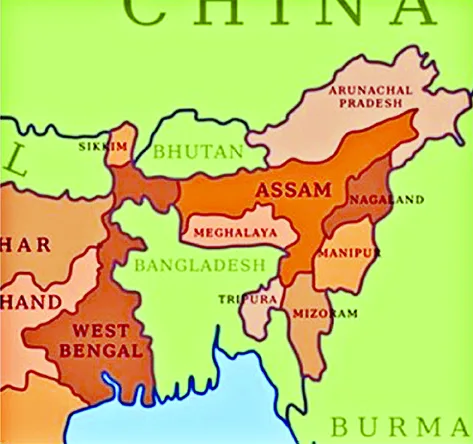
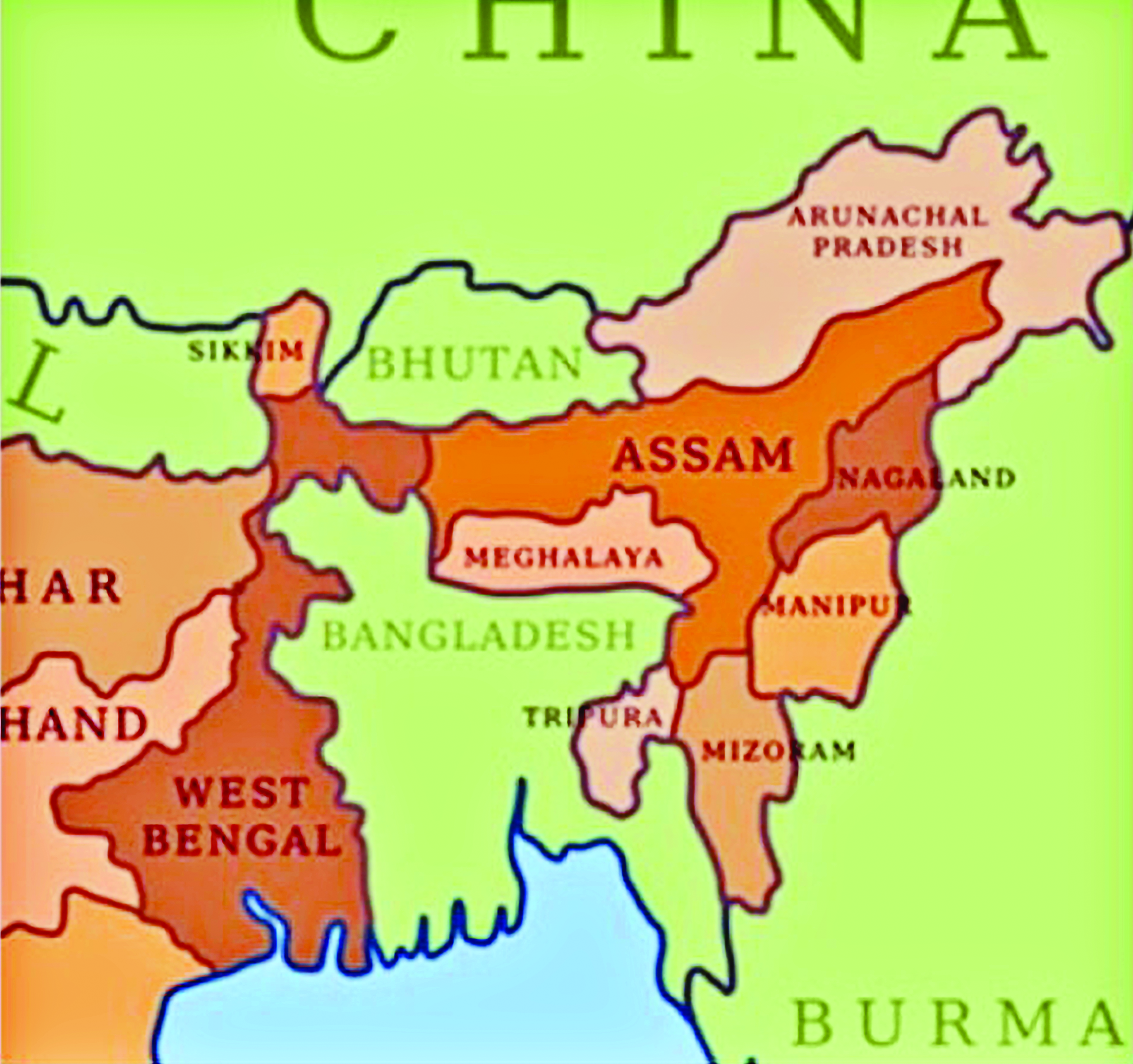
After Assam and Tripura, Bharatiya Janata Party winning the West Bengal Assembly elections completed the mission Eastern Bharat. BJP is the only party that has consistently taken a stand against illegal migration and devised some policy mechanism to deal with the same. The Bharat-Bangladesh border stretches for 4,096 km, encompassing five Indian states: West Bengal, Assam, Tripura, Meghalaya, and Mizoram. All these states have a either BJP-led or friendly governments in place. Till now, consecutive West Bengal governments starting with Congress, then Communists and later TMC were complacent towards the security challenge created by the illegal infiltration from the Bangladeshi side. The unnatural partition of Bharat on religious lines at the behest of colonisers entrapped us in permanent issues of demographic invasions and border disputes. The demography of Bharat’s Eastern Frontier, from Assam to Bengal, is being deliberately altered through the sheltering and protection of illegal infiltrators. Many districts in lower Assam and the Barak Valley have become Muslim-majority due to large-scale infiltration. The same has happened in Bengal, where districts such as Murshidabad and Malda have also become Muslim-majority. The problem is not a community but this illegality.
Undoubtedly, all this became possible because of the administrative failures of the Congress Governments that ruled Assam for decades, and the Congress-Left-TMC regimes that governed Bengal for many years. The irony is that despite being aware of this threat, Mamata Banerjee, who governed Bengal for the last 15 years, opposed the Central Government’s decision to extend the BSF’s jurisdiction from 15 km to 50 km along the border to curb infiltration and anti-national activities including cow-smuggling, drug and arms trafficking, counterfeit currency business and human trafficking. It is disappointing that the Bengal Government resisted any attempt to address these challenges to play the vote-bank politics. Successive regimes refused to provide land for border fencing to the BSF, keeping hundreds of kilometres of the border porous. Even the apex court had to say that Bharat is not a “Dharmshala.” Now that the BJP has formed the Government in both Bengal and Assam, one can hope that difficult days have arrived for illegal infiltrators and their patrons in Bharat. That is the reason, when Suvendu Adhikari landed in Guwahati and clicked a photo with Himanta Biswa Sarma, that imagery combined the ideological bond with the clear agenda of fencing borders. It was a posturing for the battle against illegal invasion not merely a fight to protect territory, but to preserve the great Bharatiya civilisation.
On May 4th, 2026, the voters of West Bengal delivered a resounding verdict to the Bharatiya Janata Party. BJP won 207 of the State Assembly’s 294 seats. The All India Trinamool Congress (AITC), which had governed the State since 2011, was reduced to 80 seats. Congress party, the Left & smaller political parties like the Indian Secular Front (ISF) together did not even cross ten seats. Critics argue that the outcome is a reflection of the polarisation of the people of West Bengal along communal lines. But in reality, this outcome marks nullification of the theory of electoral polarisation along communal lines. By any measure, this was not merely a change of Government due to anti-incumbency factor but signalled a massive mandate in favour of good governance and development which constitute the core values of BJP.
Finally, Rule of Law Returns
The newly elected BJP Government in Bengal has taken many key decisions to correct the damage done by Mamata-led Trinamool CongresGovernment for the past 15 years
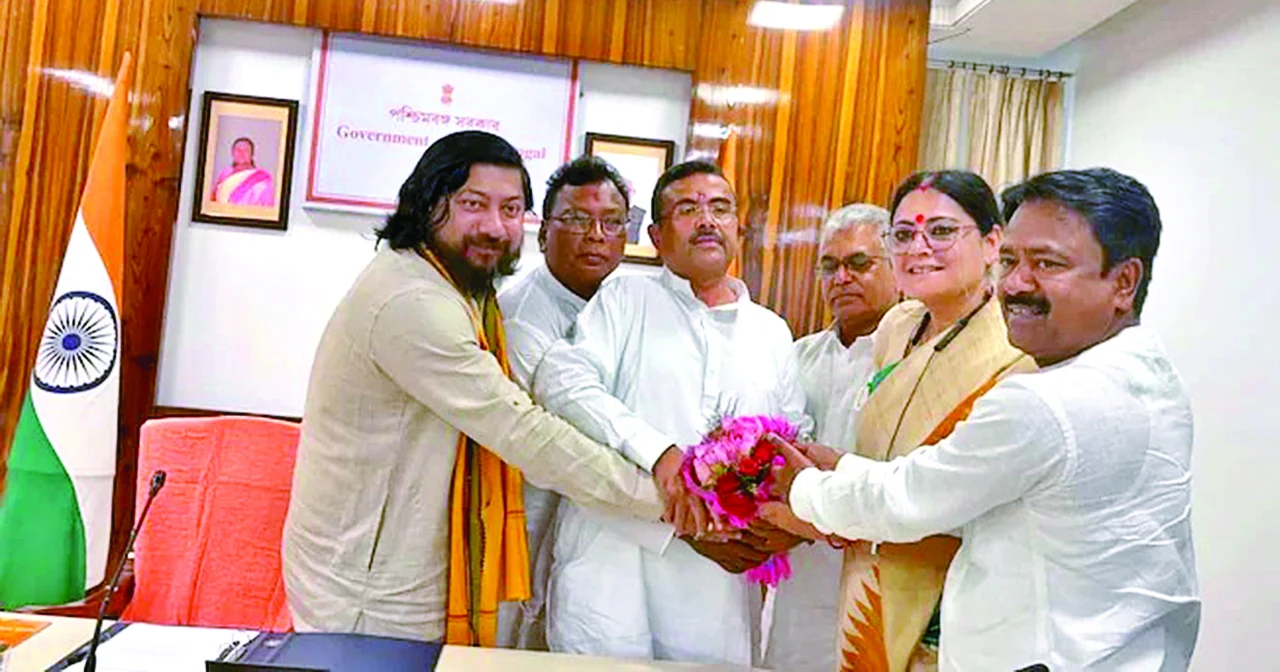
- The government will take responsibility for all welfare measures for the families of the 326 martyrs, while paying tribute to them
- Aayushman Bharat has been launched in Bengal
- No ongoing social welfare scheme will be discontinued
- Necessary powers will be granted to the BSF within 45 days for strengthening border security
- West Bengal has been included in all major central schemes
- The upper age limit for applying to government jobs has been increased by 5 years
- Bharatiya Nyaya Sanhita (BNS) comes into effect in place of CRPC
- Census work in West Bengal will begin immediately as per the Centre’s directive
- Immediate shutdown of all illegal toll gates, drop gates and extortion checkpoints operating without approval
- All Departments to immediately end the services of TMC-appointed nominated members, directors, and Chairpersons of PSUs, Boards, organisations and non-statutory Boards under its control
- Withdrawal of security cover of individuals with criminal antecedents
- Announcement of plans to curb ‘Syndicate Raj’ and illegal mining in the State
- Action against illegal cattle markets that are operating in Dinajpur, Malda, Murshidabad, and North 24 Parganas districts
- The national song ‘Vande Mataram’ has been made mandatory during morning assemblies in all government schools across West Bengal
- Instruction issued to Bengal Police to review of all 2021 post-poll violence cases
In fact, the recent West Bengal Legislative Assembly elections of 2026 are quite momentous and mark a watershed moment in the political history of West Bengal. The electoral results of the Assembly elections of 2026 cannot be merely seen as a transition of power from one regime to the next but it heralds a major shift in the political fabric of West Bengal.
Porous Border
Among the least discussed but most consequential problems are issues of national security and the state of the Indo-Bangladesh border. The total length of the Indo-Bangladesh border in West Bengal is 2,216.7 km, of which 1,647.696 km of fencing has been done. Of the remaining feasible unfenced stretch of 456.224 km, land for only 77.935 km had been handed over to the executing agency. For the balance of 378.289 km, land acquisition had either not been initiated or had only remained in early stages.
This was not merely a logistical problem, but the previous State Government’s persistent non-cooperation with the process of land acquisition which was a political choice rooted in the electoral arithmetic of the border districts. India and Bangladesh disagreed over fencing constructions in Malda as well as Cooch Behar. Bangladesh claimed that it violated a 1975 bilateral agreement that prohibits defence structures within 150 yards of the border. There was an active diplomatic row in January 2025 when India summoned Bangladesh’s acting High Commissioner Nural Islam after Dhaka objected to fencing in those districts. BSF, which tried to extend fencing in Mekhliganj near the Dahagram Angarpota enclave, found Bangladeshi border guards physically attempting to stop the construction.
In areas like Jalpaiguri, where the Dahagram Angarpota enclave lies, natural barriers like rivers make physical fencing practically impossible, with India utilising the BSF’s water wing to patrol and secure such stretches.
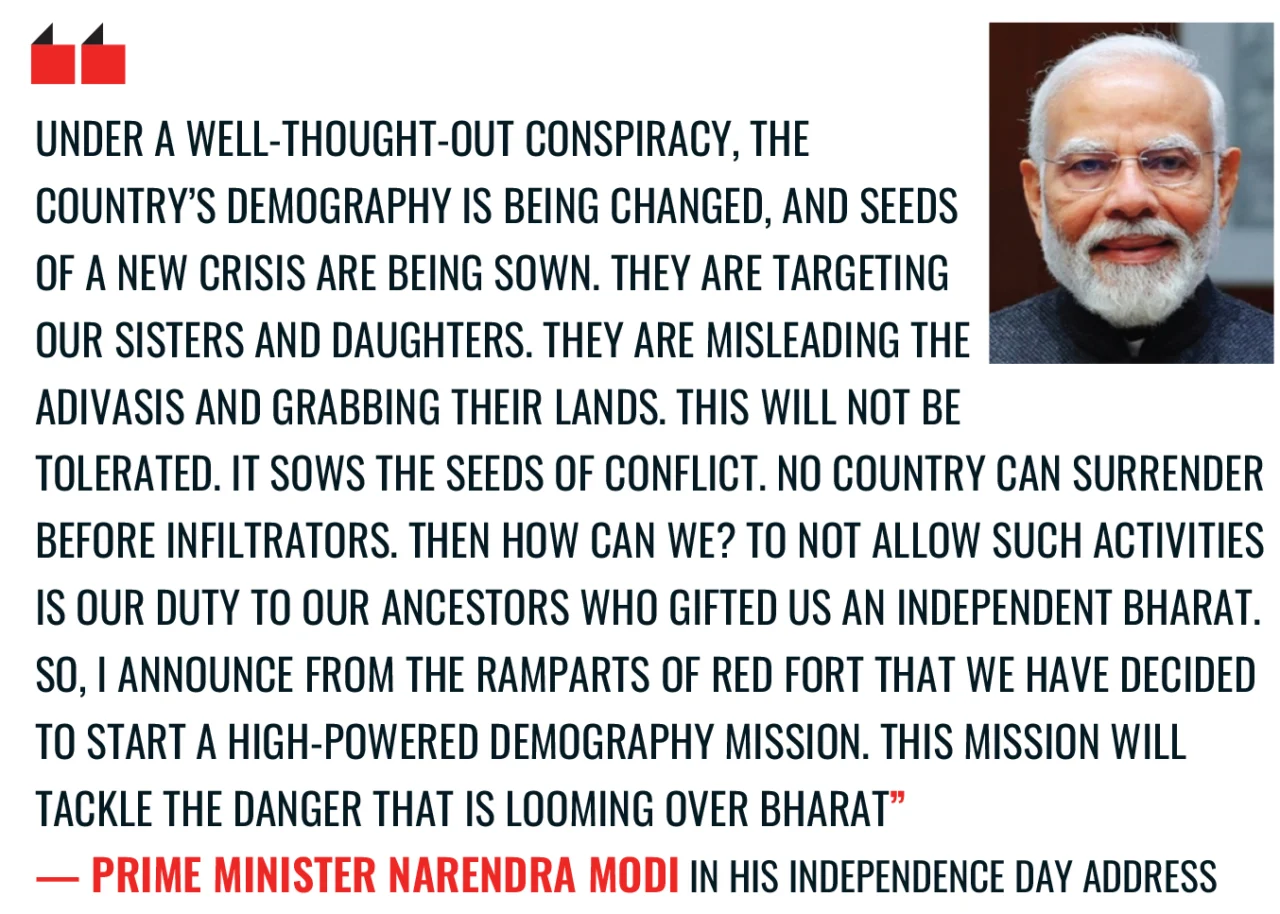
The border region is densely populated and porous in ways that have enabled documented flows of smuggling, counterfeit currency & illegal infiltration for years. The issue of porous border, the rise of Islamic fundamentalism in the border areas and the illegal migration of Rohingya refugees and Bangladeshi immigrants leading to gradual demographic change in West Bengal became a major political issue during Assembly elections for the people of Bengal.
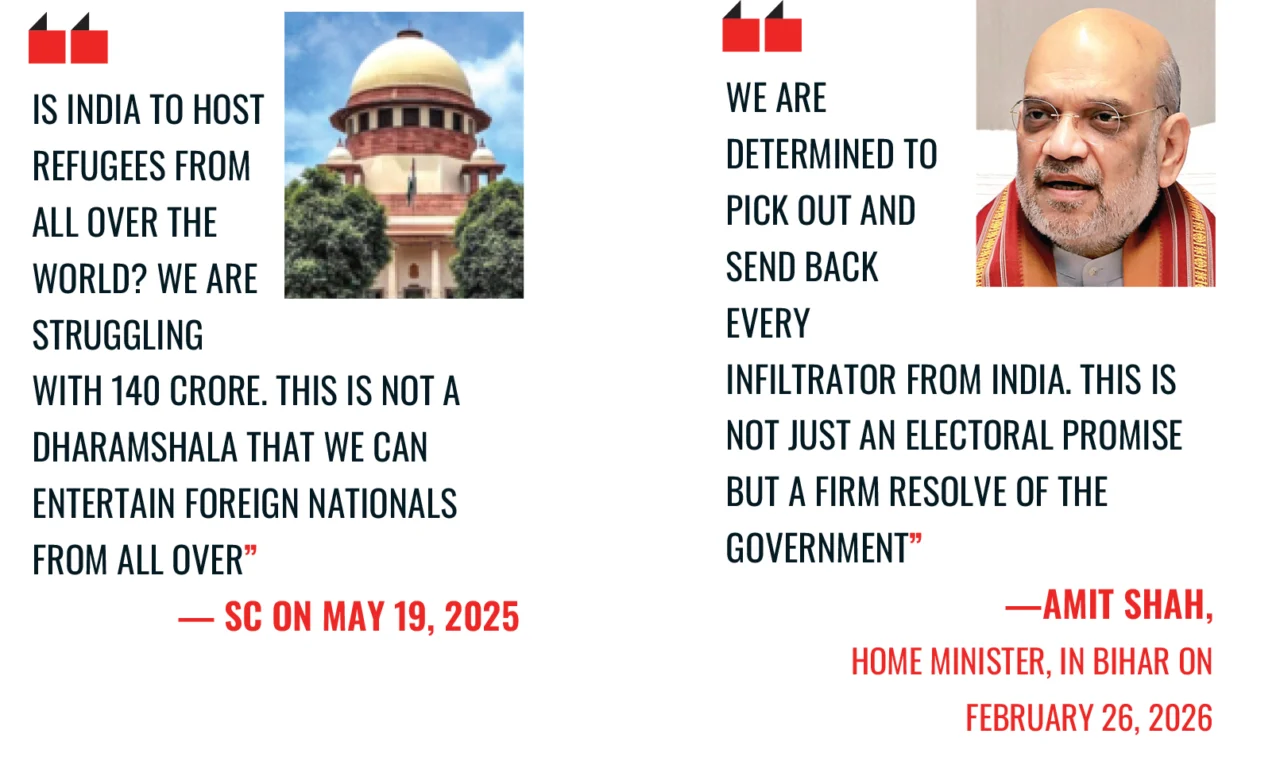
The BJP, in its campaign trail, had promised several measures to tackle this border crisis if voted to power. Firstly, the Home Minister himself guaranteed that within 45 days of the formation of the BJP Government in the State, adequate land would be handed over to the Centre in order to enable the Border Security Force (BSF) to complete the fencing process. Secondly, greater cooperation would then exist between the State administration and BSF which would facilitate tackling issues like cross-border cattle smuggling and illegal infiltration. Thirdly, the BJP would also implement the Citizenship Amendment Act in order to identify the persecuted Hindu refugees (like the Matuas) and grant them citizenship. Initiatives like the Special Intensive Revision were also being operationalised by the Election Commission of India simultaneously so that the electoral rolls could be purified and illegal migrants identified. The Government would then follow the procedure of ‘detect, delete, deport’ while dealing with illegal immigrants. Finally, they also highlighted the strategic importance of the Siliguri Corridor (referred to as the Chicken’s neck) not only to curb infiltration but also to preserve and enhance national security.
While the victory of the BJP in West Bengal is momentous, it also raises the expectations of the people of West Bengal. The electoral mandate in West Bengal reflects growing public expectations for transparent, development-oriented, and responsive governance under the newly formed Bharatiya Janata Party administration. The Government must deliver on its pre-poll promises like greater economic growth and healthier investments, job creation, prevention of illegal immigration from the international border of Bangladesh, end of appeasement policies targeting a particular minority community. One must remember that in the State of West Bengal, electoral success is not necessarily a guarantor of political permanence, and long-term trust can only be cemented through effective governance and respecting the cultural legacy of Bengal.