The election results in West Bengal have astonished and delighted the entire nation. I had the opportunity to visit Bengal in December 2025 and February 2026. Most people there certainly desired change, but very few truly believed that such a change could actually become possible. The circumstances were such that change seemed nothing short of a miracle. Creating the open and fearless environment necessary for free and fair voting was the greatest challenge. Yet, through the combined efforts of the Election Commission, the Supreme Court, the Union Home Ministry, and the security forces, this became possible.
This time, the people of Bengal voted in unprecedented numbers. In the previous five elections (2001 to 2021), the average voter turnout was 79.22 per cent, whereas in 2026 it rose to 92.47 per cent. The contribution of SIR to this sudden increase of nearly 13 per cent cannot be denied. At the same time, this remarkable rise also reflects the fearless atmosphere and the extraordinary enthusiasm of the people. The other critical facts that society viewed this election as a civilisational battle, that the security forces discharged their responsibilities effectively, and that people were reassured about their democratic rights, cannot be ignored.
In February 2026, I met a senior woman journalist in Kolkata who holds firm leftist views. I spoke with her again on May 29. She told me that she had cast her first vote when she was eighteen years old, and now, in 2026, she had voted once again. She is presently forty-six years old. Indeed, the intense desire for a change and the belief that change was indeed possible were among the most important motivations behind this exceptional voter turnout.
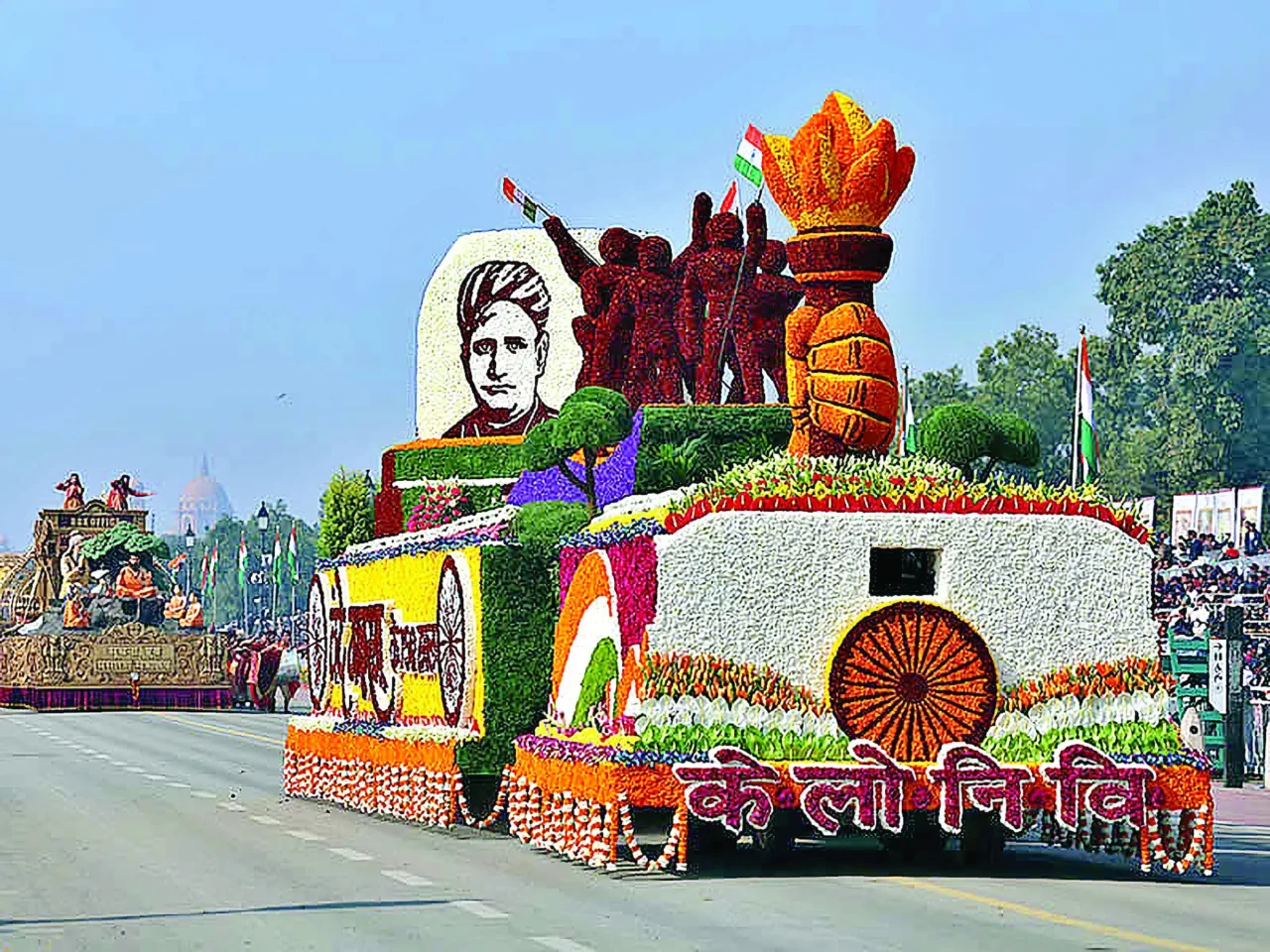
For a long time, Bengal had a history of violence during elections. In such a context, this election was comparatively peaceful. Credit for this may also be given to the Union Home Ministry. That is why people came out fearlessly to cast their votes. This election was not only a victory for the BJP, the people of Bengal have also ensured the triumph of Bharat’s spiritual tradition and the idea of Hindutva. It appears that the soul of Bengal has awakened once again. This is the victory of the Bengal of Ramakrishna Paramahansa, Swami Vivekananda, Sri Aurobindo, Bankim Chandra Chattopadhyay, Rabindranath Tagore, Jagadish Chandra Bose, Bipin Chandra Pal and countless other great pioneers of spiritual and national awakening.
The Bengal That Refused to Break
This moment reminds me of the resistance to the partition of Bengal proposed by British rule in 1905. At that time, accompanied by the resounding cry of “Vande Mataram,” Bengal witnessed the rise of indomitable energy, unprecedented unity, and a powerful national consciousness. The force of that awakening was so immense that it eventually compelled the British government to revoke the Bengal Partition proposal in 1911. Not only that, the British administration was also forced to shift its capital from Kolkata to Delhi in 1911. Viewed from this perspective, the victory of Bharat’s spiritual tradition and the idea of Hindutva in this Bengal election may rightly be called Bengal’s “Vande Mataram Moment.”
The song Vande Mataram was written by Bankim Chandra Chattopadhyay in 1875 for his novel Anandamath. In 1896, it was sung for the first time at a session of the Indian National Congress by Rabindranath Tagore. Thereafter, during the agitation against the British proposal to partition Bengal in 1905, the people of Bengal adopted Vande Mataram as the battle mantra of the freedom movement.
The entire nation rose in opposition to the proposed partition of Bengal. Lala Lajpat Rai, Bal Gangadhar Tilak, and Bipin Chandra Pal popularly known as Lal-Bal-Pal were accepted by all as their leaders. The very singing of Vande Mataram infused people with indomitable energy and national consciousness. Countless revolutionaries embraced the noose with smiles on their faces, offering their lives while raising the cry of Vande Mataram.
The Power of a National Mantra
In the struggle against the British proposal to partition Bengal, the role of Vande Mataram was of immense significance. On Sunday, October 16, 1905, the Raksha Bandhan celebration observed in Calcutta was historic and profoundly significant. Ordinarily, Raksha Bandhan falls on the full moon day of the month of Shravana, that is, in August. However, in protest against the partition of Bengal, on October 16, Hindu and Muslim men and women throughout Kolkata bathed in the sacred Ganga, tied rakhis on one another’s wrists, and pledged that, just as this silken thread binds us together, so too would they keep Bengal united and never allow it to be divided.
Sri Aurobindo was the first to describe Vande Mataram as the mantra of freedom. To awaken national consciousness, he published a weekly newspaper titled Vande Mataram. In 1907, the flag of Free India unfurled by Madam Bhikaji Cama in Germany bore the words Vande Mataram. From then onwards, Vande Mataram became the hymn of freedom, a song of patriotic inspiration, and the mantra of consciousness for revolutionaries.
Alarmed by the revolutionary fire ignited by the song, the British Government banned its public singing in April 1906. Yet this repression only generated greater enthusiasm and energy in Bengal, and eventually forced the British government to withdraw the proposal to partition Bengal.
This energy and enthusiasm did not remain confined to Bengal. The flames of this awakening spread across the entire nation. At Nagpur, in 1907, Dr Hedgewar, the future founder of the Sangh and then a tenth-grade student, publicly proclaimed Vande Mataram and incurred the wrath of the school authorities. As a consequence, he was expelled from school. Thereafter, the complete song continued to be sung at every annual session of the Indian National Congress. Eminent musicians such as Rabindranath Tagore, Pandit Vishnu Digambar Paluskar, and Omkarnath Thakur lent their voices to it. All Congress members whether Hindu or Muslim sang it as the life-breath of the freedom movement.
However, after 1921, under the influence of Britain’s divisive politics, communal forces began to gain influence within the Congress. As a result, tendencies emerged that supported the Khilafat Movement and opposed Vande Mataram by labeling it communal. The very song that until 1920, had been regarded as the life-mantra of the freedom movement, was called communal after 1923. It was from this point that the seeds of Bharat’s partition began to be sown.
Understanding Deeper Impulse
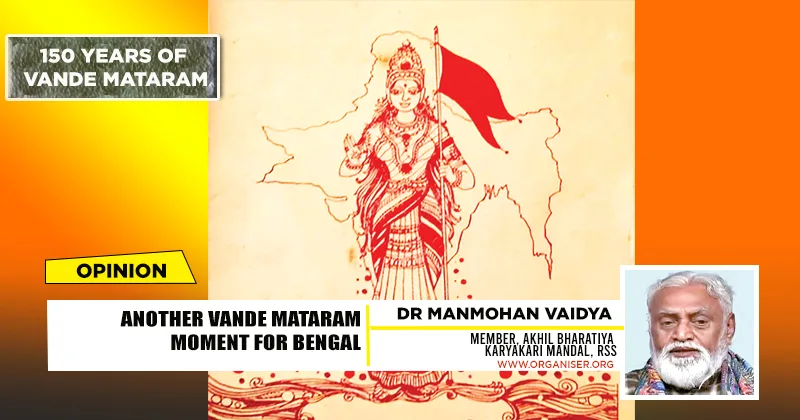
In Bharatiya thought, the human being is not viewed merely as a physical body, but as a five-layered existence comprising body, life-force, mind, intellect, and soul. In the same way, Vande Mataram presents the complete form of Bharat. Its first stanza describes the land of Bharat; the second portrays its people; while the later stanzas depict Bharat’s mind, intellect, life-force, and spiritual consciousness.
“Tumi Vidya, Tumi Dharma,” “Vidya” refers to Bharat’s spiritual wisdom that teaches the path to emancipation, and “Dharma” (not religion) means reducing the prominence of the individual ‘I,’ expanding the collective spirit of ‘we,’ and giving back to society with a sense of belonging. Sister Nivedita observed that when people do not keep the remuneration of their labour solely for themselves but contribute back to society, that society accumulates social capital, becomes prosperous and enriched, and enables every individual to flourish. This is Dharma.
In that sense, enriching the social capital of society itself is Dharma. That is why, after Independence, Bharat’s leadership consciously adopted ideals such as “Dharmachakra Pravartana” for the Lok Sabha, “Satyam Vada, Dharmam Chara” for the Rajya Sabha, “Yato Dharmastato Jaya” for the Supreme Court, and incorporated the Dharma Chakra into the national flag. This Vidya and Dharma, it is said, reside in the heart of Bharat Mata; they are the very life-force of Bharat.
Bharat Mata is the united embodiment of Durga, the goddess of strength; Lakshmi, the goddess of prosperity; and Sarasvati, the goddess of knowledge. This is Bharat. For this very reason, the complete rendition of Vande Mataram continued to be sung at the annual sessions of the Indian National Congress from 1905 onwards. It takes approximately three minutes to sing the entire composition.
Later, under the influence of divisive and communal elements, opposition to it began to emerge a trend that, in one form or another, continues even today. Those who see communalism in it merely display their ignorance of Bharat’s spiritual heritage and traditions. Or else, it appears that they are either part of, or unwitting instruments in the hands of, the divisive forces that once served British rule and today work against Bharat.
Yet Vande Mataram stirred the very spirit of Bharat. It awakened national consciousness and ignited the sense of freedom in every heart. It was precisely for this reason that such widespread public outrage arose against the partition of Bengal that the British government was ultimately compelled to withdraw its proposal. Recently, the Government of India has accorded greater prominence to Vande Mataram and has encouraged the singing of the complete composition. This is both appropriate and commendable.
Bengal’s Second Awakening
The results of the 2026 Bengal elections have revived memories of the awakening, determination, national consciousness, and decisive activism that characterised Bengal between 1905 and 1911. This election has shattered attempts to separate Bengal on the basis of linguistic identity. Although the Bengali language is distinct, its identity is not separate from Bharat’s spiritual identity; rather, it is an inseparable part of it. The results of this election have reaffirmed that truth.
Just as, in 1905, British colonial forces and extremists were working together to undermine Bharat’s national identity, so too, in 2026, mindless politicians, fanatics, and Marxists were working in concert to sever Bengal’s ties with the rest of Bharat. Both in 1905 and in 2026, the Hindus of Bengal were confronted with a crisis affecting their very existence.
It appears as though the spirit and identity of the Bengal of Ramakrishna Paramahamsa, Swami Vivekananda, Sri Aurobindo and Rabindranath Tagore have awakened once again. Bharat’s all-inclusive, integrated, and spiritual philosophy of life has once again found a clear and powerful expression. Heartfelt congratulations to the women and men of Bengal who displayed extraordinary courage and determination by coming out fearlessly and voting in unprecedented numbers. Their commitment to democracy and their aspiration for change made this historic outcome possible. Without a doubt, this is Bengal’s “Vande Mataram Moment.”