West Bengal: From social unity to politicised club culture
August 31, 2026
  • Read Ecopy
  • Circulation
  • Advertise
  • Careers
  • About Us
  • Contact Us
Android AppiPhone AppArattai
Organiser
  • ‌
  • Bharat
    • Assam
    • Bihar
    • Chhattisgarh
    • Jharkhand
    • Maharashtra
    • View All States
  • World
    • Asia
    • Europe
    • North America
    • South America
    • Africa
    • Australia
  • Editorial
  • International
  • Opinion
  • RSS @ 100
  • More
    • Op Sindoor
    • Analysis
    • Sports
    • Defence
    • Politics
    • Business
    • Economy
    • Culture
    • Special Report
    • Sci & Tech
    • Entertainment
    • G20
    • Azadi Ka Amrit Mahotsav
    • Vocal4Local
    • Web Stories
    • Education
    • Employment
    • Books
    • Interviews
    • Travel
    • Law
    • Health
    • Obituary
  • Subscribe
    • Subscribe Print Edition
    • Subscribe Ecopy
    • Read Ecopy
  • ‌
  • Bharat
    • Assam
    • Bihar
    • Chhattisgarh
    • Jharkhand
    • Maharashtra
    • View All States
  • World
    • Asia
    • Europe
    • North America
    • South America
    • Africa
    • Australia
  • Editorial
  • International
  • Opinion
  • RSS @ 100
  • More
    • Op Sindoor
    • Analysis
    • Sports
    • Defence
    • Politics
    • Business
    • Economy
    • Culture
    • Special Report
    • Sci & Tech
    • Entertainment
    • G20
    • Azadi Ka Amrit Mahotsav
    • Vocal4Local
    • Web Stories
    • Education
    • Employment
    • Books
    • Interviews
    • Travel
    • Law
    • Health
    • Obituary
  • Subscribe
    • Subscribe Print Edition
    • Subscribe Ecopy
    • Read Ecopy
Organiser
  • Home
  • Bharat
  • World
  • Operation Sindoor
  • Editorial
  • Analysis
  • Opinion
  • Culture
  • Defence
  • International Edition
  • RSS @ 100
  • Magazine
  • Read Ecopy
Home Politics

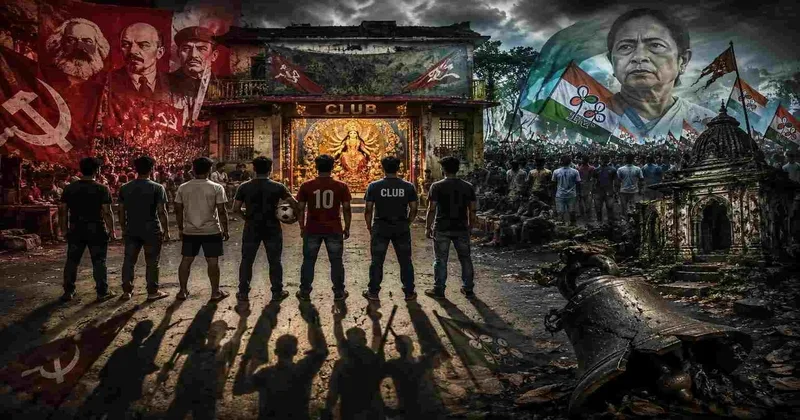
From Community Spirit to Political Structure: The transformation of West Bengal’s club culture over decades

West Bengal’s club culture, once a pillar of community unity and cultural expression, is now at the centre of debate over its growing political influence. From grassroots social institutions to politically linked networks, this transformation raises critical questions about youth, identity, and social direction

WEBDESKWEBDESK
May 16, 2026, 03:00 pm IST
inPolitics, Bharat, West Bengal
Follow on Google News
The transformation of West Bengal’s club culture over decades

The transformation of West Bengal’s club culture over decades

Facebook
Twitter
WhatsAppTelegramEmail

Kolkata: West Bengal was once widely regarded as a centre of cultural consciousness, intellectual debate, and grassroots social organisation. The state that produced icons like Swami Vivekananda, Bankim Chandra Chattopadhyay, and Subhas Chandra Bose built a strong tradition of community engagement through its local club culture. However, in recent decades, this very structure has become the subject of intense debate. What was once seen as a symbol of social unity has increasingly evolved into a politically influenced network, raising questions about cultural continuity, youth engagement, and the broader social fabric of the state.

Origins of Club Culture in Bengal

Club culture in Bengal dates back several decades and has historically been deeply embedded in both rural and urban life. These clubs were informal yet highly organised community units that played a central role in:

* Organising religious festivals such as Durga Puja, Kali Puja, and Jagadhatri Puja
* Conducting sports tournaments, especially football
* Hosting cultural programs, theatre, and literary events
* Facilitating social bonding and local problem-solving

Far beyond recreation, these clubs functioned as platforms for collective identity and community cohesion. They brought together youth across economic and social backgrounds, fostering leadership, teamwork, and cultural awareness.

The Left Front Era: Institutionalising Political Influence (1977–2011)

The transformation of club culture began during the rule of the Left Front government, which came to power in 1977. Over time, a structured approach was adopted to integrate local social institutions into a broader political framework.

* Clubs began receiving state patronage in the form of grants and administrative support
* Local leaders established influence over club activities and leadership structures
* Clubs increasingly became spaces for political mobilisation and ideological dissemination

This period saw the emergence of what some describe as “political socialisation,” where young individuals were gradually introduced to party-based thinking through everyday community participation.

Neighbourhood clubs gradually began influencing key local decisions, including the allocation of resources and contracts, the organisation of rallies and political events, and even the regulation of economic and social activities within their areas. While this process helped build a highly organised grassroots network, it also led to a narrowing of focus, from broader cultural and social engagement to a more defined political alignment.

Post-2011 Shift: Expansion Under the All India Trinamool Congress

After the political transition in 2011, the framework established during the Left era did not disappear; instead, it expanded and adapted under the new ruling dispensation. There was a significant increase in financial grants to clubs, particularly for major festivals like Durga Puja, along with greater visibility and scale of club-organised events and a stronger alignment with local political leadership. While these developments enhanced the grandeur of cultural celebrations, they also deepened clubs’ dependence on state support, which in many cases reduced their autonomy and reinforced their role within local power structures.

Politicisation and Its Social Impact

The increasing political integration of club culture has had several consequences:

Erosion of Independent Identity

Clubs that once operated as community-driven institutions now often function as extensions of political influence, limiting independent decision-making.

Shift in Youth Engagement

Youth participation has, in many cases, shifted from cultural and social activities to:

* Political campaigning
* Event management tied to political visibility
* Local power assertion

Concerns Over Violence and Intimidation

Reports and observations, including those noted by the National Human Rights Commission, have raised concerns about electoral violence and the role of localised networks in political conflicts.

Also Read: Journey of Suvendu Adhikari’s Mother Gayatri Adhikari: From partition displacement to Bengal’s political legacy

Cultural Consequences: Ritual vs Consciousness

One of the most debated outcomes of this transformation is the perceived gap between cultural practice and cultural understanding. Festivals like Durga Puja continue to grow in scale and spectacle, drawing massive participation and visibility; however, the deeper engagement with cultural, philosophical, and historical aspects appears to have diminished. In this context, while “religious ceremonies” remain vibrant, “cultural consciousness” has weakened, and clubs that once served as spaces for discussion, learning, and social reflection are now increasingly focused on logistics and organisation.

The Untapped Potential of Bengal’s Youth Network

Despite these challenges, Bengal’s club ecosystem remains one of the most extensive in India. Nearly every neighbourhood has an active youth organisation, representing a powerful and structured social base. Experts suggest that this network could be redirected toward:

* Cultural education and heritage awareness
* Community service initiatives
* Social harmony and conflict resolution
* Intellectual and civic engagement

The inherent organisational strength of these clubs is widely acknowledged—it is their direction that remains contested.

In recent years, a growing discourse, particularly on digital and social media platforms, has questioned the current trajectory of club culture.

Key demands include:

* Reducing political interference in club functioning
* Encouraging independent cultural and educational activities
* Reviving discussions on history, philosophy, and social issues

Youth-led initiatives in some areas are already experimenting with alternative models of engagement. If its youth networks are reoriented toward inclusive, culturally rooted, and socially constructive goals, Bengal could once again emerge as a leading force in defining the country’s social and cultural direction.

 

Topics: cultural identityClub cultureYouth networksWest BengalLeft FrontAll India Trinamool Congress
Share
Tweet
SendShareSend
✮ Subscribe Organiser YouTube Channel. ✮
✮ Join Organiser's WhatsApp channel for Nationalist views beyond the news. ✮
Previous News

Justice in Question: How Tadmetla attack case exposed flaws in investigation & left 76 CRPF martyrs without closure

Next News

Five-Nation Visit: “Feels like a festival in India,” PM Modi says after grand diaspora welcome in Netherlands

Related News

Home Minister Amit Shah holds a review meeting on the security situatinon in Siliguri Corridor

Home Minister Amit Shah outlines Siliguri strategy; Calls for inter-departmental synergy to foster national security

Asphulla Mallik created his AI image and projected himself as a Mujahideen on social media

Karnataka: Suspected TTP operative Asphulla Mallik arrested in Bengaluru; Police probe reveal terror links

National Women Commission Conclave in West Bengal: Women could be key entrepreneurs in pharma sector

Taslima Nasrin returns to Kolkata

The Return of Taslima Nasrin to Kolkata: The story of exile and belonging

Muslim League anchored planned atrocities against Hindus on Direct Action Day in Calcutta

Decoding the horrors of Direct Action Day; Revisiting the forgotten lessons from the streets of Calcutta

Decolonisation saw nations across Africa and Southeast Asia reclaim their cultures, languages and identities after independence (This image is generated by AI)

From Colonial Rule to Cultural Revival: How African and Southeast Asian nations shed their colonial legacies

Load More

Latest News

Students at the Gautam Buddha University, Greater Noida

Mann Ki Baat: PM Modi praises GBU’s mission ShakthiSAT, says dreams of daughters are now taking flight to space

Dutch TikTokker Angelo Bryson, known as Superhuman Unchained, at a pro-Palestine protest.

Dutch TikTokker recently converted to Islam livestreams stabbing three in Amsterdam; Watch video

From Kanchipuram to Kalamkari, India’s traditional textiles reflect its rich regional cultures and centuries-old craftsmanship

From Kanchipuram to Kalamkari: Exploring India’s rich traditional textiles and regional clothing heritage

Punjabi Influencer Abducted, Burnt Alive Near Morinda

Punjab Law and order crisis: Influencer Manjeet Kaur abducted, burnt alive after attack near Morinda

‘Dimagi Naxals’ romanticising Mao, Stalin and Pol Pot

The Swadeshi movement turned Indian enterprise into a powerful force for economic self-reliance, national pride and the struggle for Swaraj

Building Economic Swaraj: How Indian enterprises fought foreign rule and reclaimed national pride

Prime Minsiter Narendra Modi and Uzbekistan President Shavkat Mirziyoyev

India-Uzbekistan Herald New Chapter: Uranium deal, 30-day visa-free entry to Indians & $5bn trade propel bilateral ties

The new FCRA rules seek to curb unchecked foreign funding, strengthen financial accountability, and protect Bharat’s national security

Stopping Unchecked Foreign Money: How new FCRA rules protect Bharat’s security and financial sovereignty

Keralam CM VD Satheeshan, DCC member Chembil Anil (Left to Right)

Keralam Congress infighting surfaces in CM VD Satheeshan’s vehicle blockade; DCC member Chembil Anil arrested, remanded

Indian Logistics Data Bank tracks ten crore containers, transforming freight visibility and strengthening the nation’s logistics network

From Lothal Dockyard to Ten Crore Containers: India’s Logistics Data Bank transforms EXIM freight tracking

Load More
  • Privacy
  • Terms
  • Cookie Policy
  • Refund and Cancellation
  • Delivery and Shipping

© Bharat Prakashan (Delhi) Limited.
Tech-enabled by Ananthapuri Technologies

  • Home
  • Search Organiser
  • Bharat
    • Assam
    • Bihar
    • Chhattisgarh
    • Jharkhand
    • Maharashtra
    • View All States
  • World
    • Asia
    • Africa
    • North America
    • South America
    • Europe
    • Australia
  • Editorial
  • Operation Sindoor
  • Opinion
  • Analysis
  • Defence
  • Culture
  • Sports
  • Business
  • RSS @ 100
  • Entertainment
  • More ..
    • Sci & Tech
    • Vocal4Local
    • Special Report
    • Education
    • Employment
    • Books
    • Interviews
    • Travel
    • Health
    • Politics
    • Law
    • Economy
    • Obituary
  • Subscribe Magazine
  • Read Ecopy
  • Advertise
  • Circulation
  • Careers
  • About Us
  • Contact Us
  • Policies & Terms
    • Privacy Policy
    • Cookie Policy
    • Refund and Cancellation
    • Terms of Use

© Bharat Prakashan (Delhi) Limited.
Tech-enabled by Ananthapuri Technologies