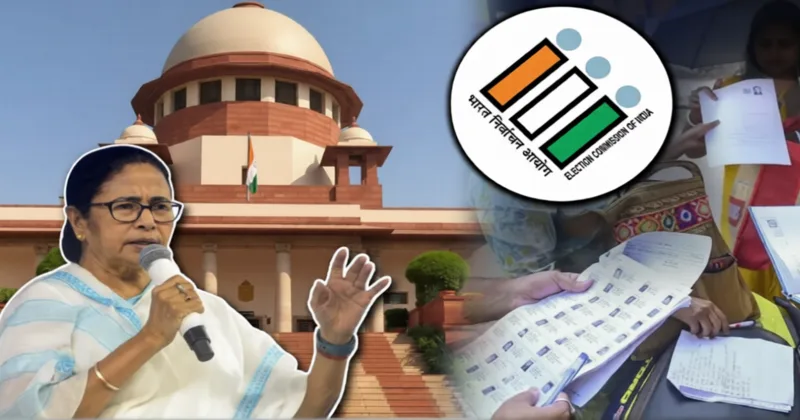
New Delhi: The Supreme Court refused to entertain the Trinamool Congress’ challenge to the Election Commission’s decision to deploy Central government and PSU employees in the vote counting process for the West Bengal Assembly elections, reinforcing the Commission’s authority to design safeguards for a neutral count.
Court finds no illegality in EC’s framework
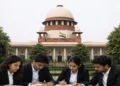
A bench of Justices PS Narasimha and Joymalya Bagchi made it clear that the Election Commission’s framework falls squarely within existing regulations. The Court observed that when rules permit both Central and State officials to be appointed, the choice exercised by the Commission cannot be termed unlawful.
The bench went further to state that even a greater presence of Central personnel would not have rendered the framework invalid under the governing regulations.
“No further orders necessary” says Supreme Court
Closing the plea, the Court recorded the assurance of the Election Commission of India that its April 13 circular would be implemented in letter and spirit. It then held that no further judicial directions were required in the matter.
This effectively put an end to the Trinamool Congress’ attempt to secure changes to the counting composition just days before results.
TMC’s apprehension of bias rejected
The All India Trinamool Congress had argued that the presence of Central government and PSU employees could create a reasonable apprehension of bias. Senior Advocate Kapil Sibal also questioned the lack of disclosed data behind the Commission’s concerns about possible irregularities.
The Court, however, did not find merit in these submissions, signalling that speculative apprehensions without concrete backing cannot justify judicial intervention in election management.
Context: Trust Deficit and Electoral Oversight
The EC’s decision to bring in Central personnel must be seen against the backdrop of repeated allegations of electoral violence and irregularities in West Bengal’s past elections. Enhancing neutrality through a mixed pool of officials is, in that sense, a calibrated administrative response, not an overreach.
By insisting on randomised selection from both Central and State pools, the Commission has aimed to insulate the counting process from local pressures and reinforce public confidence.
Additional reliefs sought
The All India Trinamool Congress sought a stay on the April 13 communication and the Calcutta High Court order, or alternatively, deployment of both Central and State staff at each counting table. It also asked for preservation of CCTV footage from counting centres.
Article 14 and selective application claim
The party argued the directive was arbitrary and in violation of Article 14, noting that similar elections in other states were conducted without mandating Central personnel at every table.
Objection to composition and authority
TMC said existing safeguards like micro-observers were sufficient and that extending Central presence to supervisors and assistants created imbalance. It also questioned the authority of the issuing officer, arguing such powers rest only with the Election Commission of India at specified levels.
Maintainability and urgency
The plea contended that courts can examine such issues despite ongoing elections and that post-election remedies are inadequate. It flagged urgency ahead of May 4 counting, warning of risks to a free and fair process, a claim the Supreme Court of India ultimately declined to accept.
EC underscores multi-layered safeguards
Appearing for the Commission, Senior Advocate Dama Seshadri Naidu emphasised that the counting process already contains multiple institutional checks, including returning officers from the state cadre and candidate-appointed counting agents.
The Court appeared satisfied that these safeguards ensure transparency and negate the possibility of systemic bias.
Reinforcement of EC’s autonomy before counting day
With counting scheduled to begin on May 4, the ruling strengthens the Commission’s hand in maintaining a neutral and credible process.
For the TMC, the setback underscores a larger challenge: political narratives around bias are unlikely to find traction in courtrooms without substantive backing.
By declining to interfere, the Supreme Court has reaffirmed that election management decisions lie primarily within the domain of the constitutional authority entrusted with conducting free and fair polls.
The Court’s refusal to intervene signals a broader principle: mere political suspicion cannot override an institutional framework designed to ensure transparency.