
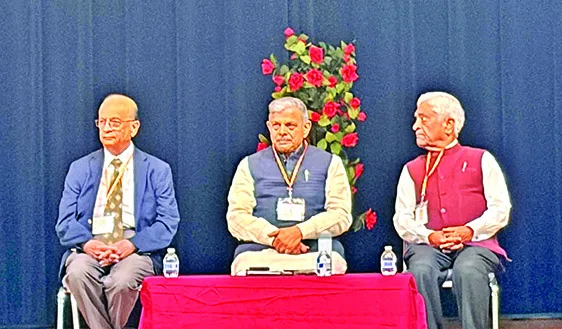
Rashtriya Swayamsevak Sangh (RSS) Sarkaryavah Dattatreya Hosabale visited the United States in April 2026 as part of the RSS centenary celebrations. The visit was aimed at engaging with the US think tanks, academia, policymakers, tech entrepreneurs, and the Indian diaspora to clarify the RSS’s position on a wide range of issues and to counter misconceptions about the RSS, Bharat, and Hinduism.
Centuries of Islamic and British colonisation resulted in widespread misrepresentation of Bharat and Hinduism, both academically and popularly. Because Bharat is a Hindu civilisation, distortions of the Hindu faith shape perceptions of the society and the country. While the common stereotypes of caste, curry, and cow are familiar, they merely scratch the surface. Orientalist narratives primitivised Hindus to legitimise their colonial rule, casting Bharatiya as primitive and uncivilised and presenting colonisers as civilised and enlightened.
Bharatiya-Americans have been fighting an ongoing battle against such misrepresentation from the earliest years of their immigration to America. California textbook case concerning the portrayal of Hindu Dharma, and the political and judicial battle against “caste” legislation in California, have tested the Hindu American resolve to fight misrepresentation of this great culture and history.
“The minority are a part and parcel of our nation and society”
In a detailed interaction with National Public Radio (NPR), a US based media organisation, Dattatreya Hosabale laid out the organisation’s ideological position, responded to criticism, and addressed questions on Bharat’s civilisational identity, minorities, and global perception. The interview, conducted by NPR’s Rob Schmitz in Washington DC during Hosabale ji’s visit to the Hudson Institute, on April 24, marked an outreach by the RSS to Western media.

Responding to a question on minorities and their place in society as to where they fit in the RSS’s vision for Bharat, Hosabale Ji stated, “They are a part and parcel of our nation and society. They are very much citizens as myself, and their forefathers have also been the people from Bharat.”
Addressing concerns about Muslims being labelled as invaders, he said: “Invasion on Bharat is a fact of history. We do not consider that the present day Muslims are invaders. The present day Muslims and their forefathers are of Bharatiya origin. I mean majority of them, they are not the inheritance of the invasion. But Bharat was invaded, that is true.”
In another significant exchange, Hosabale ji said: “We identify them as civilisationally, culturally Hindus. If you consider being a Hindu by some religious angle, there is no one Hindu religion. It is a way of life.”
The NPR also raised allegations linking individuals associated with Hindu groups to incidents of violence.
Responding to this, Hosabale ji said, “RSS is not an extremist organisation. We are not an underground organisation. We are an open organisation. We are a grassroots organisation and we are seen every day. We are not doing any activity behind the curtain.” On specific cases cited during the interview, he stated, “All those incidents have been tried in the court of law and they have been disproved. No RSS member was ever involved. The court of law has given the verdict.”
As the West gained control over intellectual discourse in its colonies, natives of the traditions became profoundly influenced, even in their self-understanding, by Western interpretations of their own religious and cultural heritage. Colonial consciousness, in a colonised mind, hinders the process of self-experience.
One of quantum theory’s most intriguing ideas is — The Observer Effect — the act of observation influences reality. This idea serves as a powerful analogy for Western scholars studying India and Hindu Dharma. It helps explain Hindu concerns that Western academic scrutiny not only records Hindu Dharma incorrectly but also reshapes it, often in ways Hindus consider unfamiliar or even negative. Suffice to say that the “observer bias” of external scholars has altered both the tradition’s perception and its self-understanding.
A Purposeful Visit
Driven by a more confident Hindu society’s desire to reclaim agency in representing Hindu Dharma and India, nearly 79 years after Bharat’s Independence and 100 years after the RSS’s founding, Hosabale Ji travelled to the US, visiting Stanford, Washington, DC, and Chicago.
He stressed that scientific and technological progress must prioritise ethics, equality, and ecology over economic gain. Highlighting the Hindu principles — ethics (Dharma), equality (all living beings in God and God in all living beings, Bhagavadgita 6.29), and ecology (Prakriti, the Bhoomi Sukta of the Atharva Veda) — he cautioned that unchecked technology could deepen inequality and social fragmentation.
He also participated in the Hudson Institute’s “New India Conference,” hosted by the Washington, DC-based think tank. He joined Hudson Scholar Walter Russell Mead, also Alexander Hamilton Professor at the University of Florida’s Hamilton School, for a fireside chat on India’s global role. The conference additionally addressed Indo-Pacific dynamics and Bharat-US strategic and economic ties. Datta Ji was accompanied by a high-level Indian delegation comprising India Foundation’s Ram Madhav, BJP’s Vijay Chauthaiwale, and former opposition MP Priyanka Chaturvedi.
After the Hudson conference, a Washington, DC-area reception on “India’s Global Vision and Role in the Emerging World” featured Indian-American community members and scholars, including Walter Andersen and Walter Russell Mead.
During his talks, Hosabale Ji stated Hindus have never invaded, enslaved, or committed acts warranting apology. He rejected ‘Hindu supremacism’ labelled against the RSS in certain sections of the media and academia, affirmed Hindu philosophy’s universal oneness, strong family values, and put impetus on strong community building.
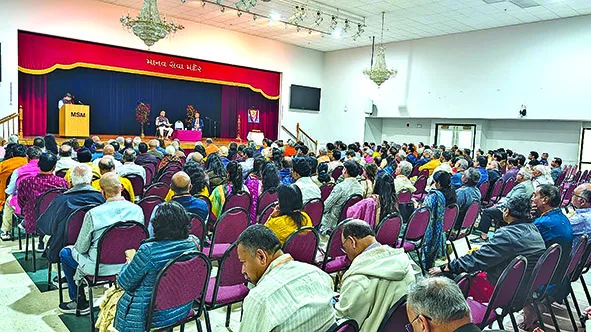
At a Chicago community event, while heralding Hindu pluralism, Hosabale Ji stressed the need for Hindu unity, lamenting that the lack of unity among Hindus has been a bane of the Hindu society, resulting in political vulnerability. He argued that preserving pluralism, religious freedom, and tolerance depends on maintaining a strong Hindu presence worldwide. He said that only Hindu Dharma can claim, “Ekam sat vipra bahudha vadanti” (Rigveda 1.164.46), meaning truth is one, but the wise speak of it in many ways.
Hosabale Ji highlighted the RSS’s role in organising society, promoting nation-building, encouraging community service, providing disaster relief, advancing education, and fostering social harmony.
Media coverage highlighted the visit’s goal of presenting the RSS’s perspective to Western audiences and of building cultural and strategic ties. The diaspora response was mostly positive; however, groups hostile to Hindu causes were unsettled by the RSS’s growing influence as a community-building organisation. In DC, a vocal anti-Hindu activist protested outside the Hudson Institute during the “New India Conference.”