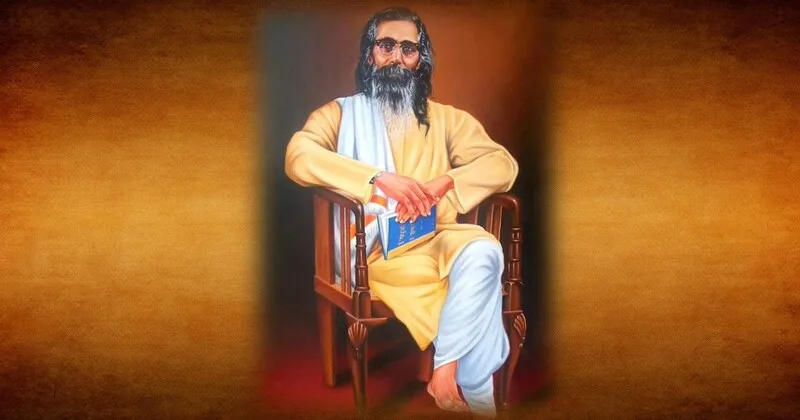
M. S. Golwalkar, popularly known as Guruji, the second Sarsanghchalak of the Rashtriya Swayamsevak Sangh (RSS), Guruji’s memory in Indian history is extremely interesting. His role was particularly profound in strengthening the RSS’s efforts to maintain social harmony.
The RSS, founded in 1925 to awaken and organise Hindu society, acquired a distinctive intellectual foundation under Guruji’s leadership. While carrying forward the organisational vision of Dr. K. B. Hedgewar, Guruji provided the Sangh’s growing cadre with a comprehensive ideological framework that shaped its future direction.
Through his vast scholarship and deep reflection, he addressed many of the fundamental challenges confronting Indian society and examined how these internal weaknesses threatened national unity. His speeches and writings consistently sought to provide solutions rooted in social cohesion and national integration.
The Sangh believes that nation-building begins with character-building. Guruji therefore urged workers to combat social evils such as caste discrimination and untouchability by eradicating the very foundations on which these practices rested. Travelling extensively across the country, he inspired volunteers to work towards an egalitarian and harmonious society.
In this context, he also publicly acknowledged the farsighted efforts of Dr. B. R. Ambedkar in combating untouchability. Guruji emphasised that every Hindu should resolve to eradicate this social evil, which had unfortunately become a part of Hindu society over the centuries.
It is this guiding philosophy that has ensured that practices such as asking a person’s caste or observing untouchability have no place within the Sangh. Guruji’s remembrance, some of his important reflections on social harmony deserve renewed attention.
The unhealthy glorification of imprisonment
Guruji cautioned against the tendency of some individuals to treat imprisonment as a badge of honour or as a qualification for acquiring political authority. He observed that periods spent in prison were increasingly being regarded as a kind of accumulated political capital, which could later be encashed for personal gain. Such a mindset, he warned, was detrimental to the nation and ultimately endangered the country’s future.
Rejecting the Aryan–Dravidian divide
Guruji acknowledged that the word Arya was an ancient and honourable expression. However, he argued that the Aryan–Dravidian divide had gained prominence largely during British rule through deliberate colonial propaganda. According to him, this divisive narrative had implanted poisonous ideas in Indian minds. He therefore urged society to reject such externally imposed theories and cultivate a spirit of social harmony and national unity.
Casteism will not disappear by magic
During an interaction on 2 February 1969, an elderly man asked Guruji why members of backward communities appeared to have limited representation within the Sangh.
In response, Guruji questioned why members of Scheduled Castes and other backward communities should continue to identify themselves primarily through such labels. He remarked that the persistence of these identities often served political interests, while the Sangh sought to rise above such distortions. Its objective, he explained, was to unite Hindu society by transcending divisions based on caste, religion, language and region.
Guruji observed that centuries of foreign domination had deeply entrenched caste consciousness within society. Eliminating it would require sustained and collective effort rather than expecting it to disappear overnight.
Hindu rashtra and secularism
On one occasion, an Englishman reportedly asked Guruji: “If India is a secular country, and you advocate a Hindu Rashtra, what would become of secularism?”
Guruji responded by pointing out that the British monarch is required to be a Protestant Christian, yet Britain continues to be regarded as a secular state. Likewise, he argued, the predominance of Hindu civilisational values in India did not, in his view, contradict the practice of secularism. He maintained that tolerance and respect for all faiths were intrinsic characteristics of Hindu civilisation.
Every Indian as a true ambassador
Guruji believed that every Indian travelling abroad should remember that he or she represents not merely an individual identity but also the nation’s culture, civilisation and values.
The world, he observed, often judges a nation by the conduct of its citizens. This responsibility is even greater for an ancient civilisation like India. If Indians fail to reflect the lofty cultural ideals of their country through their conduct, the nation’s image inevitably suffers. He therefore urged every Indian to travel abroad with the awareness that they are ambassadors of India’s true civilisational spirit.
Never stop until social harmony is achieved
Guruji repeatedly warned that divisive forces—both internal and external—were constantly seeking opportunities to exploit India’s social differences.
He referred to instances where, in his assessment, foreign interests had attempted to aggravate domestic conflicts, including linguistic disputes in Assam and the international amplification of reports concerning atrocities against Harijans. He cautioned that if Hindu society became fragmented along caste, religious or sectarian lines, national unity itself would be endangered.
Accordingly, he urged Sangh workers never to cease their efforts until a harmonious society was established. That warning, many believe, continues to hold relevance even today.
A vision beyond the Sangh
Through his speeches and guidance, Guruji introduced Sangh workers to multiple dimensions of social harmony. He explained the philosophical foundations of peaceful coexistence and emphasised how caste divisions could weaken the nation from within.
Today, Samarasata (social harmony) remains one of the central principles of the Sangh’s organisational philosophy. Untouchability has no place within its internal functioning, and the practice is regarded as wholly unacceptable in its activities and shakhas.
The larger aspiration is that Guruji’s vision of social harmony should extend beyond the Sangh and inspire the nation as a whole. At a time when social cohesion is both a challenge and a necessity, his message of unity, equality and national integration deserves thoughtful reflection.