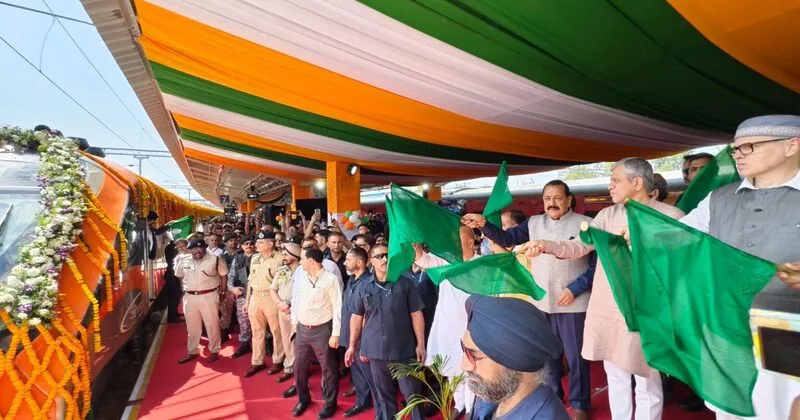
JAMMU: Union Railway Minister Ashwini Vaishnaw on April 30, Thursday flagged off a Vande Bharat train from Jammu to Katra. So far, because of paucity of infrastructure and additional platforms at Jammu railway station, this train service used to run from Katra to Srinagar only. Effectively, it is an extension of existing Vande Bharat train services, twice daily, available between Katra and Srinagar as also the other way around.
This marks a significant step towards enhancing rail connectivity across the Union Territory (UT) of Jammu and Kashmir. It is now possible for passengers to book themselves on Vande Bharat trains connecting Jammu to Srinagar. They can actually start their journey from Delhi in the evening earlier, get down at Jammu railway station, wait for some time and board another train for Srinagar.
The journey between Jammu and Srinagar is expected to take less than five hours, something unimaginable a couple of years ago. The travel time between Jammu to Srinagar on the national highway took about eight to 10 hours a decade ago. The creation of a new tunnel at Banihal has cut down travelling time signficanly.
Minsiter Vaishnaw stressed that while maintenance practices remained central to safety and security, the next major focus will be enhancing the capacity of the Jammu–Srinagar rail corridor. This will be done through infrastructure upgrades, including track doubling to facilitate increased train operations.
Track doubling is easier said than done between Jammu and Srinagar as for most part of the journey, the tracks run through tunnels. Doubling of tracks up to Banihal from Kashmir side is still easier as the tracks pass through flat plains for most part. Anything like track doubling beyond Katra, towards Reasi and beyond to Banihal is truly going to be a herculean task.
The Jammu–Udhampur-Katra-Srinagar rail line, built using advanced technology, has already boosted cargo movement, with large-scale transportation of horticultural produce from Kashmir to other parts of the country. In fact, the cargo movement for the coming season for cherries excites the horticulturists as they expect direct movement between Srinagar and Mumbai. The minister said that millions of kilograms of apples and other fruits have been transported through rail connectivity, significantly benefiting growers and traders.
Highlighting the success of the Vande Bharat Express on the Katra–Srinagar sector, Vaishnaw said the train has recorded full occupancy since its launch, with more than 5.5 lakh passengers travelling so far. He added that the train has been specially designed to operate in extreme weather conditions, including sub-zero temperatures, with advanced systems preventing water freezing and ensuring smooth functioning.
The present trains that run between Katra and Srinagar are comparatively smaller trains having only eight bogies. In contrast, the new train on this route will comprise 20 coaches each. That means their carrying capacity will be more than double the existing trains. The Vande Bharat Express is fairly advanced as it has modern electronic systems, including thousands of microchips, making it one of the most technologically sophisticated trains operating in India.
Jammu and Kashmir Chief Minister Omar Abdullah, who was present on the occasion, welcomed the expansion and said the rail link has significantly improved connectivity between Jammu and Srinagar. He noted that the increased capacity will ease travel for nearly 1,400 passengers per trip and also support freight movement, including cement, vehicles, and horticulture produce. He also stressed the need for a dry port in J&K and streamlined customs clearance facilities.
Speaking on the occasion, Union Minister in PMO Dr. Jitendra Singh credited Prime Minister Narendra Modi and the Railway Ministry for completing long-pending rail projects. The Chenab Bridge and Anji Khad Bridge in the Reasi districts are two iconic engineering marvels constructed on this route. He called the development a historic milestone in connecting the Kashmir Valley with the rest of the country.
Officials said the train, earlier operating up to Katra with eight coaches, has now been extended to Jammu Tawi and upgraded to 20 coaches. This enhanced capacity will help meet the rising demand, particularly during peak travel and pilgrimage seasons. In the summer months that follow, this train is also expected to run to its full capacity with hardly a vacant berth.
The first service (Train No. 26401) will depart from Jammu Tawi at 6:20 AM, halts at Shri Mata Vaishno Devi Katra, Reasi, and Banihal and reach Srinagar at 11:10 AM, a journey of four hours and fifty minutes. On return (Train No. 26402) will leave Srinagar at 2:00 PM and reach Jammu Tawi by 6:50 PM. This pair will run six days a week, except Tuesday.
The second service (Train No. 26404) will depart from Srinagar at 8:00 AM, will have halt at Banihal and Katra, and reach Jammu Tawi by 12:40 PM. On return (Train No. 26403) will depart Jammu Tawi at 1:20 PM and reach Srinagar by 6:00 PM. This pair will also run six days a week, except Wednesday. Together, the two pairs ensure that passengers have a morning and an afternoon Vande Bharat option from both ends of the corridor on most days of the week, giving travellers meaningful flexibility in planning their journeys, according to the officials.
With more footfalls in the Jammu railway station, security deployment has also been enhanced. So far, only three platforms, 1, 2 and 3 are operating but the construction of additional platforms had been going on for some time. There will soon be three or four additional platforms available on the station. This has become possible as the massive oil (diesel, petrol) depot next to the station on Narwal side has been moved out to Bajalta, around 12 km from Jammu city.