Terrorism is no longer confined to weapons, bombs and infiltrators sent from across the border. In these changing times, its most dangerous manifestation has emerged as “ideological terrorism”, where books, propaganda and psychological influence serve as weapons instead of guns. If books portraying terrorists, separatists, or individuals linked to anti-national ideologies as “great figures” find their way into school libraries, do not mistake it for a mere oversight; it is a deliberate act aimed at embedding terrorist ideology within national security, the education system, and the ideological makeup of the next generation.
This is precisely why the Jammu & Kashmir government has ordered a comprehensive review of every book available in all government and private schools, as well as coaching institutes, across the region. This move follows a controversy involving allegations that certain books found in government school libraries glorified terrorism and separatism.
Every book to be inspected; Report to be submitted within seven days
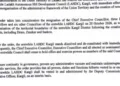
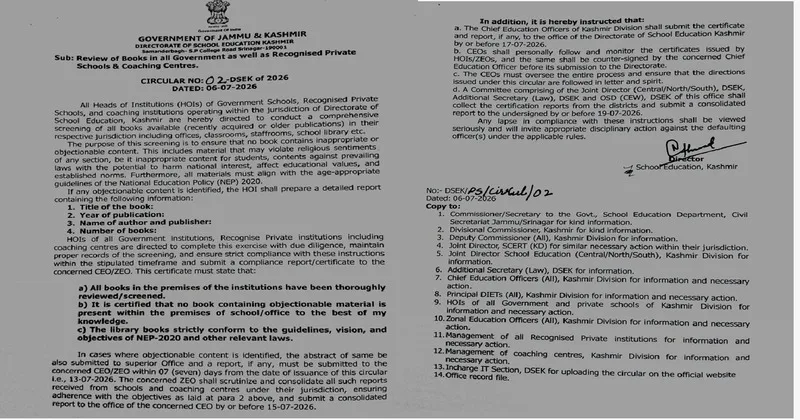
The Directorate of School Education, Jammu (DSEJ), has issued Circular No. 10-DSEJ-2026, directing the heads of all government and private schools as well as coaching institutes to conduct a thorough inspection of all books, both new and old, kept in offices, classrooms, staff rooms, and libraries. The Jammu and Kashmir government has clarified that no book should contain material that hurts religious sentiments, goes against national interests, violates prevailing laws, or contradicts educational values and the age-appropriate standards of the National Education Policy (NEP-2020).
If any objectionable material is found in a book, full details- including the title, author, publisher, number of copies available and the specific content, must be submitted to the concerned authorities within seven days. Clear timelines have been established for monitoring this process at both the district and divisional levels and a warning of disciplinary action has been issued against officials who fail to comply with these instructions. This order, which has reached approximately 10,787 government and 2,386 private schools, indicates that the government views this matter with the utmost seriousness.
Why did the government feel the need to take such a major step?
The backdrop to these events is a recent controversy that raised serious questions regarding the oversight mechanism of the education system. Allegations arose that two books procured for government school libraries glorified terrorists and separatist leaders. Upon the matter coming to light, the government immediately banned the books and recalled their copies; simultaneously, the police’s Counter-Intelligence Wing registered an FIR under the Unlawful Activities (Prevention) Act (UAPA) and initiated an investigation.
The government suspended eight officials, terminated the services of a contractual employee, blacklisted the concerned author and publisher and ordered a high-level inquiry into the entire procurement and approval process. The current directive to review books across all schools is seen as the next phase of that same course of action.
Which books sparked the controversy?
Two books became the center of the controversy: “Personalities and Legends of J&K” and “Great Personalities of Jammu and Kashmir.” These books portrayed separatist leaders and individuals linked to terrorism in a positive and inspiring light. The Jammu and Kashmir Peoples Forum (JKPF) claimed that these books had been supplied to government school libraries under the Samagra Shiksha scheme (2025-26). A government inquiry revealed that copies of these books had been distributed to schools across various districts, including Jammu, Ramban, Udhampur and Baramulla. Subsequently, orders were issued for the immediate recall of all copies.
Greatest controversy surrounding Maqbool Bhat and Hafiz Saeed
In the controversial books, Maqbool Bhat, the founder of the Jammu and Kashmir Liberation Front (JKLF), was portrayed using highly reverential epithets. Reports claim he was described as a “martyr”, a “great revolutionary of modern Kashmir,” and the “Father of the Nation of Kashmir.” Furthermore, the books allegedly referred to the “armed revolution” that began after his execution in a positive light.
Similarly, the inclusion of Hafiz Saeed, the mastermind behind the Mumbai terror attacks, amongst “great figures” came to light, further intensifying the controversy. If such individuals are glorified in school-level textbooks, the question naturally arises: what kind of image regarding history and the nation’s constitutional framework is being presented to students?
Questions raised over Pakistan-backed terminology
Controversy also arose regarding the use of terms like “Indian Occupied Kashmir (IOK)” and “Indian Held Kashmir (IHK)” in the books, terminology that has long been part of Pakistan’s official propaganda. Additionally, allegations were made that statements contradicting India’s constitutional position had been included.
Is education becoming a new battleground for ideological conflict?
Surendra Mishra, the Central and North Zone Organization Secretary of the ‘Purva Sainik Parishad’, who has served in Jammu and Kashmir for a long time, states, “In modern times, terrorism is rapidly spreading beyond violent activities to other spheres. When direct violence becomes difficult, extremist ideologies attempt to influence the new generation of society through education, literature, social media and cultural discourse. School libraries are considered highly sensitive areas because students accept the material available there as authentic knowledge”. He stated, “For this reason, the process of book selection cannot be limited merely to literary quality; it also involves considerations of factual accuracy, constitutional values, the National Education Policy and national security. This responsibility becomes even greater in a sensitive region like Jammu and Kashmir”.
The recent order for a comprehensive review of books across Jammu and Kashmir indicates that the government is unwilling to take lightly the possibility of any ideological infiltration into the education system. While the issue may have surfaced due to concerns regarding just two books, it is essential to uphold, at all costs, the trust in national unity that prompts parents to send their children to school. If the objective of education is to mold informed, responsible citizens who respect constitutional values, then ensuring the factual accuracy, impartiality and accountability of every book reaching schools is just as vital as providing quality education; consequently, this move by the Jammu and Kashmir government is being viewed as an effective step in the right direction.