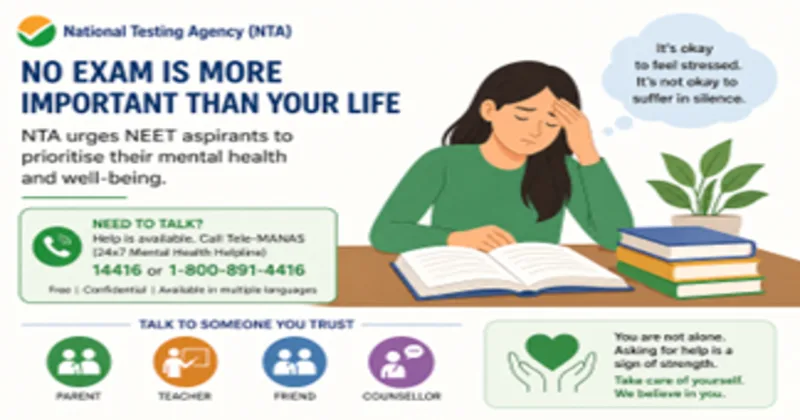
NEW DELHI: The National Testing Agency (NTA) has issued a public advisory urging students preparing for the NEET to prioritise their mental health and emotional well-being over exam performance. The message was shared on April 26, 2026. It comes at a crucial time when lakhs of aspirants across the country are under intense pressure ahead of one of India’s most competitive entrance examinations. The advisory carries a strong and clear message: “No exam is more important than your life.” With this statement, the NTA has attempted to shift focus from marks and ranks to the overall well-being of students, acknowledging the psychological strain that often accompanies high-stakes exams like NEET.
NEET is the gateway to medical education in India, and every year, millions of students compete for a limited number of seats in government and private medical colleges. This intense competition, combined with expectations from family, peers, and society, creates a high-pressure environment for aspirants. Many students spend years preparing, often sacrificing leisure, social interaction, and personal time. Recognising this reality, the NTA’s advisory openly addressed the stress, anxiety, and emotional challenges faced by candidates. It noted that such feelings are common but should not be ignored or suppressed. Instead, students are encouraged to acknowledge their emotions and seek help when needed.
https://twitter.com/NTA_Exams/status/2048254344638943355 )
Focus on Mental Health Support
As part of the advisory, the NTA highlighted the government’s mental health initiative, Tele-MANAS. This is a 24×7 national helpline designed to provide immediate psychological support to individuals experiencing stress, anxiety, or emotional distress. Students can access this free and confidential service by calling 14416 or 1-800-891-4416. The helpline offers counselling in multiple languages, ensuring accessibility for students across different regions of the country. By promoting Tele-MANAS, the NTA aims to ensure that no student feels isolated or unsupported during this critical phase.
One key point of the advisory is to encourage open communication. Students are encouraged to talk to someone they trust: be it a parent, teacher, friend, or counsellor. This is a crucial step to break the stigma around mental health, especially in academic environments where stress is often normalised.
The NTA says that asking for help is not a weakness but a sign of strength and self-care. It also reminds students that they are not alone and that support is always available. Traditionally, exam-related communication has focused primarily on preparation strategies, exam schedules, and performance expectations. However, this advisory marks a shift in approach by placing equal importance on mental health. By addressing emotional well-being directly, the National Testing Agency (NTA) is setting a precedent for other educational institutions and examination bodies.
In recent years, there have been multiple reports highlighting the psychological toll of academic pressure on students. People have repeatedly pointed out that unrealistic expectations, fear of failure, and lack of emotional support can lead to serious mental health issues. Against this backdrop, the NTA’s advisory will act as both a preventive measure and a call to action for students, families, and educators alike.
In addition, students should take self-care. This includes maintaining a balanced routine, getting adequate sleep, eating well, and taking short breaks during study sessions. Such practices can significantly improve focus, reduce stress, and enhance overall well-being.
The message shared by the NTA ends on a reassuring note: “Help is available. Take care of yourself. We believe in you.” These words aim to instill confidence and remind students that their worth is not defined by a single examination. By emphasising that life and mental health are more important than any exam, NTA has taken a compassionate and progressive step.
For students, the message is clear: success is important, but not at the cost of well-being. Seeking help, talking openly, and taking care of oneself are just as crucial as studying hard.