For decades Uttar Pradesh had lived under a maligned reputation, as India most ungovernable state, a state of lawlessness, communal strife and the nexus between crime and politics. The collapse of law and order over successive governments become endemic to the state political culture.
When the Samajwadi Party under Akhilesh Yadav swept to power in 2012, it did so with a promise of change. The young Chief Minister, Oxford-educated and politically savvy was seen as a breath of fresh air. For Five years that promise was fulfilled with riots, mafia patronage and a police force compromised by political interference.
In 2017, the Bharatiya Janata Party, led by Yogi Adityanath a mahant, a parliamentarian and a man with zero chief ministerial experience staked its claim on UP. What followed was one of the most positive changes in governance that any Indian state has witnessed ever. As Yogi Adityanath approaches the completion of two full terms as Chief Minister, in UP tumultuous political history. One should be aware of the changes.
The Akhilesh Era (2012–2017): Promise meets paralysis
Akhilesh Yadav inherited a state reeling from BSP misgovernance and won with an emphatic mandate. His government’s first few months were marked by cautious optimism. But the structural reality of SP governance dominated by the MY (Muslim-Yadav) alliance, patronage politics and interference in the police bureaucracy quickly reasserted itself.
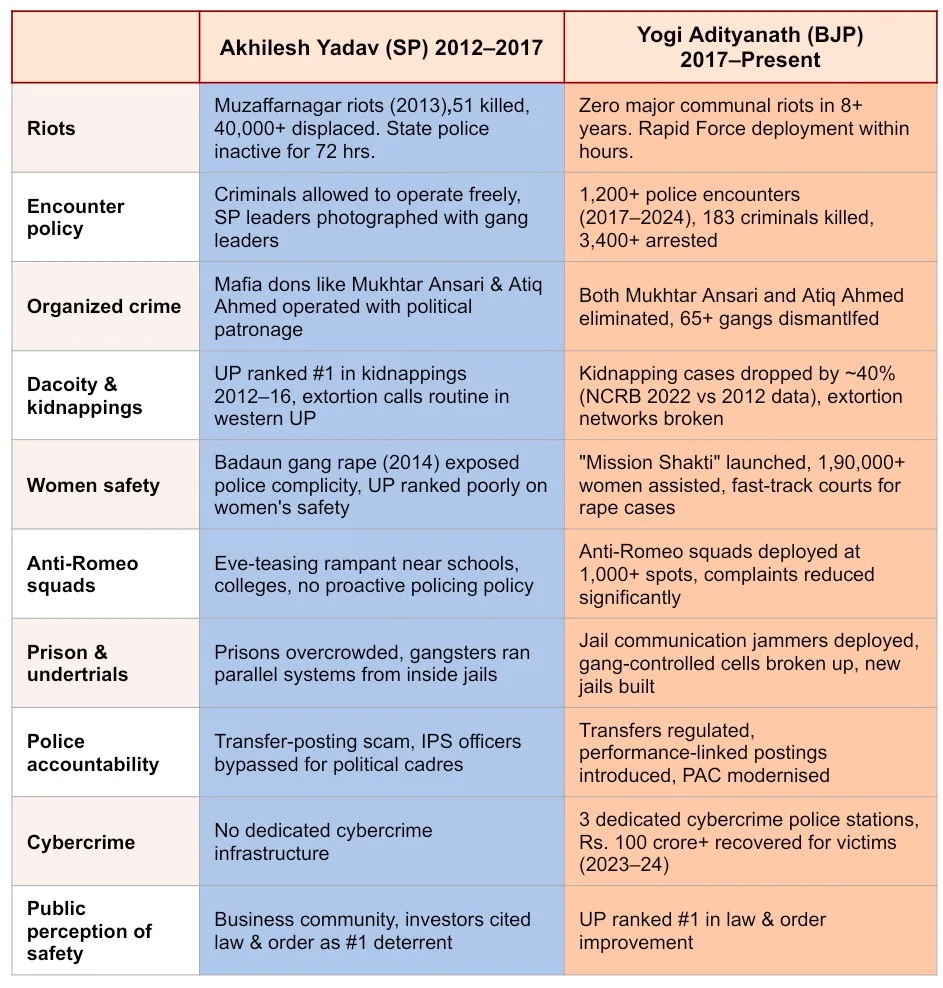
The Muzaffarnagar riots of September 2013 stand as the most damning act during the SP’s law enforcement record. Communal tensions, stoked by a local land and honour dispute, spiralled into full-scale riots over 72 hours. Fifty-one people were killed. Over 40,000 predominantly Muslim were displaced into relief camps as winter set in. What investigators and journalists documented was not just administrative failure, but deliberate inaction of the state police, compromised by political instructions, stood down as mobs rampaged.
Beyond Muzaffarnagar, the rot ran deeper. Mafia dons like Mukhtar Ansari and Atiq Ahmed both sitting legislators operated their criminal networks with near total impunity. Police transfers were openly sold. IPS officers who dared act against political interests were shunted out within weeks. Kidnapping, once a problem concentrated in specific regions of UP has become routine across the state’s western districts. The NCRB data for 2014 and 2015 consistently placed UP among the top two states in reported kidnapping cases nationally.
The law and order are most fundamental prerequisite for any other development, remained a critical failure. By 2017, UP’s business community consistently cited crime as their primary deterrent to investment. Voters of the Up were well aware of Mafia Raj.
The Yogi Era(2017–Present): Bulldozers & encounters are the new normal
On the day Yogi Adityanath was sworn in as Chief Minister, the phones of Uttar Pradesh most notorious criminals began going silent. Within days, the new CM had signalled that the rules had changed fundamentally and irreversibly.
The encounter policy became the most visible symbol of the Yogi government’s approach. Over 1,200 police encounters were conducted between 2017 and 2024. Critics including several human rights organizations, raised concerns about due process. But in a state where courts moved at glacial speed and bail was routinely converted into currency for criminals, the street-level message was clear the state would no longer be a bystander to crime.
The guiding philosophy behind Yogi Zero Tolerance Policy mirrors Lord Ram’s dharma in the Ramcharitmanas:
aparādhinha nisicara jani prānī, kara ḍārauṃ mahi kaṭhinu abhimānī||
अपराधिन्ह निसिचर जनि प्रानी, कर डारौं महि कठिनु अभिमानी॥
The innocent shall not be touched, while the wicked and arrogant will be eliminated. Just as Shri Ram had taken an oath to spare innocent creatures while punishing demons, Yogi Ji never harasses an innocent citizen while going after hard-core offenders relentlessly. This equilibrium of compassion and justice renders his leadership inherently dharmic.
The mafia dismantlement was perhaps the most politically significant achievement. Mukhtar Ansari, who had terrorised eastern UP for three decades and served as an MLA while in custody, died in judicial custody in 2024 broken, stripped of assets, his network in tatters. Atiq Ahmed was arrested, prosecuted across multiple cases and eventually killed by assailants while in police custody. Whatever one’s view of the circumstances, the symbolism was unmistakable that the nexus between crime and electoral politics had been publicly shattered.
Mission Shakti launched to provide women’s safety, deployed 1,90,000+ women into formal grievance redressal mechanisms and expanded fast-track courts for sexual crimes. Anti-Romeo squads initially mocked by liberal media as cultural policing, dramatically reduced eve-teasing incidents near educational institutions. The India Today State of States survey for 2023 ranked Uttar Pradesh first in law and order improvement among large states a verdict that would have seemed fantastical in 2016.
Law & Order Score card
The Deeper Question: Governance or majoritarian policing?
The Yogi government’s critics argue that the law and order narrative papers over a more troubling reality that policing in UP under BJP has been selectively aggressive, targeting Muslim criminals and communities while being softer on Hindu nationalist groups. The demolition of properties in the aftermath of riots and protests, often called “bulldozer justice,” has drawn objections from the Supreme Court, which issued guidelines in 2024 against arbitrary demolitions.
These are legitimate debates in a democracy. The Supreme Court’s intervention on demolitions is a necessary guardrail. But the comparison being made here is not with some ideal of liberal democratic policing, it is with the Akhilesh regime that directly preceded it. And on that comparison, the data says riots decreased, kidnappings declined, organised crime syndicates were dismantled. The average citizens women, the poor and those in Purvanchal who had lived under mafia terror for decades experienced a measurable improvement in everyday safety.
Akhilesh Yadav failure on law and order was structural, partly a failure of political will. Yogi Adityanath, by contrast, brought a different kind of political will and one unconstrained by the patronage calculus that had paralysed his predecessors.
There is a phrase that circulates among traders and businessmen in the lanes of Lucknow and Kanpur when asked about the change since 2017 “Pehle criminal darte nahin the, ab darte Hain” before, the criminals weren’t afraid, now they are. In a state where fear had for so long flowed in only one direction from citizen to criminal, the reversal is not nothing.
As Yogi Adityanath completes second tenure, what would historically be among the most durable Chief Ministerial tenures in UP post-Independence history, the law and order ledger is the most straightforward column to assess. The changed atmosphere on the ground confirms it. And the 2022 election in which voters returned BJP to power despite anti-incumbency pressures.