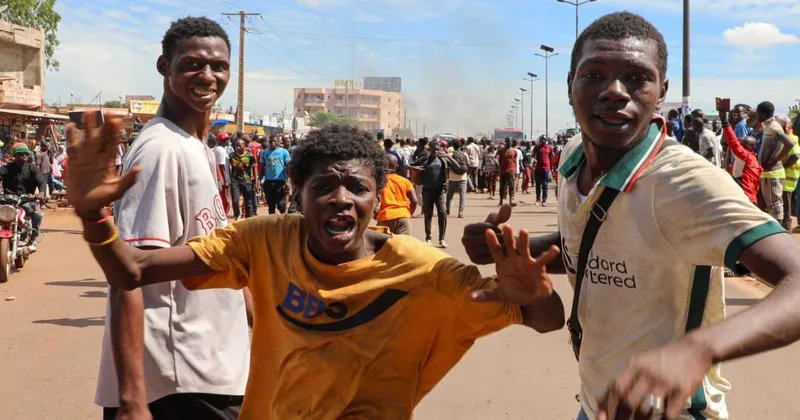
Bamako: A series of coordinated terrorist attacks in the West African country of Mali on the morning of April 25 has sharply intensified the country’s ongoing armed conflict with Islamic terrorism. The attacks were carried out simultaneously from the capital Bamako to the key cities of Sevare, Kidal, and Gao in the central and northern regions.
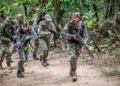
At around 6 a.m. local time, loud explosions and sustained gunfire were reported at a military camp near Bamako’s international airport and in the vicinity of the Kathi military base. The intensity of the attacks disrupted normal operations, with even passenger flights unable to take off. Initial indications suggest that the attackers primarily targeted strategic military installations where members of the Russian private military group Wagner Group are reportedly stationed.
Plumes of smoke rising from military facilities and the sound of continuous gunfire triggered widespread panic among residents. In response, the Malian armed forces swiftly launched counter-operations and sealed off major roads across the capital to establish a security cordon and prevent further infiltration.
Coordinated attacks and suspected perpetrators
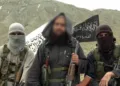
Although no group has officially claimed responsibility for the attacks, security agencies strongly suspect the involvement of the Islamic terror wing al-Qaeda-linked Jamaat Nusrat al-Islam wal-Muslimeen (JNIM). The presence of jihadist organisations remains a persistent and serious threat in Mali, complicating the country’s already fragile security environment. Mali is currently governed by a military administration led by Assimi Guetta, who came to power following coups in 2020 and 2021. Despite assurances of restoring stability, the security situation has continued to deteriorate, particularly in the central and northern regions where insurgent activity remains strong.
Further complicating the situation, intelligence sources indicate that the attacks may have been jointly carried out by JNIM along with the Asawad Liberation Front (FLA), an alliance of Tuareg rebel groups operating in northern Mali. A spokesperson for the FLA has reportedly claimed that the group now controls several strategic centres in the north, signalling an expansion of rebel influence.
Rising geopolitical tensions and security challenges
The attacks represent a significant challenge to the government of Assimi Guetta, whose military leadership had pledged to restore peace and stability. The inability to prevent such a large-scale assault, particularly one targeting the capital, is likely to fuel public discontent and could potentially trigger protests. Following the withdrawal of French military forces from Mali, the country has increasingly relied on Russian military support, particularly through the Wagner Group, to combat insurgency. However, recent developments indicate that this reliance may not be sufficient to address the dual threats of Islamic terrorism and separatist rebellion.
There are also emerging reports that Mali is attempting to revive military cooperation with the United States while maintaining its growing proximity to Russia. Notably, the attacks occurred at a time when Mali and the United States were reportedly preparing to sign an agreement that would allow American aircraft to conduct intelligence-gathering operations using drones. The timing of the attacks has therefore added a geopolitical dimension to the crisis, raising questions about Mali’s strategic alignment and future security partnerships. Analysts suggest that the country may be forced to reconsider its current approach and potentially seek broader international assistance.
The internal security situation in Mali is becoming increasingly complex, with overlapping conflicts involving jihadist groups, separatist rebels, and external military actors. Recent events highlight the limitations of relying solely on Russian support, as the Malian army continues to face simultaneous threats on multiple fronts. In the immediate aftermath, the military has significantly strengthened security measures in Bamako and surrounding areas. Authorities have urged citizens to remain indoors and avoid unnecessary travel. Meanwhile, the United States embassy has issued a security alert advising its citizens to exercise extreme caution.
As the situation unfolds, the international community is closely monitoring developments to assess whether Mali will escalate military operations, deepen foreign partnerships, or seek multilateral intervention to stabilise the country.