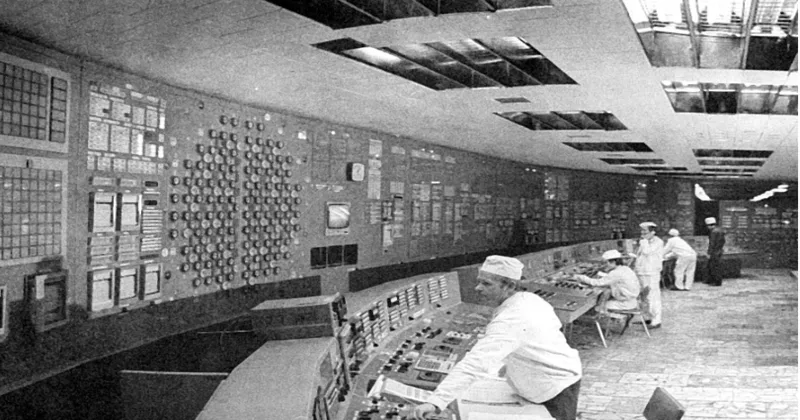
In the early hours of April 26, 1986, disaster struck at ground zero, the control room no. 4 of Chernobyl nuclear plant of the erstwhile USSR – Soviet Russia as it was then known.
It began as a routine safety test but quickly spiralled into the worst nuclear disaster in human history. Inside Reactor 4 of the Chernobyl plant (then a part of the Soviet Union, now in Ukraine), operators were attempting to simulate a power outage.
They wanted to find an answer to a simple but crucial question: Could the turbine’s residual momentum keep coolant pumps running long enough for backup generators to kick in?
The answer came in the form of two explosions at 1:23 a.m.
Within seconds, the reactor core was exposed, radioactive debris was hurled into the sky, and a fire began releasing deadly isotopes across Europe.
The science behind the meltdown
Chernobyl’s reactors were based on the RBMK (Reaktor Bolshoy Moshchnosty Kanalny) design, a Soviet innovation that differed fundamentally from reactors used in the West and in India.
The RBMK is a High Power Channel-type Reactor, is a Soviet-designed, graphite-moderated boiling water N-set-up. It uses individual pressure tubes instead of a single large pressure vessel, allowing for online refuelling, and uses lightly enriched uranium fuel. Key characteristics of it are a positive void coefficient, a large core size, and a lack of robust containment.
The reactor design was inherently flawed.
RBMK reactors were cheaper to build but unstable at low power.
Soviet engineers knew this.But rather than fix the issue, they buried it in classified documents.
The design flaw was a ticking time bomb.
(The RBMK reactor 👇) pic.twitter.com/OxKrBQAFtc
— Darshak Rana ⚡️ (@thedarshakrana) January 7, 2025
At its core was nuclear fission: splitting uranium atoms to release energy. But unlike “light water reactors,” the RBMK used graphite as a moderator and water only as a coolant.
That distinction proved fatal.
As steam formed inside the reactor, instead of slowing the reaction, as it would in Western designs, the RBMK reactor accelerated it. This phenomenon, known as a positive void coefficient, created a runaway reaction.
Worse still, the control rods, designed to stop the reaction, had graphite tips. When inserted, they initially increased reactivity before damping it.
When operators finally hit the emergency shutdown button, the reactor surged instead of stabilising. Seconds later, it exploded.
Human error meets design failure
The disaster wasn’t just about flawed engineering, it was also about flawed decisions. Operators violated safety protocols, ran the reactor at unstable low power, and removed too many control rods.
A less-experienced night shift took over mid-test, compounding the risks. But crucially, they were working within a system that encouraged compliance over questioning. In the Soviet Union (USSR), deadlines mattered more than quality checks.
Decades later, experts agree: Chernobyl was not a single mistake, it was a chain reaction of design flaws, poor training, and institutional secrecy.
Radiation without borders
The explosions released radioactive iodine, cesium, and strontium into the atmosphere.
On April 26, 1986, a single reactor accident at the Chernobyl Nuclear Power Plant sent a radioactive cloud across Europe.
— Science girl (@sciencegirl) February 9, 2026
The Soviet Union initially tried to suppress the scale of the disaster. But within days, radiation alarms sounded as far away as Scandinavia.
The world learned the truth not from Moscow, but from rising radiation levels in Europe.
The movement of the radioactive cloud after the Chernobyl disaster
— Science girl (@sciencegirl) February 11, 2026
Entire towns, including Pripyat, were evacuated. Over 100,000 people were displaced in the immediate aftermath, eventually rising to hundreds of thousands.
Firefighters who rushed in without protective gear absorbed lethal doses of radiation. Many died within weeks.
Health toll: What we know, and don’t
The immediate death toll was relatively low, two workers died in the explosion, and dozens succumbed to acute radiation sickness soon after.
But the long-term impact remains contested. A 2000 United Nations report found no broad rise in overall cancer mortality. However, it did confirm a significant spike in thyroid cancer among children exposed to radioactive iodine.
Other estimates, including those by activist groups, place the death toll far higher.
The truth likely lies somewhere in between, complicated by latency periods and incomplete data.
India’s nuclear lesson
For India, Chernobyl was a turning point.
India’s nuclear programme, overseen by entities like the Nuclear Power Corporation of India Limited, relies largely on Pressurised Heavy Water Reactors (PHWRs), which differ significantly from RBMK designs.
These reactors have
- Negative feedback mechanisms (safer under rising temperatures)
- Robust containment structures
- Strict regulatory oversight by the Atomic Energy Regulatory Board
Post-Chernobyl, India strengthened:
- Emergency preparedness protocols
- Operator training standards
- Reactor shutdown systems
The emphasis shifted from just generating power to ensuring fail-safe safety.
From fear to cautious revival
Despite Chernobyl, and later the Fukushima nuclear disaster in Japan (after a Tsunami triggered by a mid-ocean earthquake), nuclear power is making a comeback globally.
Today, nuclear energy supplies about 10 per cent of the world’s electricity. For countries like India, it offers a low-carbon alternative amid rising energy demand.
India plans to expand nuclear capacity significantly, aiming to balance climate goals with energy security.
But Chernobyl remains a cautionary tale: nuclear power is unforgiving of complacency.
A radioactive legacy
Today, the Chernobyl exclusion zone spans roughly 2,600 square kilometres, one of the most radioactive places on Earth.
Yet nature has returned. Wildlife roams abandoned towns. Forests reclaim concrete.
It is, paradoxically, both a graveyard of human error and a laboratory of ecological resilience.
Forty years on, Chernobyl still asks a fundamental question:
How safe is safe enough?