2008 Delimitation: How Congress tilted Kerala’s power to Malabar
September 20, 2026
  • Read Ecopy
  • Circulation
  • Advertise
  • Careers
  • About Us
  • Contact Us
Android AppiPhone AppArattai
Organiser
  • ‌
  • Bharat
    • Assam
    • Bihar
    • Chhattisgarh
    • Jharkhand
    • Maharashtra
    • View All States
  • World
    • Asia
    • Europe
    • North America
    • South America
    • Africa
    • Australia
  • Editorial
  • International
  • Opinion
  • RSS @ 100
  • More
    • World Hindu Congress 2026
    • Op Sindoor
    • Analysis
    • Sports
    • Defence
    • Politics
    • Business
    • Economy
    • Culture
    • Special Report
    • Sci & Tech
    • Entertainment
    • G20
    • Azadi Ka Amrit Mahotsav
    • Vocal4Local
    • Web Stories
    • Education
    • Employment
    • Books
    • Interviews
    • Travel
    • Law
    • Health
    • Obituary
  • Subscribe
    • Subscribe Print Edition
    • Subscribe Ecopy
    • Read Ecopy
  • ‌
  • Bharat
    • Assam
    • Bihar
    • Chhattisgarh
    • Jharkhand
    • Maharashtra
    • View All States
  • World
    • Asia
    • Europe
    • North America
    • South America
    • Africa
    • Australia
  • Editorial
  • International
  • Opinion
  • RSS @ 100
  • More
    • World Hindu Congress 2026
    • Op Sindoor
    • Analysis
    • Sports
    • Defence
    • Politics
    • Business
    • Economy
    • Culture
    • Special Report
    • Sci & Tech
    • Entertainment
    • G20
    • Azadi Ka Amrit Mahotsav
    • Vocal4Local
    • Web Stories
    • Education
    • Employment
    • Books
    • Interviews
    • Travel
    • Law
    • Health
    • Obituary
  • Subscribe
    • Subscribe Print Edition
    • Subscribe Ecopy
    • Read Ecopy
Organiser
  • Home
  • Bharat
  • World
  • Operation Sindoor
  • Editorial
  • Analysis
  • Opinion
  • Culture
  • Defence
  • International Edition
  • RSS @ 100
  • Magazine
  • Read Ecopy
Home Bharat

How Congress leveraged 2008 delimitation to tilt Keralam’s power balance towards Malabar and erode Southern Hindu clout

Keralam’s 2008 delimitation was not a neutral exercise but a calculated political shift that strengthened select regions and communities while weakening Hindu-dominated areas in the south. What Congress and INDI Alliance now call injustice elsewhere was the very blueprint it executed in Keralam, exposing a stark double standard in how it redraws power to suit its own political interests

Dr Vishnu AravindDr Vishnu Aravind
Apr 17, 2026, 10:00 am IST
inBharat, Kerala
Follow on Google News
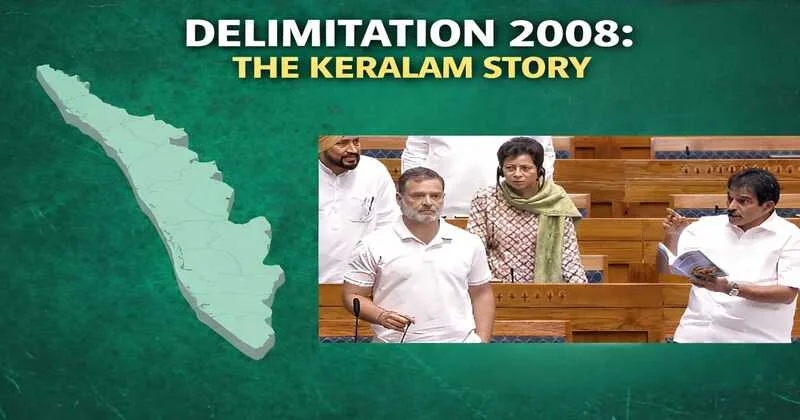
The 2008 delimitation carved a visible North–South divide in Keralam, concentrating power in Malabar while diminishing southern representation

The 2008 delimitation carved a visible North–South divide in Keralam, concentrating power in Malabar while diminishing southern representation

Facebook
Twitter
WhatsAppTelegramEmail

The debate around the 2026 women’s reservation and fresh delimitation has reignited a buried truth from Keralam’s political past,  the 2008 constituency delimitation carried out under the Congress-led UPA government. Marketed as a neutral, population-based exercise, the redrawing of constituencies in Keralam ended up decisively shifting political power toward northern districts, particularly Malabar, in favour of Congress- Muslim League-led UDF, while weakening the influence of southern regions with stronger Hindu and Christian populations.

Malabar Gains, South Loses: The unequal redistribution of power

The most striking outcome of the 2008 delimitation was the sharp increase in assembly seats in northern Keralam districts, especially those with significant Muslim populations. Malappuram witnessed the highest jump, with its seats increasing from 12 to 16, a gain of 4 seats. This district has a Muslim-majority population of approximately 70.24 per cent, with Hindus at 27.60 per cent and Christians at 1.98 per cent.  Kozhikode saw its seats rise from 12 to 13, an increase of 1 seat, where Muslims form  around 39 per cent. Palakkad’s seats increased from 11 to 12 (up by 1), with Muslims constituting 39% of the population. Wayanad’s representation went up from 2 seats to 3, adding another seat to the northern bloc. Kannur also gained, moving from 10 seats to 11, where  Muslims 29.43 per cent.

This systematic increase in northern representation effectively concentrated political power in Malabar, altering the electoral balance of the state. While Keralam overall has a demographic composition of approximately 54.73 per cent Hindus, 26.56 per cent Muslims, and 18.38% Christians as per 2011 census, the redistribution of seats tilted representation in a way that amplified certain regions disproportionately.

Southern Decline: Shrinking representation of Hindu-Christian regions

In stark contrast, the southern districts of Keralam,  historically marked by lower population growth but significant Hindu and Christian presence,  experienced a reduction in assembly seats.  Alappuzha lost two seats, where Hindus constitute 68.44 per cent and Christians 19.86 per cent. Kollam lost one seat, with Hindus at 64.42 per cent and Christians 18.66 per cent. Pathanamthitta lost one seat, where Hindus form 56.03 per cent and Christians 38.28 per cent. Kottayam lost one seat, with Hindus at 49.32 per cent and Christians 43.48 per cent. Idukki lost one seat, where Christians constitute 43.42 per cent and Hindus 48.86 per cent. Thrissur lost one seat, with Hindus forming 58.42 per cent and Christians 24.27 per cent.

These reductions were not mere statistical adjustments; they translated into a tangible erosion of political voice for these regions. The decline in representation meant fewer legislators, reduced influence in policymaking, and a long-term weakening of political bargaining power. The delimitation exercise, therefore, did not just redraw boundaries; it redrew the contours of political influence in Keralam. The Congress-led UPA government justified this as a population-based exercise, but the consequences clearly reveal a one-sided redistribution. Regions with lower population growth,  many of them Hindu-Christian dominated, were penalised, while high-growth regions gained disproportionate representation.

Also Read: Muslim Personal law under SC scanner: Supreme Court flags limits, seeks govt reply on 1937 act challenge

Silence Then, Outrage Now: Congress’s contradictions exposed

At the time of the 2008 delimitation, there was no significant opposition from the very political forces that now raise alarm over delimitation. The present-day Indi alliance, including Congress, the Muslim League, and CPI(M), remained silent when these changes were implemented in Keralam. There were no claims of injustice, no warnings of democratic imbalance, and no protests against the restructuring of political power. Today, however, the same Congress party alleges that delimitation linked to women’s reservation is a conspiracy against southern states. This sudden shift exposes a clear contradiction. The very party that executed a politically skewed delimitation in Keralam now attempts to portray itself as a defender of federal balance.

Prime Minister Narendra Modi, addressing the Lok Sabha, directly refuted what he described as false propaganda spread by Congress and its allies. He stated that claims of southern states losing out in future delimitation exercises are baseless and intended to mislead the public. According to him, such narratives are being pushed to divert attention from the historic implementation of 33% women’s reservation,  a reform long delayed.

The Reality of New Delimitation: Expansion, not reduction

Contrary to the fear-mongering, the facts presented by the government indicate that no state will lose representation. Instead, there will be a proportional increase of 50 per cent in the number of seats across all states. This ensures that political rights remain intact while expanding representation.

Union Home Minister Amit Shah provided detailed assurances in the Lok Sabha, stating that the number of Members of Parliament in southern states will rise significantly,  from 129 to 195. Tamil Nadu’s seats will increase from 39 to 59, Keralam’s from 20 to 30, and Karnataka’s from 28 to 42. In terms of proportional representation, Southern India’s share will slightly increase from 23.76 to 23.87. Tamil Nadu’s share will move from 7.18 per cent to 7.23 per cent. Keralam’s ratio will change marginally from 3.68 to 3.67, indicating stability rather than decline.

These figures directly counter the narrative of loss. Instead of reducing representation, the proposed delimitation expands it across the board while ensuring that women receive their rightful 33% reservation. Amit Shah also emphasized that the delimitation process will follow the same legal framework established during the UPA era. The rules currently in place were formulated and passed under the Congress-led government itself. Therefore, the present exercise is not a deviation but a continuation of an existing legal structure.

A pattern of political manipulation

The 2008 delimitation in Keralam reveals a pattern that cannot be ignored. Under the guise of administrative reform, the Congress-led UPA government implemented changes that concentrated power in specific regions while weakening others. The Hindu community, particularly in southern districts, found its political representation reduced as a result of these changes. Yet, despite these consequences, there was no outcry at the time. The silence then stands in sharp contrast to the loud opposition now. The same forces that engineered a politically advantageous delimitation are today attempting to create fear and confusion over reforms that promise broader representation.

The current debate is not about North versus South, but about transparency versus distortion. While the government proposes an expansion of representation and greater inclusion through women’s reservation, the opposition continues to rely on misleading narratives.

The reality is clear that the 2008 delimitation reshaped Keralam’s political landscape in a way that disproportionately affected Hindu-majority regions. Today’s reforms, however, aim to expand representation for all without reducing anyone’s share.

As the nation moves toward a more inclusive democratic framework, attempts to derail progress through misinformation are unlikely to succeed. The focus, as emphasised by the government, remains on strengthening democracy, ensuring fair representation, and empowering women, goals that stand in stark contrast to the selective and politically motivated restructuring witnessed in 2008.


 

Topics: Kerala electionsDelimitation 2008Malabar PoliticsWomen Reservation 2026indian politicsUPA governmentKeralam
Dr Vishnu Aravind
Dr Vishnu Aravind
Dr Vishnu Aravind is a researcher, political commentator and writer based in New Delhi, with a PhD from Jawaharlal Nehru University (JNU). His areas of interest include international politics, Indian foreign policy, electoral politics, election analysis, political developments, and cultural affairs. [Read more]
Share
Tweet
SendShareSend
✮ Subscribe Organiser YouTube Channel. ✮
✮ Join Organiser's WhatsApp channel for Nationalist views beyond the news. ✮
Previous News

Beyond the Tracks: PM Modi highlights data-driven railway transformation, safety improves by 89% in a decade

Next News

Delimitation Back in Focus: India prepares for major electoral realignment, electoral reforms ahead of 2026

Related News

512 people in Keralam embraced Sanatana Dharma in a Ghar Wapsi, reconnecting with their ancestral roots

Ghar Wapsi in Keralam: 512 people return to Sanatana Dharma in voluntary homecoming to their ancestral roots

Modi government steps in with 150 MW power relief for Keralam

Relief for power-cut hit Keralam: Modi govt allocates 150 MW from today amid Congress-CPM mismanagement in the state

The RSS has spent a century building influence through organisation, social networks and ideological formation beyond the electoral arena

RSS at 100: How the Sangh built a century-long network of influence beyond Indian politics

Representative Image

Marriage under Muslim Personal Law no shield against POCSO: Kerala HC refuses to quash case Involving 17-year-old wife

Augustine Brothers (inset)

Keralam: ED and SIT to probe Augustine Brothers over Rs 126 Cr deal after Nov ’25 Messi tour cancellation

The social cost of Gulf migration goes beyond money, as Islamic conservative social norms return to Keralam with migrant communities.

Keralam’s Gulf Money, Radical Return: World Bank study exposes how conservative Islamic norms come home with migrants

Load More

Latest News

BMS launches National Organisation for Digital Employees (NODE) for IT workforce; aims to strengthen employee welfare

GalaxEye’s US patent for OptoSAR marks a major boost for India’s private space sector, advancing its global Earth-observation ambitions

GalaxEye secures US patent for OptoSAR technology, boosting India’s private space and deep-tech ambitions

The arrested Bangladeshi national

Keralam: Series of Bangladeshi arrests raises questions over alleged support ecosystem of fake IDs, jobs and shelter

The Indian Army has launched AASHVAST to detect hidden software and electronic vulnerabilities in military drones

Indian Army strengthens drone security with AASHVAST lab to detect software vulnerabilities & Chinese components

Nileema Mishra’s grassroots work empowered women and helped transform more than 200 villages across Maharashtra

Nileema Mishra: The woman who transformed more than 200 villages across rural Maharashtra

Shree Stambheshwar Mahadev Mandir in Gujarat

Shiva Mandir that disappears into the sea and returns with the tide: The fascinating story of Stambheshwar Mahadev

Vishwa Hindu Parishad (VHP) spokesperson Surendra Jain (file photo0

VHP condemns Hamid Ansari over remarks citing Nehru on Hindu right-wing communalism

Ganesh murti visarjan incidents raise concerns over radical Islamic intolerance and law and order in Tamil Nadu

ABVP registers 3-0 win in Delhi University Students’ Union elections; wins president, secretary, joint secretary posts

Ganapati murti visarjan procession at T. Narasipura on September 18

Karnataka: Ganapati procession follows approved mosque route in T Narasipura amid allegations of police high-handedness

Load More
  • Privacy
  • Terms
  • Cookie Policy
  • Refund and Cancellation
  • Delivery and Shipping

© Bharat Prakashan (Delhi) Limited.
Tech-enabled by Ananthapuri Technologies

  • Home
  • Search Organiser
  • Bharat
    • Assam
    • Bihar
    • Chhattisgarh
    • Jharkhand
    • Maharashtra
    • View All States
  • World
    • Asia
    • Africa
    • North America
    • South America
    • Europe
    • Australia
  • Editorial
  • Operation Sindoor
  • Opinion
  • Analysis
  • Defence
  • Culture
  • Sports
  • Business
  • RSS @ 100
  • Entertainment
  • More ..
    • Sci & Tech
    • Vocal4Local
    • Special Report
    • Education
    • Employment
    • Books
    • Interviews
    • Travel
    • Health
    • Politics
    • Law
    • Economy
    • Obituary
  • Subscribe Magazine
  • Read Ecopy
  • Advertise
  • Circulation
  • Careers
  • About Us
  • Contact Us
  • Policies & Terms
    • Privacy Policy
    • Cookie Policy
    • Refund and Cancellation
    • Terms of Use

© Bharat Prakashan (Delhi) Limited.
Tech-enabled by Ananthapuri Technologies