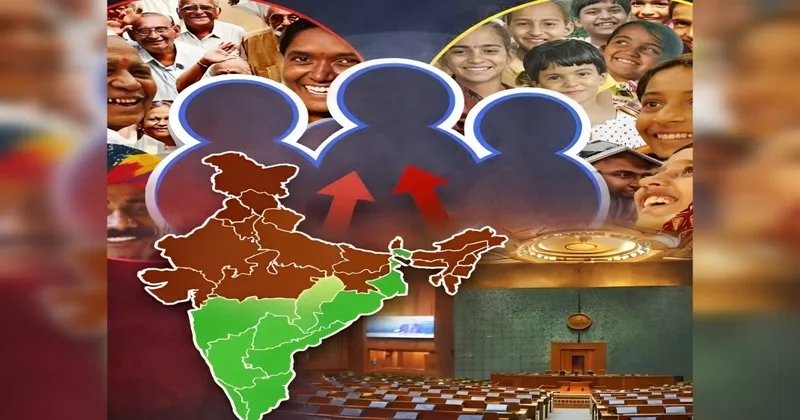
Bharat is once again at a crucial moment in its journey to democracy. The Centre’s step to introduce the Constitution (131st Amendment) Bill and the Delimitation Bill, 2026, during a special session of Parliament from April 16 to 18 has brought the issue of delimitation back into the focus of all Indians. Though often seen as a technical or administrative exercise, delimitation has deep political consequences. It shapes how citizens are represented, how power is distributed among states, and how democracy functions in practice.
To understand why this issue is so important today, it is necessary to look at how delimitation was carried out earlier, what paused it, and what challenges lie ahead.
What Delimitation Means and Why It Matters
Delimitation literally means a process or act of fixing limits or boundaries in election areas (constituencies) so that each area has roughly equal population and fair representation. In simple terms, it ensures that each elected representative, whether a Member of Parliament (MP) or a Member of Legislative Assembly (MLA), represents roughly the same number of people.
The basic idea behind this process of delimitation is fairness. In a democracy, every citizen’s vote should carry equal weight. This principle is often described as “one person, one vote, one value.” If one constituency has 10 lakh people and another has only 5 lakh, then the vote of a person in the smaller constituency effectively carries more influence. The work of delimitation is to correct such imbalances.
India’s Constitution provides the legal foundation for this exercise. Articles 82 and 170 require that constituencies be adjusted after every Census. These rules make sure that representation stays fair as population changes, while also keeping in mind area size, geography, and existing boundaries. Without regular delimitation, fast-growing areas would become underrepresented, while regions with stable populations would enjoy relatively greater influence. Over time, this would distort democratic fairness.
How Delimitation works in Bharat?
A structured and transparent system for delimitation is followed in India to reduce political interference. The process starts only after the Census is completed. First, Parliament passes a Delimitation Act. Based on this law, the central government sets up a Delimitation Commission. This commission is an independent body, usually chaired by a retired Supreme Court judge. It also includes the Chief Election Commissioner (or another Election Commissioner) and State Election Commissioners as members.
The Commission’s main work is to:
● Redraw constituency boundaries
● Allocate seats for Scheduled Castes (SC) and Scheduled Tribes (ST)
● Ensure constituencies are balanced in population
The Commission uses Census data as its base. It then publishes draft proposals and invites objections from the public. Public hearings are held in different regions to ensure transparency and participation. Once the process is completed, the Commission issues final orders. These orders have the force of law and cannot be easily challenged in court. This ensures that delimitation is done smoothly without long political or legal fights.
History of Delimitation: Early Years After Independence
In the decades following Independence, delimitation was carried out regularly and without major controversy. Bharat established four delimitation Commissions in 1952, 1963, 1973, and 2002 respectively.
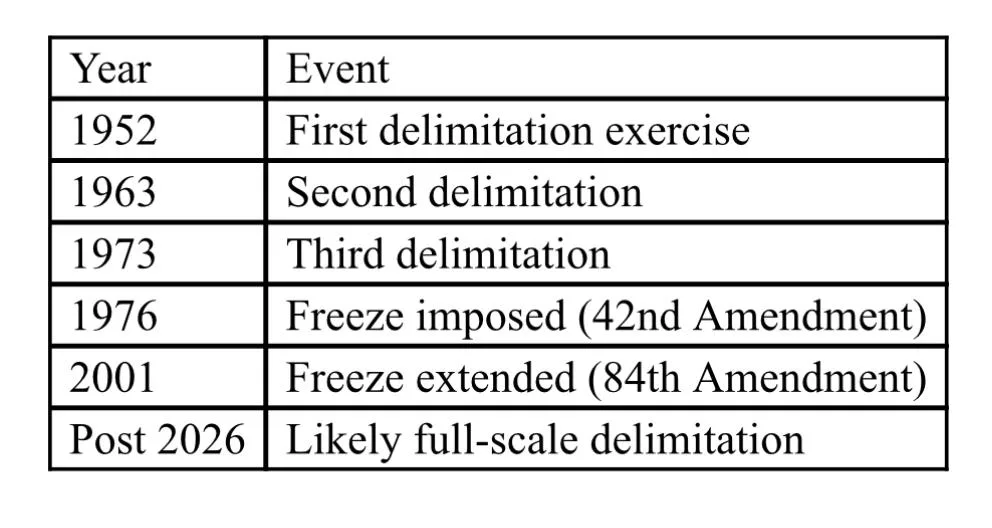 1951 Census: The first exercise in 1952 was based on the 1951 Census. At that time, India was still building its democratic institutions, and delimitation was seen as a routine requirement.
1971 Census: By the time of the 1973 Commission, which used data from the 1971 Census, the structure of representation had become more stable. The strength of the Lok Sabha was effectively fixed at 543 seats. During this period, delimitation had only two main tasks: first, to redraw boundaries within states, and second, to reallocate the Lok Sabha seats among states based on population. For example, northern states (like UP, Bihar, MP, Rajasthan) with higher population increases had their representation increase, while southern states ( like Tamil Nadu, Kerala, Karnataka) with slower growth received fewer seats. At that time, this system was considered fair because it directly reflected demographic realities.
The situation changed dramatically in the 1970s when India was facing a population explosion. The government had launched aggressive family planning programmes to control population growth. However, a serious concern emerged. Since parliamentary seats were linked to population, states that successfully controlled their population (mostly in southern India) feared losing seats. On the other hand, states with higher population growth (mainly in northern India) would gain more seats. This created a political and ethical dilemma. Should states be “punished” in this way for successfully implementing national policies like family planning?
To address this issue, the government at that time, led by Indira Gandhi, introduced the 42nd Constitutional Amendment in 1976. This amendment froze the allocation of Lok Sabha seats among states based on the 1971 Census. This is how delimitation was frozen, and it became a turning point. The freeze fixed the number of seats for each state, meaning population changes no longer affected how many representatives a state gets. This protected states, especially those that controlled population growth, from losing political influence.
2001 Census: By the time India approached the 2001 Census, the gap in population growth between states had widened even further. If the freeze had been lifted at that point, the redistribution of seats would have been drastic. To avoid political instability, the government passed the 84th Constitutional Amendment in 2001. This extended the freeze on seat allocation until the first Census conducted after 2026. However, some changes were allowed. The Delimitation Commission, which was set up in 2002, could redraw constituency boundaries within states and update reserved seats for SCs and STs, but it could not change the total number of seats given to each state. Delimitation continued within states, but not between them.
Current Debate: What Lies Ahead
With the proposed Constitution (131st Amendment) Bill and the Delimitation Bill, 2026, India is revisiting this long-pending issue. If the freeze is lifted after 2026, the impact could be big i.e., the northern states with higher populations may gain more seats, while southern states may see their share reduce, which will ultimately change the balance of power in Parliament. This has raised concerns, especially in southern states, about losing influence despite better performance in areas like population control, education, and healthcare. Whereas, supporters of delimitation say that representation must show the current population realities. Thus, the challenge lies in designing a system that is both democratic and politically acceptable.