
Even those countries that are not involved in the continuing hostilities in West Asia, are experiencing distress as a result of the unrest. Lack of fuel is one of the many problems that many non-warring nations are dealing with. The world is in jeopardy because the warring nations have lost the importance of moral diplomacy for their own self-interest. With over 1.4 billion people and a massive need for petroleum, fertilizers and other related supplies, the central government of Bharat is effectively handling a number of difficulties through diplomatic channels in the midst of this global upheaval and panic. The diplomatic ideals established by Bhagwan Shri Krishna and Shri Hanuman form the foundation of the government’s approach to diplomacy. Let’s comprehend outstanding supreme souls’ diplomacy.
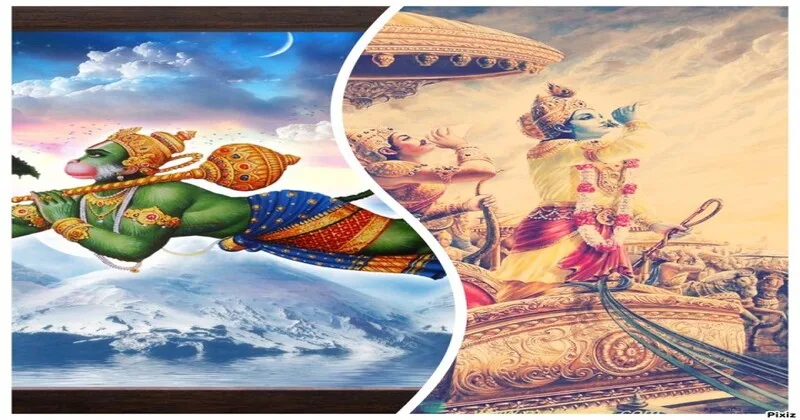
It is historically incorrect to believe that diplomacy and the study of international relations started in the West. The first Bharatiya diplomat and undoubtedly one of the first in world history was Shri Hanuman. He was also Bharat’s finest ambassador. At Ravana’s court, he skillfully advocated for Ma Sita’s release; when Ravana attempted to burn Shri Hanuman, burning of entire Lanka was the outcome. As a result, Bharat’s first ambassador was extremely strong.
The diplomacy of Bhagwan Shri Krishna and Shri Hanuman are two different but complimentary master lessons in ethics, negotiations and strategic communication. Bhagwan Krishna used diplomacy to prevent a conflict from breaking out. Hanuman used diplomacy to get ready for battle. Both provide us with guidance, a method of thinking and the actions that are required in light of the current circumstances based on Dharma.
Bhagwan Shri Krishna’s diplomacy
Extreme accommodation: The epitome of world politics and diplomacy is the diplomacy of Shri Krishna in the Mahabharata. He attended the Hastinapur court to learn a crucial lesson in resolving disputes. After Duryodhana rejected his initial request for a half kingdom for the Pandavas, Bhagwan Krishna just asked for five villages. This is a diplomatic strategy known as “extreme accommodation,” which involves offering an offer so reasonable that the opponent believes it is unreasonable to turn it down.
This is the bracketing approach, a traditional negotiation strategy. He deprived the Kauravas of any moral superiority by beginning with the demand of a half-kingdom and settling for only five villages. Krishna signaled to the world that Kauravas are immoral, avaricious, lone aggressors, and conceited when Duryodhana rejected even that.
The influence of proximity: Instead of staying at the Dhritarashtra royal palace, Krishna stayed at the home of Vidur, a man of greater integrity. This was a symbolic diplomatic rebuff to Duryodhana, indicating that riches cannot purchase Krishna. His behavior made it very evident to Duryodhana that Krisha would not be subjugated or controlled in any way.
Dissension in strategy: After the peace effort failed, Krishna turned to Duryodhana’s most powerful pillar and asset, Karna. He told him about his true ancestry not only out of compassion but also to sow discord in the enemy’s camp. Without shooting a single arrow, the opponent’s team might be weakened using this kind of soft power.
Multi-alignment and neutrality: Krishna gave both sides an option prior to the battle: either his army or Krishna, who was also unarmed. He continued to serve as a non-combatant mentor, demonstrating how a diplomat might affect a conflict’s result without taking the lead in hostilities.
Track II diplomacy: Krishna conversed with the elders Bhishma, Drona, and Vidur in addition to the Duryodhana. This strategy, known as “track II diplomacy”, aims to sway the decision-maker by persuading and winning over the other cabinet members.
Shri Hanuman’s diplomacy
Building the faith: By reiterating Rama’s virtues, he first won Ma Sita’s faith. Hanuman believes that the first stage in diplomacy is to build a bridge of psychological safety.
The power of restraint and respect: Despite his capacity to save Ma Sita, he accepted the “sovereignty” of Rama’s promise. He came to see that a diplomat’s job is to complement the principal’s objective, not to overshadow it.
Finding the Strength of the Enemy: Hanuman’s approach in the Ramayana is often categorized as prudential diplomacy. His objective in Lanka was not just to convey a message but also to assess the enemy’s power. Before exhibiting his power, Hanuman addressed Ravana as a scholar. He referenced the Vedas and reminded Ravana of the laws of kingship.
This demonstrated the moral superiority of his side. After completing the primary task of locating Ma Sita, Hanuman desired to evaluate King Ravana’s military prowess. With the goal of confronting the troops (guarding the Vatika) in a display of power, he used his presence of mind to begin harming Ashok Vatika. In fact, Hanuman was too powerful and unbeatable for the warriors.
After learning of the soldiers’ defeat, King Ravana requested that his son Meghnath travel to Ashok Vatika. Following a short battle, Meghnath seized Hanuman and took him to King Ravana’s court. Hanuman’s presence of mind, which allowed him to face Ravana and gauge his power by not resisting his capture, is crucial to note once more.
He committed “Signaling” by allowing himself to be captured and then igniting Lanka. He demonstrated that if a mere messenger could cause such devastation, the army as a whole would be unstoppable. Hanuman agreed to be bound by the Brahmastra. In diplomacy, this is referred to as “strategic submission”. By letting the enemy “capture” him, he was able to gain a front-row seat in Ravana’s court, assess the palace defenses, and communicate directly with the head of state. This was a diplomatic demonstration of power.
When Hanuman confronted Ravana in his court, he proudly declared himself to be Ram’s obedient servant. Without hesitation, Hanuman recounted the magnificence of Bhagwan Ram. He tactfully advised Ravana to set Ma Sita free and ask Ram for forgiveness. Ravana was enraged by such remarks. To exact revenge on Hanuman for his haughty remarks in court, he ascended off his throne.
As Ram’s representative, Hanuman was able to accurately assess Ravana’s fury, tantrums, demeanor, mental state and power. Hanuman noticed that Vibhishan, Ravana’s younger brother and one of his ministers and courtiers, was not like the others. Vibhishan told his brother that it is against King Ravana’s moral obligation to kill an ambassador. Following his brother’s advice, Ravana gave the order to punish Hanuman for his disobedience, insult and invasion of Lanka.
Modi government’s diplomacy
We are seeing that NSA Ajit Doval, EAM Dr. S. Jaishankar and PM Modi’s diplomacy aligns with that of Krishna and Hanuman. The multifaceted globe with its intricate web of relationships and self-interest makes diplomacy extremely challenging. Nonetheless, even in the most dire circumstances, PM Modi and his team have maintained the ideal balance in foreign policy and diplomacy with a nation-first mindset and humanism at their core.
The American foreign policy journal has acknowledged that “Bharat has the best opinion” in the current unrest in West Asia. We are managing the fuel and fertilizer situation more effectively, especially in the face of crises in developed and small countries with minimal needs while still providing humanitarian aid to other countries.
During the difficult times of the coronavirus, the PM Modi government demonstrated ethical diplomacy by providing vaccines to numerous impoverished countries. Bharat assisted the evacuation of Americans, Europeans and Muslims from conflict areas such as Syria, Russia, Ukraine and others. Bharat supported many countries during natural disasters and continues to provide medical assistance to Iran and Afghanistan.
As a result, when Bharat needs fuel, nearly all fuel-supplying countries support us. Iran is assisting us through the Strait of Hormuz because every country trusts our moral diplomacy, despite the fact that Iran and Israel are the fiercest rivals. Controlled escalation via Operation Sindoor demonstrated the power of India’s military forces and defense system, which integrated both foreign and indigenous technologies in a very complex manner. The diplomacy made it apparent that while we do not intend to go to war, the world has witnessed our strengths through this controlled escalation and what we have accomplished.
Since Sanatan dharma-based diplomacy is the answer to every problem the world faces, people everywhere must turn their heads with an open mind and heart in order to comprehend and find solutions using Sanatan-based ethical diplomacy for various situations in order to uphold dharma and improve humanity.