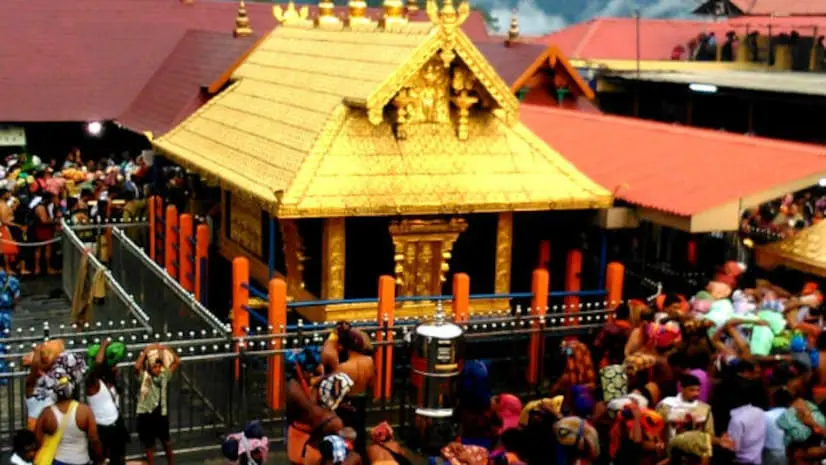
The Supreme Court of India on April 8, commenced hearings in the long-pending review petitions concerning the Sabarimala Temple entry issue, revisiting one of the most debated constitutional and religious questions in recent years. The matter is being heard by a nine-judge Constitution Bench led by Chief Justice of India Surya Kant.
At the centre of the proceedings lies a complex legal and philosophical debate over the balance between constitutional guarantees of equality and the autonomy of religious denominations to preserve their traditions.
Appearing for the Union government, Solicitor General Tushar Mehta presented a strong defence of the temple’s practices, arguing that the Sabarimala issue is intrinsically linked to the very nature and attributes of the deity, Lord Ayyappa.
He told the bench that such matters fall outside the scope of judicial examination. According to him, courts must exercise restraint when dealing with deeply embedded religious beliefs that are integral to a denomination’s identity. He argued that attempting to apply constitutional tests to such practices risks overlooking the unique theological foundations on which they are based.
The Centre’s submission essentially framed the issue not as one of discrimination or exclusion, but as a question of preserving a distinct religious tradition tied to the character of the deity itself.
A key argument advanced by the Centre was that the Sabarimala practice is “sui generis,” meaning it is unique and cannot be compared with other cases or broadly applied constitutional doctrines. The restriction, which relates to a specific age group of women, was described as a practice rooted in the temple’s long-standing traditions associated with the celibate nature of Lord Ayyappa.
By calling the case sui generis, the Centre sought to distinguish it from general questions of gender equality or social exclusion, asserting that the practice is not a manifestation of discrimination but a reflection of a particular religious belief system.
This line of argument challenges earlier interpretations that framed the issue within the broader framework of fundamental rights, especially equality under Article 14 and religious freedom under Articles 25 and 26 of the Constitution.
The Constitution Bench, which includes Justices Joymalya Bagchi, BV Nagarathna, R Mahadevan, MM Sundresh, Ahsanuddin Amanullah, Aravind Kumar, AG Masih and Prasanna B Varale, is tasked with examining wide-ranging constitutional questions.
These include the extent to which courts can intervene in religious practices and whether all such practices can be subjected to fundamental rights scrutiny. The court is also examining the interplay between individual rights and collective religious freedoms, particularly in cases involving denominational practices.
The outcome of this case is expected to have significant implications not only for Sabarimala but also for similar disputes involving religious customs across different faiths in India.
During the hearing, the Centre strongly objected to attempts to equate the Sabarimala issue with untouchability under Article 17 of the Constitution. It argued that such comparisons are legally and conceptually flawed, as the temple practice does not involve caste-based exclusion.
Solicitor General Mehta emphasised that not every religious practice can be tested solely on the grounds of individual dignity or personal freedom. He illustrated this by referring to practices at other places of worship, such as covering one’s head at religious sites, suggesting that such customs are accepted as part of religious discipline rather than viewed as infringements of rights.
As the hearings continue, the Supreme Court is expected to delve deeper into the constitutional questions raised by the case. The judgment, whenever delivered, will likely set a precedent for how courts approach conflicts between religious customs and fundamental rights in the future.