
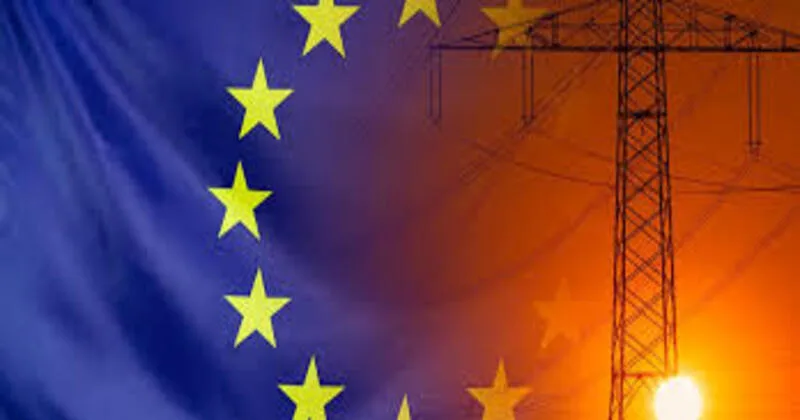
If one looks at Europe’s energy system from a distance, it appears almost elegant. Nuclear reactors hum across France, pipelines stretch through Eastern Europe, oil tankers move steadily across seas and wind farms line the northern coasts. For decades, this system gave Europe a quiet confidence that its energy future had been secured.
Europe built a sophisticated energy system without controlling the resources that sustain it. The European Union today imports nearly 60 percent of the energy it consumes, making it one of the most import-dependent economic blocs in the world. It lacks significant domestic oil and gas reserves and even its nuclear programme depends on uranium sourced from outside its borders. What Europe created was not energy independence, but a complex web of dependence spread across regions assumed to be stable.
That assumption, however, has collapsed rather quickly. Over the past few years, Europe’s energy system has been shaken from multiple directions at once. The disruption did not come from a single source, but from a wide arc stretching from the Sahel region of Africa to Eastern Europe and now to the Middle East.
For starters, the Sahel region remained peripheral in global discussions, associated more with instability than strategy. Yet countries of the Sahel region quietly became central to Europe’s nuclear energy supply chain. A significant portion of uranium feeding European reactors originated from this region. France,
which generates the majority of its electricity from nuclear power, was particularly dependent on these flows, accounting for approximately 15-20 per cent of Europe’s nuclear power output. French companies operated major mines in the region and uranium shipments travelled north toward European fuel-processing facilities. It was a quiet, situational relationship, rarely discussed in the headlines,
but strategically very important.
However, this fragile stability began to erode after 2020. Military coups in the countries constituting the Sahel region, such as Mali, Burkina Faso and eventually Niger, disrupted political continuity. New regimes questioned older hegemonic agreements, pushed out the French military presence and began reasserting control over natural resources, followed by the expansion of Russia’s security footprint and China’s deepening economic presence through infrastructure and mining investments. What was once considered a constant in Europe’s energy security framework became a destabilising variant. At roughly the same time, Europe’s gas architecture also began to fracture.
For decades before the Russia-Ukraine war, Russian natural gas formed the backbone of Europe’s industrial economy, with a substantial share flowing through pipelines crossing Ukraine. The war in 2022 changed that equation overnight. Infrastructure was damaged, flows were disrupted and political trust
collapsed. What Europe had long treated as a stable energy corridor became a conflict zone.
The consequences were immediate. Russian gas imports dropped sharply, forcing Europe to search for alternatives in a rapid, costly scramble. Much of that gap was filled by the Liquefied Natural Gas(LNG), particularly from the United States. Making US LNG exporters unique beneficiaries of the Russian-Ukrainian war, adding billions to the US treasury chest. In a matter of months, Europe replaced one dependency with another, this time routed across the Atlantic rather than through pipelines. The system adjusted, but at a price. Energy costs surged and parts of Europe’s industrial base slowed down under the pressure.
Despite tall claims by the EU, followed by virtue-signalling to the rest of the world to move toward renewables, oil continues to dominate transport, aviation and industry in the European Union. A significant portion of that oil comes from West Asia, passing through narrow maritime chokepoints such as the Strait of Hormuz. Roughly a third of global seaborne oil flows through this corridor. Any disruption, whether political or military, has immediate global consequences.
For Europe, this means that events in distant waters can translate directly into domestic economic stress. Taken together, these developments point to something larger than a temporary crisis. Europe’s energy model was built on the assumption that global supply chains would remain stable, that political risks
would be manageable and that distant regions would continue to function as reliable extensions of its economy.
Control over minerals, pipelines, shipping routes and infrastructure is no longer just an economic question. It is a strategic one. Russia, China, the United States and regional powers are all actively positioning themselves across these networks, not just to supply energy, but to shape influence. And perhaps that is the real lesson of this crisis. Energy security was once treated mostly as a technical
problem of infrastructure and markets. Today, it has returned to what it always really was: a matter of geopolitics, geography, power and unending lust of Superpowers.
Therefore, it is also a lesson for India, a lesson to be bold, to invest in bold ideas, invest in strategic energy autonomy. But sadly, the problem with the fruition of this statement “Strategic Energy Autonomy” lies in India’s lethargic bureaucracy, which has completely misunderstood and misinterpreted the very idea, reducing it to a meagre diversification of energy dependence onto the shoulders of various energy players across the geopolitical chessboard.
Rather than developing energy insulation with the means available in its own backyard, the Indian Babudom still fantasises about tiptoeing its way through the mercy of superpowers, naming it a great diplomatic success while, in reality, being exposed to the elements of geopolitical weather the entire time.
For instance, countries like China are already taking steps toward achieving energy insulation; their tryst with green methanol is one such example. The Guangdong Bio-Methanol Project Biomass to Methanol), reportedly operational in 2025, is already producing around 40,000 tonnes per annum, with plans to scale
it to 2.5 lakh TPA by 2027. Similarly, the Buzzbord Sustainable Aviation Fuel is another important milestone, with countries like Singapore already producing around 1 million tons of green aviation fuel from diverse feedstocks such as used cooking oil. Concomitantly, Japan and Malaysia are also on the same path.
In terms of India, it has a unique advantage: the blessings of abundant biomass that is not only resilient and indigenous but also replenishes itself with every little effort. With the right bureaucratic attitude, it can potentially become the gamechanger India needs to shield itself from geopolitical storms. Green Gold or bamboo, which is abundant across the North-Eastern parts of India, can serve as feedstock biomass for a never-ending supply of Green Methanol, provided India wakes up to the will to implement.
Although a more hypothetical assumption, had India implemented something like this a decade ago, India could have become a net exporter of cooking gas(Methanol–DME), at least to its friendly neighbours, instead of today rationing LPG after the unprecedented Middle East crisis. India has the raw materials it needs, the human resources to work with and the potential to scale up; all it needs is the administrative will to break the orthodox, archaic thought process and make the bold move.