The question of whether Hindutva is merely a political ideology or something deeper has been widely debated in modern India. For some, it appears as a political doctrine associated with contemporary movements and governance. For others, it reflects a much broader civilizational identity rooted in India’s long intellectual and cultural history. To understand this debate properly, it is important to look beyond present day politics and examine the historical and philosophical context in which such ideas evolved.
A key source of confusion lies in how Indian traditions were interpreted during the colonial period. European scholars and administrators approached India with their own understanding of religion, shaped largely by the structure of Christianity, defined by a single scripture, a central authority and fixed doctrines. When they encountered the Indian civilizational landscape, they tried to fit it into the same framework. This lead to the classification of diverse Indian traditions under the single label of Hinduism, often treating it as a religion similar to those of the West.
However, Indian thought has traditionally operated with a much wider conceptual framework. The Sanskrit term dharma, often translated as religion, actually encompasses duty, ethics, law and the natural order of life. Similarly, the Vedic idea of ‘ṛta’ refers to the cosmic rhythm that sustains the universe. These concepts do not align neatly with the Western definition of religion as a system of belief. Instead, they represent a holistic worldview that integrates philosophy, ethics, science and social life.
Colonial attempts to categorize Indian traditions had lasting consequences. Census classifications, administrative policies and missionary narratives gradually transformed fluid cultural identities into rigid religious categories. Practices that were once interconnected, such as philosophy, medicine, music and spirituality were separated and often misunderstood. This process also contributed to the perception that Indian knowledge systems were primarily religious or even superstitious, overlooking their scientific and rational dimensions.
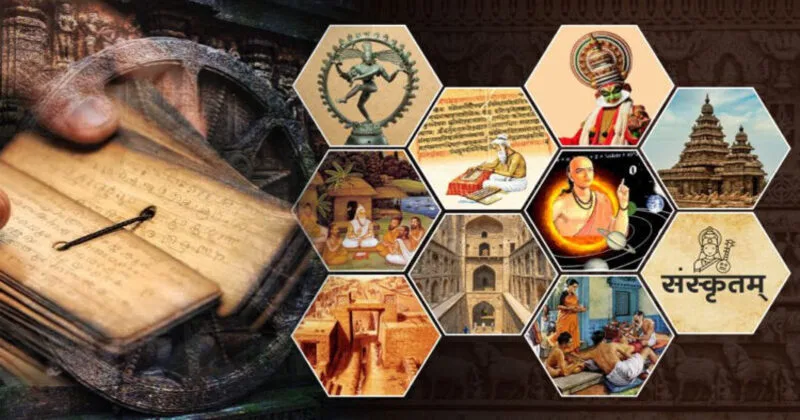
In reality, ancient Indian civilization produced significant contributions to various fields of knowledge. Systems like Nyaya developed formal logic, while Vaisheshika explored atomic theory and categories of matter. Ayurveda approached health through observation, diagnosis and holistic balance. Astronomy was advanced enough to calculate planetary motions and eclipses with remarkable accuracy. These traditions demonstrate that what is often labelled as religion in the Indian context was deeply intertwined with scientific inquiry and philosophical reflection.
During the freedom struggle, this broader understanding of Indian civilization became a source of intellectual and cultural strength. The movement for independence was not only political but also civilizational, it sought to restore confidence in India’s knowledge systems and ways of life. Thinkers and leaders drew upon India’s philosophical traditions to counter colonial narratives of inferiority.
Swami Vivekananda, for example, emphasized the compatibility of Indian philosophy with modern science. He argued that both sought truth, albeit through different methods. Mahatma Gandhi, through his emphasis on swadeshi and the symbolic use of the spinning wheel, highlighted the importance of self-reliance and indigenous technology. Institutions like Banaras Hindu University and the Indian Institute of Science were established to bridge traditional knowledge with modern scientific education.
In this context, what is often referred to as Hindutva was not merely a political slogan. It functioned as a form of cultural resilience, a way of asserting that India’s identity was rooted in a long standing civilizational framework that included science, philosophy and ethical living. It provided a sense of continuity, linking the past with aspirations for the future.
At the same time, modern science in India developed through the work of pioneering individuals such as C.V. Raman, Jagadish Chandra Bose, and P.C. Ray. Their achievements demonstrated that scientific excellence could coexist with cultural self-confidence. They did not see a contradiction between engaging with global scientific methods and drawing inspiration from Indian intellectual traditions.
Despite this broader context, contemporary discussions often reduce Hindutva to a purely political ideology. This narrowing of meaning can obscure its historical and cultural dimensions. The term itself, as used in the early twentieth century, referred not only to religious identity, but to a shared cultural and historical experience. It encompassed language, traditions, arts and ways of life that had evolved over centuries.
Understanding Hindutva as a civilizational framework does not mean ignoring its political interpretations. Rather, it involves recognizing that political expressions are only one aspect of a much larger and more complex phenomenon. Civilizations are shaped not only by power structures but also by knowledge systems, ethical values and cultural practices that sustain them over time.
One way to approach this idea is to see Indian civilization as an integrated system in which different domains of knowledge are interconnected. The same tradition that produced philosophical texts like the Upanishads also developed medical treatises, mathematical theories and artistic forms. This integration reflects a worldview in which knowledge is not compartmentalized, but unified.
Such a perspective can also offer insights into contemporary challenges. For instance, the idea of harmony between humans and nature, embedded in many Indian traditions resonates with modern concerns about environmental sustainability. Similarly, the emphasis on balance and ethical living can inform discussions on social and economic development. In this sense, civilizational ideas are not relics of the past, but resources for addressing present and future issues.
It is also important to acknowledge that interpretations of Hindutva vary widely and not all perspectives agree on its meaning or implications. Some critics argue that its political usage can lead to exclusion or homogenization. Others emphasize its potential as a unifying cultural framework. A balanced understanding requires engaging with these differing viewpoints and recognizing the complexity of the subject.
Ultimately, the question is not simply whether Hindutva is political or cultural, but how it is understood and applied. If viewed narrowly, it can be reduced to ideology. If viewed more broadly, it can be seen as part of a civilizational discourse that integrates knowledge, culture and identity. India’s historical experience suggests that its strength has often come from this ability to synthesize, to absorb new ideas while maintaining continuity with its past. The challenge today is to interpret this legacy in a way that is inclusive, forward looking, and grounded in both critical inquiry and cultural awareness.
Thus, Hindutva cannot be fully understood if confined to the category of political ideology alone. It emerges from a deeper civilizational context shaped by centuries of intellectual, cultural and scientific development. Recognizing this broader perspective allows for a more nuanced discussion, one that moves beyond rigid categories and engages with the richness of India’s heritage.