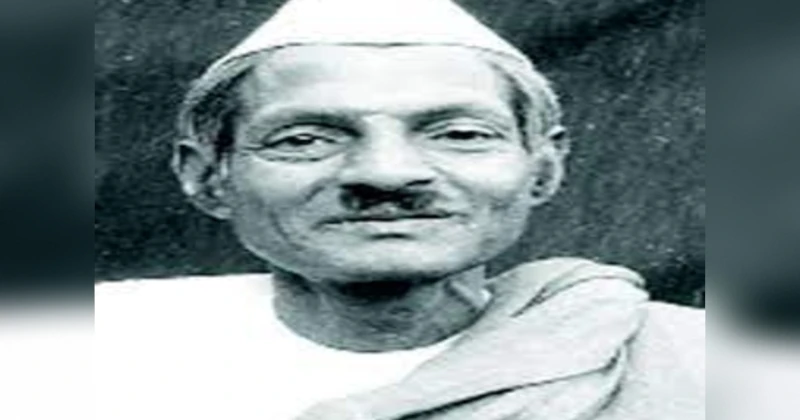
New Delhi: At a time when India’s history and cultural traditions were often viewed through fragmented or externally defined narratives, Dr Vasudev Sharan Agrawal emerged as a scholar who sought to establish the depth of Indian civilisation through rigorous research, archaeology, art, literature and the study of folk traditions.
Born on August 7, 1904, in Kheda village of present-day Hapur district, Uttar Pradesh, Dr Agrawal became one of the prominent archaeologists, historians, Indologists and cultural scholars of the 20th century. His scholarship sought to connect India’s literary traditions, archaeological remains, art, language and popular culture, giving a wider intellectual framework to the study of Indian civilisation.
7 अगस्त/जयंती
पुरातत्ववेत्ता : डा. वासुदेवशरण अग्रवाल
ऐतिहासिक मान्यताओं को पुष्ट एवं प्रमाणित करने में पुरातत्व का बहुत महत्वपूर्ण स्थान है। सात अगस्त, 1904 को ग्राम खेड़ा (जिला हापुड़, उ.प्र) में जन्मे डा. वासुदेव शरण अग्रवाल ऐसे ही एक मनीषी थे, जिन्होंने अपने शोध से भारतीय… pic.twitter.com/mhTEPLnwvE
— Rashtra Sevika Samiti Delhi Prant (@sevikasamiti) August 7, 2026
His contribution was not limited to excavating or preserving antiquities. For Dr Agrawal, archaeology and history were deeply connected with the living cultural traditions of India. His work demonstrated how India’s past could be understood not merely through monuments and artefacts, but also through literature, languages, customs, folk traditions and the collective memory preserved in villages.
Dr Agrawal’s academic journey began with an outstanding performance at Banaras Hindu University, where he passed his Class 12 examination in the first division in 1925. He also cleared his Sanskrit examination from the Government School.
His academic brilliance attracted the attention of Madan Mohan Malaviya, who personally signed his first-division B.A. degree. He subsequently obtained his M.A. and law degrees from Lucknow University, again securing first-division results.
During his formative years, Dr Agrawal received considerable encouragement from the distinguished historian Dr Radhakumud Mookerji. That association would prove significant in shaping his intellectual direction.
Initially, Dr Agrawal practised law and was also involved in the family business. However, his academic interests eventually drew him towards archaeology and museum studies. At the insistence of Dr Mookerji, he joined the Mathura Museum, where he took up the challenging task of organising and systematising its collections.
He was later sent to the Lucknow Provincial Museum, which at the time had fallen into considerable disorganisation and was described as a “dead museum”. Dr Agrawal’s efforts transformed his responsibilities into an opportunity to demonstrate how museums could become centres of knowledge, research and public education.
In 1941, Lucknow University awarded Dr Agrawal a Ph.D. for his research on Panini, reflecting the breadth of his engagement with India’s ancient intellectual traditions.
His career took another important turn in 1946 when Dr Mortimer Wheeler, then head of the Archaeological Survey of India, established a museum in Delhi to house artefacts obtained from Central Asia. The responsibility for the museum was entrusted to Dr Agrawal.
Following Independence, the establishment of the National Museum of Archaeology in Delhi brought another major responsibility. Dr Agrawal was entrusted with its work and soon organised a successful exhibition in the national capital.
The exhibition helped establish his reputation beyond India, bringing his scholarship and organisational abilities to wider attention.
Yet his tenure in Delhi was not without differences of opinion. His intellectual disagreements with Dr Wheeler and subsequently with Dr Chakravarti eventually led him to leave government service in 1951.
Rather than stepping away from archaeology and Indology, Dr Agrawal moved to Banaras Hindu University, where he joined its newly established Department of Archaeology.
At Banaras Hindu University, Dr Agrawal founded the College of Indology, creating a platform for the systematic study of India’s intellectual, artistic and cultural heritage.
His years in Banaras became among the most productive phases of his life. He authored nearly 50 books in Hindi and English, covering subjects ranging from Indian art and classical literature to cultural history and philosophy.
His important works included Indian Art, Harshacharita: A Cultural Study, Meghdoot: A Cultural Study, Kadambari: A Cultural Study, Jayasi Padmavat Sanjivani Commentary, Kirtilata Sanjivani Commentary, Gita Navneet and Upanishad Navneet.
His English works included Shiva Mahadev: The Great God and Studies in Indian Art, among others.
These works reflected his central intellectual concern: understanding Indian civilisation as an interconnected cultural continuum rather than as isolated fragments of history.
One of Dr Agrawal’s most significant contributions was his understanding of the relationship between India’s classical heritage and its folk traditions.
He believed that Indian culture was fundamentally rooted in the folk culture of rural India. For him, villages were not merely peripheral to the study of civilisation; they were repositories of language, memory, customs, idioms, traditions and knowledge passed from one generation to another.
He therefore encouraged students and researchers to study provincial cultures, folk languages, idioms, proverbs and village traditions.
This approach helped preserve thousands of proverbs and traditional sayings that might otherwise have disappeared from academic attention. His work effectively challenged the narrow idea that the study of Indian culture should remain confined to classical texts, royal histories and monumental architecture.
For Dr Agrawal, the voice of the village was also a historical source.
His intellectual presence in Banaras also contributed to the growth of Ray Krishna Das’s Bharat Kala Bhavan, an important institution devoted to Indian art and cultural heritage.