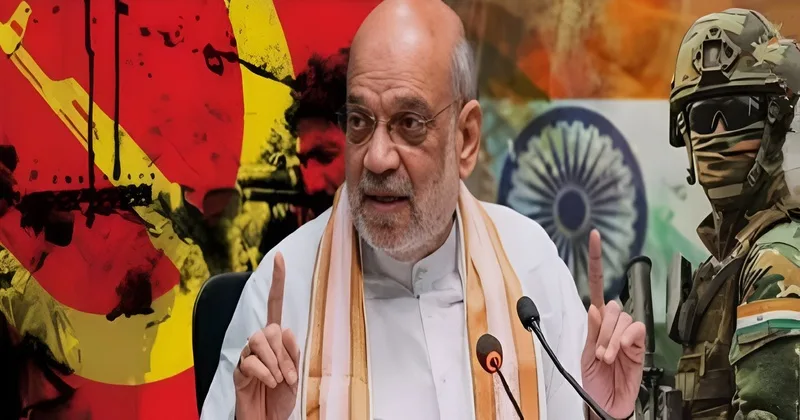
New Delhi: Amit Shah, India’s Home Minister, announced on the floor of the Lok Sabha on 30 March 2026 that Maoism has been eliminated from Bharat. Fulfilling his pledge to end Red terrorism by 31 March 2026, Shah has achieved what is widely considered one of the most challenging internal security milestones in post-independence India. Having first made this commitment on 24 August 2024, the Home Minister’s success has drawn comparisons to Sardar Vallabhbhai Patel’s historic integration of over 565 princely states at the time of Partition in 1947. Analysts say this achievement places Shah among the most effective Home Ministers in India’s history. He is also credited with the landmark abrogation of Article 370 in Jammu & Kashmir in August 2019.
Prime Minister Narendra Modi gave Home Minister Amit Shah full freedom to design an aggressive and time-bound strategy against Red terrorism. After assuming office in 2019 under the Modi 2.0 government, Shah implemented decisive measures to end Maoism. The Central Armed Police Force (CAPF), state police, commando units, and intelligence agencies were equipped with high-tech tools, and logistics in remote interiors were significantly strengthened. Security forces steadily penetrated Maoist strongholds, operating with urgency and purpose once the deadline was announced, with the backing of the Prime Minister. Following this campaign, 706 Maoists were killed, 2,218 arrested, and 4,839 cadre members—including prominent Maoist leaders—surrendered.
To assess the success of the security forces, these are impressive figures in a short time. But according to intelligence reports, a handful of cadres in states like Jharkhand, Chhattisgarh, Odisha, Telangana, and Maharashtra are still active. Some prominent Maoist leaders, like Ganapathi and Mishir Besra, remain elusive. Therefore, some immediate security concerns in the near future are feasible. While the ideology of Red terrorism stands defeated in India, the Modi government deserves credit for extending good governance to the Maoist strongholds liberated in the last decade. There should be further impetus for rapid development in the Maoism-affected areas, which have suffered economically and socially.
From the remnant Maoists, the most obvious threat would be to undermine the government’s claim that India is Maoist Mukt Bharat and embarrass the Modi government. To do so, Maoists may target security forces in a spectacular ambush, similar to attacks before 2014. They may also target VIP convoys or public meetings addressed by prominent leaders. Security forces and state/district administrations must strictly enforce protocols and follow SOPs rigorously. It is recommended that operations in Maoism-affected areas maintain momentum for the next three months, i.e., until 30 June 2026. States with no active Maoist cadres should also remain vigilant.
Another security concern is the detection and neutralisation of land mines and IEDs laid by Maoists to deter the movement of security forces. Demining operations are time-consuming and risky, and local populations should be restricted from entering suspected areas until they are fully cleared. Additionally, Maoists are believed to have hidden relatively new and automatic weapons in safe havens, while many surrendered with older, low-quality arms. Such tactics are similar to those used by insurgent groups in India’s Northeast. High-quality hidden weapons may also find their way to Jammu & Kashmir or Manipur, making continued combing and search operations critical.
Identifying the support base of Maoists, particularly in rural areas, is another priority. These overground workers, known as Rural Party Committee (RPC) members, number in the thousands across various states. Weaning them away from Red terrorism ideology and integrating them into society is a major challenge for security forces and local administration. Quick, visible development in rural and remote areas is essential to demonstrate government commitment. NGOs can also play a valuable role in supporting civil administration.
Finally, the threat from Urban Maoists is likely to surface more prominently. Remnant leadership may attempt to propagate Red terrorism ideology in small towns and cities that have yet to see much development. Left-leaning groups may encourage unemployed youth to join them. Intelligence agencies must remain vigilant to prevent any such attempts. In opposition-ruled states, local administrations may not always act proactively, making strong coordination between the Centre and states imperative before Maoism can be considered fully eradicated.
Post-independence, the near-elimination of Maoism in March 2026—after nearly 59 years of impacting India’s internal security—is a historic milestone. Prime Minister Narendra Modi and Home Minister Amit Shah deserve credit for their steadfast approach in tackling this menace with clear deadlines. While some immediate security concerns remain, India now has reason to celebrate the end of Red terrorism and Maoism on its soil with cautious optimism and continued dedicated governance.