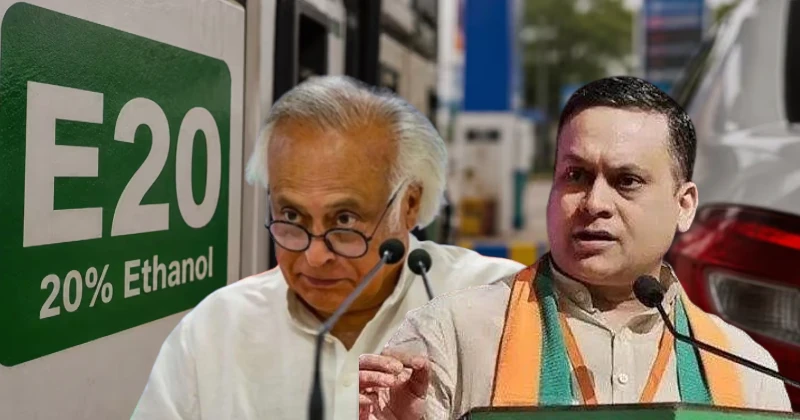
New Delhi: BJP IT Cell chief Amit Malviya has launched a detailed rebuttal to Congress leader Jairam Ramesh’s allegations that the Modi government’s ethanol-blending programme has caused widespread vehicle problems while concealing scientific evidence.
Responding to Ramesh’s criticism of Union Road Transport and Highways Minister Nitin Gadkari’s statement in Parliament, Malviya accused the Congress leader of selectively quoting technical reports, relying on anecdotal complaints, and ignoring more than two decades of scientific evaluation and real-world experience involving crores of vehicles.
According to Malviya, the criticism surrounding E20 petrol is based on “selective quotations, anecdotal complaints and a partial reading of technical reports,” while disregarding the phased implementation of the Ethanol Blended Petrol Programme, extensive testing by scientific institutions, and field data accumulated over several years.
He said the concerns surrounding E20 had been examined well before nationwide implementation by an Inter-Ministerial Committee constituted under NITI Aayog, supported by studies conducted by Indian Oil Corporation (IOCL), the Automotive Research Association of India (ARAI), and the Society of Indian Automobile Manufacturers (SIAM).
The criticism of the nationwide rollout of E20 petrol is based on selective quotations, anecdotal complaints and a partial reading of technical reports, while ignoring over two decades of scientific evaluation, phased implementation and real-world operating experience across… https://t.co/0pTEGRxvC7
— Amit Malviya (@amitmalviya) August 3, 2026
Countering allegations that E20 causes significant mileage reduction and engine damage, Malviya argued that no scientific or field evidence supports claims of widespread performance issues.
He pointed out that ethanol possesses a significantly higher octane number around 108.5 which raises the effective octane rating of E20 petrol to approximately RON 95. According to him, this improves anti-knock characteristics, enables smoother combustion and enhances engine performance, particularly in engines calibrated for higher ethanol blends.
Malviya argued that attributing reduced mileage solely to E20 fuel ignores multiple factors affecting fuel economy, including traffic conditions, tyre pressure, vehicle maintenance, air-conditioner usage, engine tuning, vehicle load and driving behaviour.
He further asserted that India’s real-world experience does not support allegations of systemic engine failures.
According to him, more than 20 crore two-wheelers and over three crore petrol cars have already been operating on E15-plus petrol for more than three-and-a-half years, while E19-E20 fuel had already been available in several regions for over two-and-a-half years before the nationwide rollout.
“If E20 genuinely caused widespread engine failures, abnormal wear or serious drivability issues, those problems would have become immediately visible in manufacturer service records, warranty claims and recalls,” Malviya argued.
Instead, he noted, automobile manufacturers continued certifying millions of vehicles for E20 operation while honouring warranties. To bolster his argument, Malviya cited field data from Maruti Suzuki.
According to him, the automobile manufacturer serviced approximately 2.84 crore vehicles during FY 2025-26, including nearly 1.5 crore vehicles that were not originally certified as E20-compatible.
He claimed the company reported no evidence of E20-related corrosion, abnormal engine wear, reduced component life or systemic engine performance issues. Similar experiences, he said, have also been reported by major two-wheeler manufacturers. He maintained that anecdotal reports circulating on social media cannot outweigh scientific studies and field data covering crores of vehicles.
Rejecting allegations, Malviya highlighted that India’s Ethanol Blended Petrol Programme began with pilot projects in 2001.
He noted that E5 fuel was introduced in 2006 and ethanol blending gradually increased from 1.53 per cent in 2013-14 to 8.1 per cent in 2020-21, 10 per cent in 2021-22, 12 per cent in 2022-23, 14.6 per cent in 2023-24, 19.2 per cent in 2024-25 before eventually reaching the 20 per cent target.
According to him, each stage was accompanied by scientific validation, infrastructure development, fuel quality monitoring and consultations with vehicle manufacturers. Material compatibility, corrosion resistance, cold-start performance, engine calibration, emissions and drivability were all evaluated before implementation, he said.
Malviya asserted that the NITI Aayog Ethanol Roadmap never concluded that pre-2023 vehicles would become unsafe or suffer widespread failures. Instead, he said, it merely identified engineering considerations requiring gradual adaptation by manufacturers.
Malviya argued that if concerns regarding long-term durability were accurate, India would have witnessed widespread warranty claims, manufacturer recalls, service advisories and consistent failure patterns across automobile brands.
According to him, none of these developments have materialised on a national scale.
He stated that leading automobile manufacturers have reported no systemic evidence of ethanol-induced corrosion, accelerated engine wear, reduced component life or widespread cold-start problems attributable solely to E20 fuel.
Addressing allegations regarding clogged injectors, damaged rubber components and corrosion, Malviya said such problems arise from multiple engineering and maintenance factors rather than ethanol blending alone.
Fuel injector clogging, he noted, may result from contaminated fuel filters, poor maintenance, fuel adulteration, deposits or prolonged vehicle inactivity. Similarly, corrosion depends on moisture contamination, storage conditions, material quality, maintenance history and vehicle age. “It is scientifically incorrect to attribute every injector or corrosion issue exclusively to ethanol blending,” he argued.
Malviya also rejected criticism that consumers were left with “no choice” after E20 became the dominant petrol grade.
He argued that India has previously transitioned from leaded petrol to unleaded petrol, adopted stricter BS-VI emission norms and upgraded fuel specifications after extensive scientific evaluation. Maintaining parallel nationwide fuel distribution systems for obsolete standards, he argued, would be economically impractical.
According to him, E20 provides multiple national benefits including:
- Higher octane fuel with superior anti-knock performance.
- Cleaner combustion and reduced emissions.
- Greater energy security.
- Reduced crude oil imports.
- Lower greenhouse gas emissions.
- Increased demand for domestically produced ethanol.
- Higher incomes for farmers cultivating approved feedstocks.
- Reduced foreign exchange outgo.
- Investments exceeding Rs 1 lakh crore across the ethanol ecosystem.
He further argued that reverting to E10 would require duplicate nationwide logistics, storage and distribution infrastructure while reversing gains achieved in energy security and farmer welfare.
Malviya accused Jairam Ramesh of misrepresenting both the NITI Aayog Ethanol Roadmap and ARAI studies. According to him, engineering observations recorded during product development have been wrongly portrayed as evidence against the programme itself.
He argued that the NITI Aayog Roadmap was designed to facilitate India’s transition to E20 by identifying engineering improvements required for legacy vehicles, enabling manufacturers to upgrade materials, seals, hoses, fuel systems and engine calibrations.
Similarly, he said, ARAI durability tests deliberately expose vehicles to extreme operating conditions to identify engineering improvements rather than simulate normal consumer usage.
He also clarified that observations regarding deterioration of rubber components referred to certain older elastomer materials used in some legacy vehicles, after which manufacturers progressively introduced ethanol-compatible hoses, seals, O-rings and gaskets before nationwide rollout.
On mileage reduction, Malviya acknowledged that ethanol’s lower energy density results in a modest decrease in fuel economy, but argued that this is a well-understood engineering trade-off rather than evidence of engine damage.
He maintained that the same technical roadmap supporting the nationwide transition had concluded that these trade-offs were acceptable considering cleaner combustion, higher octane rating, reduced emissions, improved energy security and lower dependence on imported fossil fuels.
“Crores of vehicles have operated on higher ethanol blends for years before nationwide rollout. No credible scientific evidence has emerged demonstrating widespread engine failures, systemic corrosion or accelerated deterioration attributable solely to E20,” Malviya asserted, adding that this is why Parliament was informed that there is no evidence of widespread vehicle damage caused by E20.
Earlier, Congress leader Jairam Ramesh questioned Nitin Gadkari’s statement in Parliament, arguing that the government’s claim of years of scientific testing and absence of widespread vehicle damage contradicts reports from consumers and mechanics across the country.
Ramesh claimed that vehicle owners have reported reduced mileage, engine performance issues, concerns over long-term engine compatibility, cold-start problems, accelerated wear and tear in pre-2023 vehicles, clogged injectors, corroded fuel lines and damaged rubber components.
He also cited a June 2026 independent survey of more than 44,000 owners of pre-2023 petrol vehicles, alleging that a significant number experienced adverse effects after the introduction of E20 fuel.
Referring to a July 2026 ARAI report and NITI Aayog’s 2021 Ethanol Policy Roadmap, Ramesh alleged that the documents acknowledged accelerated deterioration of rubber components, engine malfunctions during durability testing, increased corrosion risks and reductions in fuel efficiency ranging from one to seven per cent depending on vehicle category.
He further criticised the government for dismissing consumer complaints, recalling Petroleum Minister Hardeep Singh Puri’s September 2025 remark in which complaints of vehicle damage due to biofuels were described as “BS.”
Claiming that public dissatisfaction is growing, Ramesh alleged that the Modi government has failed to provide convincing evidence proving that E20 is harmless and accused it of lacking transparency on the issue.