FCRA and NGOs: Ensuring accountability, protecting sovereignty
August 23, 2026
  • Read Ecopy
  • Circulation
  • Advertise
  • Careers
  • About Us
  • Contact Us
Android AppiPhone AppArattai
Organiser
  • ‌
  • Bharat
    • Assam
    • Bihar
    • Chhattisgarh
    • Jharkhand
    • Maharashtra
    • View All States
  • World
    • Asia
    • Europe
    • North America
    • South America
    • Africa
    • Australia
  • Editorial
  • International
  • Opinion
  • RSS @ 100
  • More
    • Op Sindoor
    • Analysis
    • Sports
    • Defence
    • Politics
    • Business
    • Economy
    • Culture
    • Special Report
    • Sci & Tech
    • Entertainment
    • G20
    • Azadi Ka Amrit Mahotsav
    • Vocal4Local
    • Web Stories
    • Education
    • Employment
    • Books
    • Interviews
    • Travel
    • Law
    • Health
    • Obituary
  • Subscribe
    • Subscribe Print Edition
    • Subscribe Ecopy
    • Read Ecopy
  • ‌
  • Bharat
    • Assam
    • Bihar
    • Chhattisgarh
    • Jharkhand
    • Maharashtra
    • View All States
  • World
    • Asia
    • Europe
    • North America
    • South America
    • Africa
    • Australia
  • Editorial
  • International
  • Opinion
  • RSS @ 100
  • More
    • Op Sindoor
    • Analysis
    • Sports
    • Defence
    • Politics
    • Business
    • Economy
    • Culture
    • Special Report
    • Sci & Tech
    • Entertainment
    • G20
    • Azadi Ka Amrit Mahotsav
    • Vocal4Local
    • Web Stories
    • Education
    • Employment
    • Books
    • Interviews
    • Travel
    • Law
    • Health
    • Obituary
  • Subscribe
    • Subscribe Print Edition
    • Subscribe Ecopy
    • Read Ecopy
Organiser
  • Home
  • Bharat
  • World
  • Operation Sindoor
  • Editorial
  • Analysis
  • Opinion
  • Culture
  • Defence
  • International Edition
  • RSS @ 100
  • Magazine
  • Read Ecopy
Home Politics

FCRA and NGOs: Ensuring accountability, protecting sovereignty

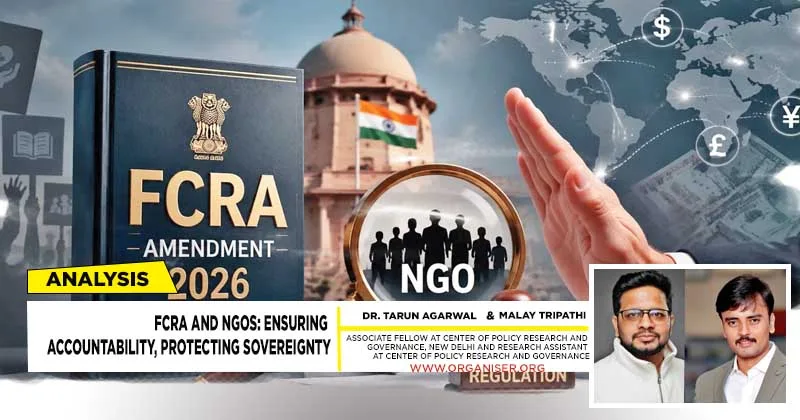
In an age where foreign-funded organisations can easily mobilise protests in any country, protecting Bharat’s sovereignty is the need of the hour. As a result, the proposed amendments to the Foreign Contribution (Regulation) Act (FCRA) are an essential prerequisite for Bharat’s security framework. The vital legal mechanism will ensure that foreign funding does not lead to strategic interference

Dr. Tarun AgarwalMalay TripathiDr. Tarun AgarwalandMalay Tripathi
Aug 3, 2026, 08:40 pm IST
inPolitics, Analysis
Follow on Google News
Facebook
Twitter
WhatsAppTelegramEmail

The proposed amendments to the Foreign Contribution (Regulation) Act (FCRA) should be viewed not merely as another round of regulatory tightening, but as a necessary recalibration of India’s national security framework. In the twenty-first century, threats to sovereignty are no longer confined to borders, conventional warfare or acts of terrorism. Increasingly, nations face sophisticated influence operations that exploit financial networks, civil society platforms, advocacy groups, digital ecosystems, and information campaigns to shape domestic political outcomes. In such an environment, transparency in foreign funding is not an administrative concern; it is a strategic imperative.

Critics often portray the FCRA as legislation intended to constrain civil society. This characterisation fundamentally misunderstands both its purpose and the changing nature of contemporary security. India continues to welcome genuine philanthropy, international cooperation, and developmental partnerships. The objective of the FCRA is not to discourage foreign assistance but to ensure that external financial flows do not become instruments of political influence, ideological mobilisation, or strategic interference under the guise of charitable activity.

The global security landscape has undergone a profound transformation. Adversarial actors today recognise that influencing societies is often more effective than confronting states militarily. Rather than deploying armies, they invest in narratives. Rather than financing insurgencies directly, they cultivate ecosystems of influence. This process is frequently sustained through what security experts increasingly describe as “pocket funding”, the dispersal of relatively small amounts of money across numerous organisations, campaigns, advocacy groups, educational initiatives, legal networks, media platforms, and grassroots institutions. Individually, these grants may appear insignificant. Collectively, however, they can create a durable ecosystem capable of shaping public discourse, influencing policy debates, and sustaining long-term ideological mobilisation.

Role of Foreign Funded Organisations

India’s own experience demonstrates why vigilance is necessary. During the debate surrounding the India-US Civil Nuclear Agreement, senior members of the then Government publicly raised concerns about the role of foreign-funded organisations in mobilising protests against the agreement. Former Minister of State V. Narayanasamy stated that foreign funding was used to support campaigns opposing the nuclear deal at a time when India was attempting to secure a strategic partnership with the United States. Whether one agreed or disagreed with the agreement itself, the episode highlighted an important national security question: should foreign financial resources be permitted to influence decisions on matters that have far-reaching implications for India’s strategic autonomy?

The issue extends beyond overt political mobilisation. Economic disruption can itself become a strategic vulnerability. Over the years, controversies surrounding reports on pesticide residues in Indian tea exports have periodically affected access to important international markets, placing pressure on tea-producing regions in Assam and North Bengal. These developments had significant economic consequences for communities dependent on the tea industry. Given the proximity of several of these regions to the strategically vital Siliguri Corridor, any prolonged economic distress warrants careful attention from a national security perspective. This is not to suggest that every report or campaign was malicious or externally orchestrated, but rather to recognise that economic narratives, when amplified internationally, can carry consequences extending beyond trade into questions of regional stability and strategic resilience.

As Parliament considers the proposed amendments, the debate should therefore move beyond the simplistic binary of regulation versus civil society. The real question is whether a sovereign democracy can afford to remain complacent about opaque foreign funding in an age where influence itself has become a strategic weapon

India’s internal security challenges have similarly evolved. Security agencies increasingly examine financial architectures alongside organisational structures. Investigations into organisations such as the banned Popular Front of India (PFI) have reinforced the importance of scrutinising funding patterns alongside operational activities.

Comprehending Amendments

This is why the proposed FCRA amendments deserve to be understood in their proper context. Stronger disclosure requirements, enhanced reporting standards, improved oversight of financial transfers, and greater scrutiny of complex funding chains are not signs of democratic insecurity. They are characteristics of a mature state adapting to the realities of hybrid warfare and foreign influence operations. Democracies across the world have adopted similar approaches through legal frameworks designed to increase transparency regarding foreign influence and funding. India is neither unique nor exceptional in recognising that foreign financial flows require careful regulation.

The FCRA is not a barrier to legitimate international cooperation. It is a safeguard ensuring that foreign assistance serves developmental objectives rather than becoming an instrument of strategic influence. As Parliament considers the proposed amendments, the debate should therefore move beyond the simplistic binary of regulation versus civil society. The real question is whether a sovereign democracy can afford to remain complacent about opaque foreign funding in an age where influence itself has become a strategic weapon.

Topics: India-US Civil Nuclear AgreementForeign Contribution Regulation Act (FCRA)Modi governmentFCRA amendmentsFCRA and NGOs
Malay Tripathi
Malay Tripathi
Research Assistant at Center of Policy Research and Governance [Read more]
Share
Tweet
SendShareSend
✮ Subscribe Organiser YouTube Channel. ✮
✮ Join Organiser's WhatsApp channel for Nationalist views beyond the news. ✮
Previous News

Tamil Nadu: Hindu Munnani’s protest stops meat waste dumping at historic Shiva temple in Tiruvallur

Next News

Priyanka Gandhi on Prof V Kamakoti: Beyond the “Gaumutra” jibe

Related News

Join hands against the US’ unilateral tariff pressures

Book Review: Young, innovative, still eternal

Modi govt strengthens its fight against fake news as ministries set up Quick Response Teams to counter misinformation within two hours

Modi govt steps up war on fake news; Ministries set up Quick Response Teams to counter misinformation

Economy: Contribute in corrections, celebrate the achievements

India’s global crackdown on fugitives has intensified, with 274 offenders brought back from 36 countries since 2019 (AI generated image)

From Vijay Mallya to Tahawwur Rana: India’s global pursuit of fugitives brings 274 offenders back from 36 countries

E20 Petrol Row: BJP slams Congress leader Jairam Ramesh over “False” engine damage claims

Load More

Latest News

Representative Image

India’s Emerging Military Challenge: Air campaign alone cannot replace boots on the ground

Lum Sohpetbneng- sacred peak of the Khasi people. They believe it to be the "Navel of Heaven"

Decoding Northeast: Celebrating ‘shared values’

Abdul El-Sayed

Who Is Abdul El-Sayed? Michigan’s Bid for America’s first Muslim Senator and How is he linked to Bin Laden & Al-Qaeda?

19th Foundation Day of GBU | Mission ShakthiSAT inaugurated; CM Yogi urges youth to embrace ‘Nation First’ spirit

Join hands against the US’ unilateral tariff pressures

A Clarion Call Against Global Hinduphobia: Organizations unite to oppose USCIRF’s anti-India agenda

Book Review: Young, innovative, still eternal

Are we losing the UPI Freedom

PM Modi interacts with space startup CEOs

National Space Day: PM Modi urge startups to revolutionise India as global space power & solve grassroot challenges

Sunelita Toppo

Icons of Women’s Hockey: The Sporting Role Models

Load More
  • Privacy
  • Terms
  • Cookie Policy
  • Refund and Cancellation
  • Delivery and Shipping

© Bharat Prakashan (Delhi) Limited.
Tech-enabled by Ananthapuri Technologies

  • Home
  • Search Organiser
  • Bharat
    • Assam
    • Bihar
    • Chhattisgarh
    • Jharkhand
    • Maharashtra
    • View All States
  • World
    • Asia
    • Africa
    • North America
    • South America
    • Europe
    • Australia
  • Editorial
  • Operation Sindoor
  • Opinion
  • Analysis
  • Defence
  • Culture
  • Sports
  • Business
  • RSS @ 100
  • Entertainment
  • More ..
    • Sci & Tech
    • Vocal4Local
    • Special Report
    • Education
    • Employment
    • Books
    • Interviews
    • Travel
    • Health
    • Politics
    • Law
    • Economy
    • Obituary
  • Subscribe Magazine
  • Read Ecopy
  • Advertise
  • Circulation
  • Careers
  • About Us
  • Contact Us
  • Policies & Terms
    • Privacy Policy
    • Cookie Policy
    • Refund and Cancellation
    • Terms of Use

© Bharat Prakashan (Delhi) Limited.
Tech-enabled by Ananthapuri Technologies