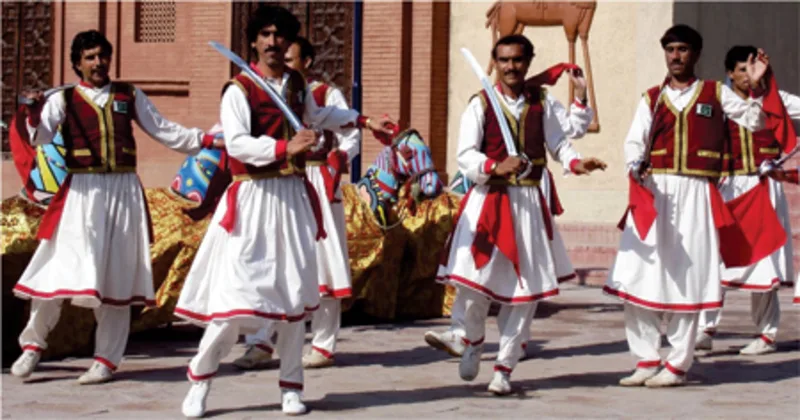
In the rugged landscapes of Balochistan, where deserts stretch into mountain ranges and the wind carries stories of centuries, lives a community that seems, at first glance, entirely out of place. The Brahuis, a people of Dravidian origin, speak languages closely related to Tamil and Telugu tongues, usually associated with southern India. Yet here they are, 1,500 kilometres from the southern Indian coast, thriving in the remote northwest of the subcontinent.
Meet the Brahuis of Balochistan
They speak Dravidian tongues of the South, yet live 1500 kms away in the rugged North-West.
How did this happen? Historians debate. Migration, ancient trade routes, forgotten kingdoms.
But beyond theories, there’s something magical: a shared… pic.twitter.com/1h5LFw24kK
— Āyudhika (@Ayudhika1310) March 25, 2026
The origins of the Brahuis are a subject of enduring fascination and debate among historians. Some suggest ancient migrations—families moving over centuries along trade routes that crisscrossed the subcontinent. Others point to forgotten kingdoms, long dissolved, whose influence may have extended far beyond what modern borders show. A third theory posits that the Brahuis are the remnants of a larger Dravidian presence that once spanned northern and western regions of South Asia before the waves of Indo-Aryan migration reshaped the linguistic map. Whatever the truth, the presence of a Dravidian language in Balochistan remains a remarkable testament to human mobility, adaptation, and cultural preservation.
But the story of the Brahuis is about more than just language or history. It is a narrative of identity surviving against the odds. In villages scattered across arid plains and jagged mountains, traditions, rituals, and oral histories have persisted, linking the Brahuis to their distant linguistic cousins in Tamil Nadu and Andhra Pradesh. Festivals, folk songs, and social structures echo a heritage that transcends geography, connecting communities separated by vast deserts and centuries of silence.
The Brahuis remind us that identity is not confined to borders drawn on maps. It flows like rivers through time, carrying fragments of ancient civilisations, stories, and languages into unexpected places. Their presence challenges simplistic notions of ethnicity, geography, and belonging, showing that culture can endure, adapt, and resonate far from its point of origin.
In an age defined by migration, globalisation, and the constant reshaping of identities, the Brahuis offer a quiet lesson. They embody the resilience of human culture and the enduring power of language to link people across space and time. The deserts of Balochistan may be harsh, but within them, the echoes of Tamil and Telugu continue to speak, bridging the past and the present, the south and the northwest, in ways that are as mysterious as they are magical.