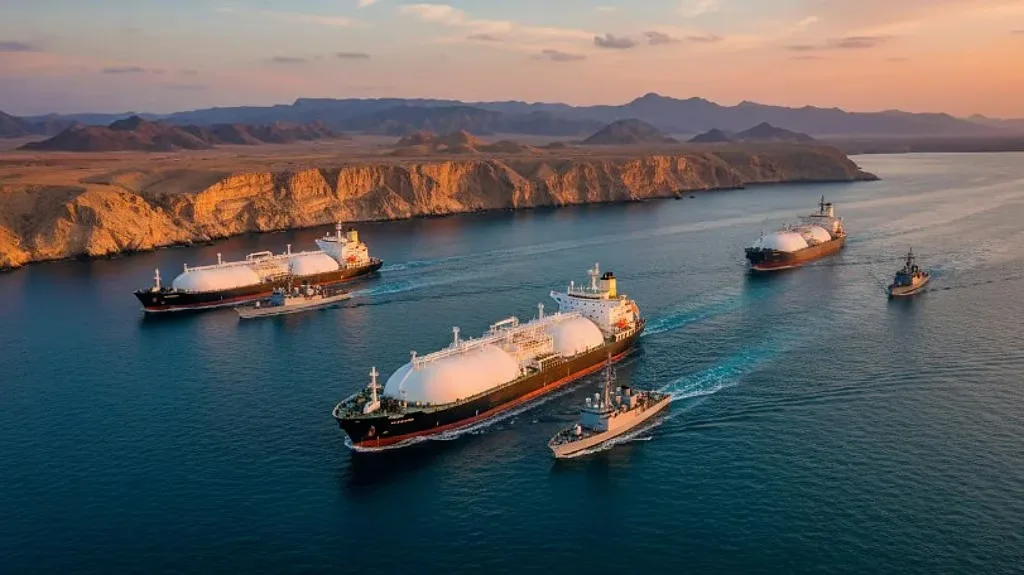
Amid escalating tensions in West Asia and disruptions in the strategic Strait of Hormuz, the Indian Navy has deployed three warships to escort merchant vessels heading toward Indian ports. The move comes in response to heightened security threats following the ongoing confrontation involving the United States, Israel and Iran.
According to official sources quoted in media reports, two of the naval ships, including the advanced guided missile destroyer INS Surat, were already stationed in the region under India’s mission-based deployment strategy. A third warship has now been tasked specifically with escorting commercial vessels destined for India.
The naval ships are currently operating across the Gulf of Oman and the Arabian Sea, providing protective presence for tankers and cargo vessels navigating the volatile maritime corridor.
Officials say the escort mission serves primarily as a deterrent, signalling the Indian Navy’s readiness to respond to any potential threat against ships carrying crucial energy supplies to India.
The Strait of Hormuz remains one of the most critical chokepoints in global maritime trade. The narrow passage, which connects the Persian Gulf to the Arabian Sea, carries nearly 20 percent of the world’s crude oil and liquefied natural gas (LNG) shipments.
Iran’s recent restrictions on maritime traffic came as retaliation for military strikes by the United States and Israel, raising fears of a wider conflict that could severely disrupt global energy markets.
With India heavily dependent on imported oil and gas from the Gulf region, the security of shipping routes through the Strait of Hormuz is of strategic importance to New Delhi.
Indian officials have therefore intensified naval monitoring and escort operations to ensure uninterrupted supply of energy cargo to Indian ports.
Security concerns are not limited to the Strait of Hormuz alone. In recent weeks, multiple attacks on merchant vessels have been reported in the Gulf of Oman as well, prompting heightened vigilance among international navies operating in the region.
Indian naval escorts are intended to deter such threats by ensuring that commercial ships remain under the protective shadow of a warship while crossing sensitive maritime zones.
Reports note that although the Arabian Sea remains relatively safe, the visible presence of Indian warships sends a strong message to hostile actors that any attack on India-bound ships would be met with swift response.
Despite the tense situation, two Indian-flagged LPG tankers, Shivalik and Nanda Devi, recently managed to cross the Strait of Hormuz safely.
The ships were carrying approximately 92,700 metric tonnes of liquefied petroleum gas (LPG) and are expected to dock at the ports of Mundra and Kandla in Gujarat.
Their successful passage came after intense diplomatic engagement between India and Iran aimed at securing safe transit for Indian-flagged vessels caught in the escalating regional conflict.
Earlier reports had suggested that up to eight LPG tankers linked to India were stranded in the Gulf region, awaiting safe passage amid uncertainty over maritime traffic through the strait.
India’s External Affairs Minister Subrahmanyam Jaishankar clarified that there is no blanket arrangement with Iran permitting Indian vessels to move freely through the Strait of Hormuz.
Speaking about the negotiations, he said diplomatic discussions had yielded “some results,” allowing the two tankers to pass through, but emphasised that each vessel’s movement was being handled separately.
“There is no exchange involved. India and Iran share a relationship, and this conflict is something we consider very unfortunate,” he said.
The minister added that talks with Tehran remain ongoing as several more Indian vessels are still present in the Gulf region.
The crisis has also reached the highest diplomatic levels. Earlier, Prime Minister Narendra Modi held a conversation with Iranian President Masoud Pezeshkian to discuss the safe transit of goods and energy shipments through the region.
Officials said ensuring uninterrupted supply of oil and gas to India was a key focus of the discussions.
Iran’s Foreign Minister Abbas Araghchi stated that the Strait of Hormuz remains open to most international vessels.
However, he indicated that the waterway is currently restricted for ships belonging to the United States, Israel and their allies due to the ongoing conflict.
According to him, vessels from other nations are free to pass through the strategic corridor, though heightened tensions continue to keep global shipping companies on alert.
Reports say India’s naval deployment is part of a broader maritime security strategy designed to protect trade routes and energy supply chains in the Indian Ocean region.
The Indian Navy has increasingly adopted mission-based deployments, keeping warships stationed in key global maritime zones so that they can respond rapidly to crises.
With tensions in West Asia showing no immediate signs of easing, Indian naval escorts are expected to continue until the security situation stabilises.
For India, the message is clear: protecting maritime trade routes and ensuring energy security remains a top strategic priority.