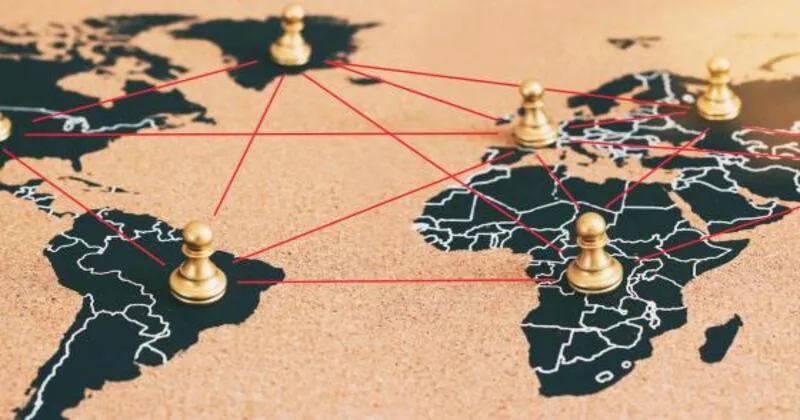
The globe has begun to consider the causes of the issues that the twenty-first century is currently facing. Ideologies like as socialism, communism, left-wing Islamic unnatural ideology, secularism, ecologism and fascism have all undergone various permutations and combinations in many places throughout the world. They are insufficient to solve issues; instead, they created new ones. The only way to find full and integral solutions is to look at humanity’s moral, social and spiritual ideals. Fiscal and economic policies are merely tools to accomplish these goals. Western nations established their own colonies throughout the world and amassed riches. In the end, they battled each other to gain worldwide dominance, which led to two World Wars in less than 30 years and an unthinkable loss of personnel and supplies due to the use of weapons developed with remarkable mental and intellectual prowess. This endeavor might also benefit from a study of Bharatiya perspectives on these ideals.
A step towards holistic economics
A workshop on “Holistic Economics” hosted by a think tank in Devon, UK, in November 2007. The following passage from the “think tank” report attests to their efforts: “We need Renaissance”. We must reconsider everything we currently take for granted from the ground up. We don’t need to “wipe the slate clean”, but we do need to take stock of all we have, start over with what is good and worth saving and let the rest go. We shouldn’t waste time on institutions, philosophies and technologies that are clearly failing. Above all, we must think “holistically”, considering everything in relation to everything else. Right now, the world utterly fails to accomplish this. In the seeming notion that we can always buy our way out of difficulties if we have enough money, the current system is specifically structured to create wealth.
Above all, political leaders want to raise the GDP or gross domestic product. However, GDP has nothing to do with the welfare of people; it is merely a gauge of the entire economy in use. However, the concept of individual accumulation and general economic progress is ingrained in our entire society. A system of economics that is intended to generate profits will undoubtedly be the most efficient way to achieve economic growth. Neoliberalism is that system, which is what we have. “We require an economy that is grounded in moral, spiritual and social values, operates on its own terms and is adapted to the physical realities of the planet”. Though many are already implemented and proven to be effective, there is no lack of ideas.
The West lacks balance
People were initially made to labour under the lash of the overseer following the Communist Revolution in Soviet Russia. Additionally, the minimum and maximum wages in Russia still differ by 1:80, which totally undermines their claimed equality. Even the existence of classes is accepted. In his book “The New Class”, former Prime Minister of Yugoslavia Djilas not only affirms this discrepancy but also indicates that certain people are receiving special advantages and facilities as social incentives. Khrushchev hailed Russia’s 1957 launch of Sputnik, Earth’s first orbital satellite, as a triumph of communism.
However, renowned philosopher Bertrand Russell quickly responded, saying, “That was not the victory but the defeat of communism – that it was because of special treatment given to the scientists, which was a privileged class, which enabled them to make the Sputnik”. I agree that this was a defeat of communism because they were unable to balance equality with this materialist way of life. This applies to all communist nations, including Yugoslavia and Russia. Specifically, all of the incompatibilities found in democracies are equally apparent in communist nations. To put it another way, western beliefs are not durable, universal, or immortal. Because they are accustomed to thinking in fragments, Western ideas are frequently reactionary rather than constructive. They are unable of balancing the different desirable objectives pertaining to a culture and a time period.
Such contradictory situations of specialization were also covered in the three-day workshop on the “Holistic Economy”. The report’s assertion that scientists and economists are morally neutral is self-explanatory. They claim that telling the rest of us how to live our lives is not their responsibility. Similarly, technologists assert that their role is to simply produce an infinite number of products that get better and more intelligent with every generation. These items are presented to the rest of us by free market economists as though we were in a global cafeteria. The promise of high tech liberalism is “choice”.
In turn, choice is generally associated with freedom, much like the free market itself. The system is set up such that individuals without money will remain without anything from the plethora, while those with the greatest money also have the most authority and hence control what the market offers. The system is not designed with justice in mind. Both free marketers and high-technologists assert their moral neutrality. However, they aren’t. The present high-tech-neoliberal axis has a tremendous impact on all of us and the fabric of the earth itself since its ideals are wholly materialistic. Any action that impacts another human or any form of living creature has some moral implications.
Significance of Dharma as explained by Deendayal Upadhyay
The significance of Dharma is explained by Deendayalji as follows: “All three are interrelated and mutually complementary, even though Dharma regulates Artha and Kama”. Dharma enables us to reach Artha. The qualities of Dharma—honesty, restraint, truthfulness, etc.—are necessary even in the economic world. In order to achieve Artha and Kama, dharma is essential. “Honesty is the best business policy”, declared Americans. “Honesty is the best policy”, they said in Europe. We take it a step further and declare that “Honesty is not a policy but a principle”, meaning that we consider Dharma to be a cornerstone of civilized existence.
“Only Dharma can decide when, where, and how to employ the tangible goods that have been generated, like delicious food. Both parties will suffer if a sick person consumes food intended for a healthy person and vice versa. Dharma aids in controlling man’s innate inclinations, enabling him to discern what is advantageous to him and differentiate between what he needs and what is enjoyable. As a result, Dharma is prioritized in our culture. Without Artha, Dharma cannot be practiced. Dharma is strengthened by wealth. The rule of the jungle states that the powerful will prey on the weak during a chaotic period. Therefore, the spread of Dharma across society depends on the state’s stability.
The Purpose of Dharma
Dharma offers a code of conduct meant to provide both worldly pleasures and ultimate bliss, in addition to the goal of achieving a union of the soul with ultimate reality. Dharma is described as “that which confers worldly joys and leads to supreme happiness” by Rishi Kanada in Vaisesika. Hindu Dharma is a Dharma that proposes ways to achieve eternal joy and the highest ideal on earth rather than in heaven. For instance, it supports the notion that getting married, starting a family and supporting them in any way required are all components of one’s dharma. Dharma practice makes life disciplined and provides a sense of inner serenity, joy, strength and tranquillity. Same applies to the global phenomena.
“We have stated that progress of man means the simultaneous progress of the body, mind, intellect and soul”, says Deendayalji in a clear explanation of the brilliance of the Bharatiya approach to the “Inward of a man”. There is a common misconception that Bharatiya culture only considers soul salvation and ignores everything else. This is incorrect. It’s not true that we don’t think about the body, mind and intellect; we do think about the soul. Others focused only on the physique. As a result, our focus on the soul seems special. Integration of all factors morally and spiritually uplifts not only the individual but also to Society, nation and globe which is interconnected.
A young lad who is single takes care of his mother. However, after being married, he takes care of his mother and wife and fulfills his obligations to them. It would be incorrect to claim that this man has no affection for his mother. At first, a wife loves her husband alone, but once a child is born, she starts to love both of them. The Upanishads unequivocally state that the body is the main tool for carrying out the duties that Dharma mandates. The body has been seen as the goal in the West. In order to attain the integrated evolution of man, we in Bharat have set the ideal of the fourfold responsibilities of attending to the needs of body, mind, intellect and soul before ourselves. The four types of Purusharthas or tenets, are Dharma, Artha, Karma, and Moksha. When these are satisfied collectively, he/she experiences total delight.
The reality that only the Bharatiya way of life and Dharma will bring tranquility, sustainable development, trust and joy to the world should be acknowledged by think tanks and political leaders worldwide. Therefore, it is crucial that the “Ekatma Manavdarshan” of Pandit Deendayal Upadhyay be studied and acted upon in all universities worldwide, as well as discussed by think tanks, so that political leaders can properly comprehend Deendayal’s outstanding principles. Let’s use the proper strategy and way of thinking to bring about world peace.