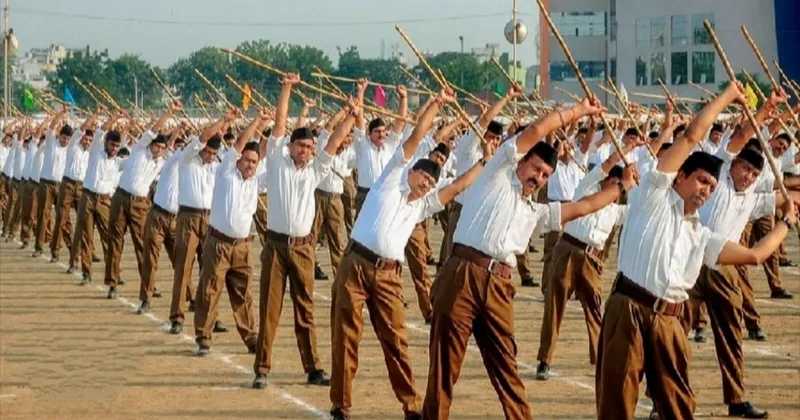
The Rashtriya Swayamsevak Sangh (RSS) stands as a monumental banyan tree that has organised and awakened Hindu society, branching out into countless stems, boughs, and tendrils. Each of these offshoots has developed the autonomous capacity to operate independently. Consequently, analysing its origins in search of a singular root is an exercise in futile intellectualism. Yet, the core remains as resilient and relevant as ever, precisely because its roots are deeply intertwined with the foundational ideals and sacrifices embedded in Indian soil. Seeking its formal registration or demanding bureaucratic compliance is as redundant as attempting to cage the wind.
Recently, Priyank Kharge—the Minister in the Government of Karnataka, and son of Congress National President Mallikarjun Kharge—addressed a letter to RSS chief Mohan Bhagwat. In it, he demanded detailed disclosures regarding the organisation’s legal status. Minister Kharge clarified that the letter was issued not in his personal capacity, but from his official ministerial position, raising eight questions regarding the RSS’s registration status, funding, organisational structure, and constitutional accountability. He argued that an organisation operating over 60,000 shakhas (branches) cannot remain outside the purview of legal and regulatory oversight. Through this correspondence, leadership within the Congress party has once again employed a familiar strategy to target Hindu society and its consciousness, albeit in a new guise. This presents an internal contradiction, given that Karnataka’s own Chief Minister, D.K. Shivakumar, publicly and proudly proclaims his Hindu identity and Kharge is working with him as minister. Shouldn’t he demit the office before questioning Hindu consciousness, as his boss applauds it.
A Philosophy Stemming from Hindu Consciousness
For the general public, it is vital to understand what the RSS—founded in 1925 for the rejuvenation of India and the protection of Dharma—has accomplished over its century-long journey, and why it has abstained from formal registration. To answer these questions, one must first comprehend the relationship between the RSS and Hinduism. Just as Hinduism does not depend on a single messiah or prophet, is not bound to a single holy book, and does not mandate a singular, formal place of worship, the RSS is also not confined to a solitary activity or platform. It permeates society like the very energy of Hinduism itself—a concept best understood through the ancient philosophy of “Dharayeyt Iti Dharma” (That which sustains is Dharma).
If there is a foundational bedrock to India’s cultural consciousness, it is Dharma. In the Indic tradition, Dharma is neither a mere religion nor a specific mode of worship; it is the eternal order that sustains the individual, society, and the universe. Derived from the Sanskrit root “Dhri” (to sustain or uphold), Dharma represents that which preserves existence and imparts meaning to life. The RSS committed itself to organising Hindu society and nurturing its consciousness to ensure its preservation. It embodies the symbols, standards, ideals, and way of life of the nation. To fulfil this role, it required no validation from the Societies Registration Act of 1860 during the British Raj, nor did the post-independence Constitution of 1950 mandate registration for working toward the welfare of Hindu consciousness. On the contrary, Article 19(1) of the Constitution guarantees the freedom of speech, expression, and assembly. It imposes no legal obligation for formal registration upon individuals or groups operating peacefully.
The core mission of the RSS is to awaken and unify Hindu society. It does not operate with the limited, transactional scope of a non-governmental organisation (NGO) seeking government grants, funding, or tax exemptions. The RSS is a voluntary, ideological institution of the society, by the society, and for the society. It is neither a commercial enterprise designed for profit, nor a political party seeking governance, nor an NGO engaged in the business of fundraising under the guise of legal registration. Does a river require registration to offer its water to humanity? It does not, though a commercial enterprise that bottles and sells that water certainly does. It reflects the mindset which treats society and its Cultural values as subservient to the state. As an educated minister, Kharge is undoubtedly aware of this distinction.
Rita and Chiti: Structuring the Collective Consciousness
“ऋतं च सत्यं चाभीद्धात्त पसोऽध्यजायत।”
“Righteousness (Rita) and Truth (Satya) were born from eternal cosmic order.”
— Rigveda (10.85.1)
Truth and cosmic order (Rita) constitute the essence of Dharma. The RSS is dedicated to manifesting this ethical and worldly order on the ground by cultivating a network of disciplined, well-intentioned, and selfless individuals. Human history demonstrates that while laws and formal regulations can construct systems and machinery, the ethical and spiritual strength of society must be nurtured to ensure the welfare of all living beings. This is the precise function of the RSS.
What constitutional provision or registration is required for this? If one wishes to teach respect for elders, social harmony, and devotion to one’s culture and heritage, must one seek state permission? It is highly improbable that Kharge is unaware of this reality.
The Ideology of Unity: From the Atom to the Universe
The operational methodology of the RSS reflects total alignment between its philosophy and practice. Its assemblies commence with the Vedic invocation from the Rigveda (Mandala 10, Sukta 191, Mantra 2):
“संगच्छध्वं संवदध्वं सं वो मनांसि जानताम्। देवा भागं यथा पूर्वे सञ्जानाना उपासते।।”
“Walk together, speak together, let your minds be in agreement, just as the ancient divinities shared their offerings in unison.”
This verse represents a potent symbol of collective unity, harmony, and cooperation. Are these timeless values not precisely what modern society requires most? Assuredly so. Does the Congress party contend that unity, harmony, altruism, and cooperation cannot occur without state registration or formal declaration? Every RSS program concludes with the universal prayer for well-being: “Sarve Bhavantu Sukhinah, Sarve Santu Niramayah” (May all be happy, may all be free from illness). Does a collective effort toward the well-being of humanity and nature require a state license? If that were so, the ancient Vedic verses would not have survived as the guiding light of Hindu society for millennia, long before the British Raj, the Congress party, or Kharge existed.
As the Mahabharata states (Shanti Parva, 109.10): “Dharmo Rakshati Rakshitah” (Dharma protects those who protect it). The RSS has consistently viewed the defence of Dharma as its primary duty. Consequently, it has remained a target for internal and external anti-India and anti-Hindu factions. For the preservation of India, the continuous empowerment of Hindu traditions is not an optional endeavour; it is an absolute necessity.
Registered Entities Guided by the RSS Philosophy
The RSS itself is a philosophy, an awakening of Hindu consciousness. In association with it, millions of citizens are serving the nation across diverse sectors through legally registered entities. These include institutions in education, healthcare, social welfare, orphanages, universities, publishing houses, media outlets, cultural trusts, agrarian organisations, labour organisations, student organisations, financial institutions, and political bodies. Kharge is well aware that all these affiliate organisations are formally registered, compliant and recognised as leaders in their respective domains.
Everything pertaining to the RSS is public; there is no secrecy. If he wishes, Kharge, along with his father, is welcome to attend any RSS event or a daily shakha to observe this firsthand. The core structure of the RSS accepts no government grants. Its operational expenses are funded entirely through Guru Dakshina—voluntary offerings made by volunteers on the occasion of Guru Purnima. All programs are sustained through public cooperation and community contributions. If the Minister is unaware of these facts, his stance appears willfully contrarian. As an elected representative, he ought to exercise discretion, ensuring that his official communications do not inadvertently serve as a toolkit for ideological factions aiming to undermine cultural institutions—a strategy that has historically cost his party dearly at the polls.
The RSS is a lifelong discipline dedicated to character building. It remains open to individuals of every caste, creed, gender, and political persuasion, provided they do not harbour anti-national or divisive intents. Individuals shaped by this institution are currently serving across various tiers of public life—including the Union government, state administrations, local governance, banking, universities, railways, and postal services. They are recognised for their integrity, humility, and dedication to social harmony. To demand the registration of the RSS is to implicitly ask whether every single Indian aligned with the concept of cultural integration must register their personal convictions with the state? Every Hindu mind will have to be registered for that matter.