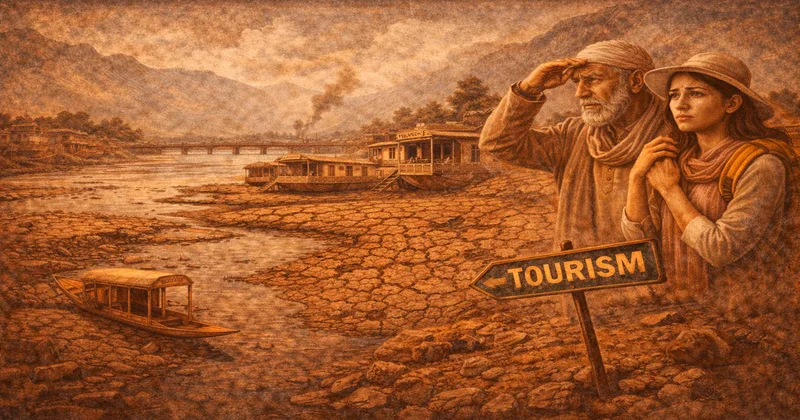
JAMMU: For most part of the month of February, particularly the second half, temperatures usually remained 9 to 10 degrees above normal in most parts of the Union Territory of Jammu & Kashmir. Old locals, above 60, vouched that they had never seen such warm weather before in their lives over decades. Very dry air, very poor quality, with waters in Jhelum hitting bottom, houseboats stranded, it did not make a good picture.
The last two days have brought some respite, with light rain in some parts of Kashmir and light to moderate snowfall in the higher reaches of Ladakh on Tuesday. The Meteorological Department has forecast intermittent spells of rain and snow across the region for almost 10 days, till March 20. This is definitely good news, as suspended particulate matter (SPM) hanging in the air is washed down by this precipitation, at least partially, if not wholly. The Air Quality Index (AQI) is likely to improve significantly for at least a short spell.
The farmers have witnessed an unusual phenomenon of very early flowering in fruit trees, mostly almonds, and a dry spell. The famed Tulip Garden on the east bank of Dal Lake is preparing to welcome tourists, but footfall is unlikely to be high due to a host of factors.
The prospects for tourism, on which a good number of people in Kashmir depend, look gloomy in the near future. Hot weather, combined with the ongoing war in West Asia and disruptions to LPG and fuel supplies, makes it difficult to predict any bright spots in the gloomy scenario. In the Jammu region, the higher reaches of Kishtwar and other snowbound areas received precipitation. Very marginal though and unlikely to impact the almost 70 per cent deficit recorded in almost all 10 districts.
Officials said the precipitation is expected to bring some relief from the unusually warm temperatures prevailing across the Valley. In Kashmir, too, it is unlikely to significantly reduce the large rainfall deficit accumulated during the winter months. The summer ahead may be very harsh, as the water deficit across the region will hit harder later, Nuzhat Parveen of Srinagar said.
According to her, late in November, the weather started to get cold, with December and January giving the feel of winter. However, come February, and it was almost like April already, Nuzhat added. Elders and weak patients from many families move out of the Kashmir valley for the harshest phase of winter. This time around, however, most stayed put in Kashmir valley, preferring not to go out as absence of rain, snow had lead to higher temperatures.
On Tuesday, light rain was reported from several parts of Kashmir, and light snow was reported in the higher reaches, while the higher reaches in the Ladakh region, including Leh and Kargil, received light to moderate snowfall. For the November-February period, Jammu and Kashmir recorded 106.7 mm of precipitation against a normal of 320.1 mm, marking a 67 per cent deficit, according to the Meteorological Department’s data. The shortfall places J&K in the “large deficient” rainfall category.
Neighbouring Ladakh recorded 8.3 mm of precipitation against a normal of 16.8 mm, registering a 51 per cent deficit during the same period, placing it in the deficient category. In the winter months, places like Pangong Lake are completely frozen, as are many smaller bodies of water. The Indus River is experiencing something similar, but de-icing has started at many places.
Separate data show both divisions of J&K recorded steep deficits during the winter season. The Kashmir division received 96.5 mm of precipitation against a normal of 288.9 mm, registering a 67 per cent deficit, while the Jammu division recorded 117.8 mm against a normal of 347.2 mm, reflecting a 66 per cent deficit, a minor difference of only one percentage point between the two divisions.
February was particularly dry, with only 14.2 mm recorded, compared with a normal of 130.4 mm, representing a deficit of nearly 89 per cent. According to Meteorological Department Director Mukhtar Ahmad, the approaching Western Disturbances are weak and will bring only light precipitation across Kashmir. “Though no major activity is expected, several areas across Kashmir have already recorded light rain, while higher reaches have received light snowfall,” Ahmad said.
He said another spell of precipitation is expected during the night of March 10 and 11, bringing light to moderate rain in the plains and snowfall in the higher reaches, particularly in parts of north Kashmir.
“A brief spell is also expected between the night of March 11 and the morning of March 12,” Ahmad said. “Further weak disturbances may affect the region between March 15 and 16 and again between March 17 and 18, bringing additional light rain and snow.” According to the department, cloudy conditions are likely to persist across the Valley until March 20, with neither a major wet spell nor a prolonged dry period expected.
Ahmad said the precipitation would help bring temperatures down, which have been running far above seasonal averages.
“Day temperatures are expected to drop by about 4 degrees Celsius by March 11, although they will still remain above normal,” he said. “Temperatures may gradually rise again before another slight dip around March 17 and 18.”
Even with the expected cooling, temperatures will likely remain above normal, as they have been running 12 to 14 degrees Celsius above the seasonal average in the first nine days of March, he said. Earlier this year, Kashmir recorded its warmest February in terms of average maximum temperatures.
In Srinagar, the average daytime temperature for February reached 15.6 degrees Celsius, surpassing the previous record of 14.9 degrees Celsius set in 2016.
The sustained warmth was particularly evident during the last two weeks of February, when daytime temperatures frequently hovered between 20 degrees Celsius and 21 degrees Celsius, pushing the monthly average to record levels.
Even traditional hill stations reported unusually high temperatures. The ski resort of Gulmarg recorded 17.2 degrees Celsius, about 13.7 degrees Celsius above normal, while Pahalgam reached 22.7 degrees Celsius, nearly 12.7 degrees Celsius above average.
Several stations also recorded sharp departures from normal earlier this month. Srinagar and Qazigund each touched 25 degrees Celsius, roughly 12 degrees Celsius above seasonal norms, while Kupwara and Kokernag recorded 23.8 and 23.9 degrees Celsius, respectively.
Meteorologists say the dry winter could have long-term implications for water availability in the region, as snowfall during the season plays a crucial role in replenishing glaciers, streams and irrigation systems.
Ahmad said March and April are climatologically among the wettest months in Kashmir, but added that it was too early to predict rainfall trends for the rest of the spring. “People travelling towards higher reaches such as Razdan Pass and the Sonamarg-Zojila axis should follow administrative advisories,” Ahmad said.
The Meteorological Department has also advised farmers to temporarily suspend activities such as spraying and irrigation until March 12, although routine field preparation and sowing work can continue.