Time is something we use every day. We wake up by it, work by it and plan our lives by it, but have you ever wondered how people measured time thousands of years ago? Long before mechanical clocks and atomic clocks were invented, ancient Indian scholars had already developed a very detailed and scientific system of timekeeping. From the blink of an eye to huge cosmic cycles lasting millions of years, ancient India built one of the most advanced systems of measuring time in the world.
Time at every scale
Ancient Indian thinkers did not limit time to simple divisions like hours and minutes. They developed a detailed system that measured time at many different scales. At the smallest level, they spoke of the nimesha, which was described as the time taken for a blink of an eye. For daily activities, they used units such as the muhurta, which helped in organizing rituals, work, and social life. They also carefully calculated monthly and yearly cycles based on the movements of the Sun and Moon. Beyond these practical measures, they imagined vast cosmic cycles such as the yuga and the kalpa, which extended over millions and even billions of years. This multi-layered system shows that their understanding of time was not only useful for daily life, but also deeply connected to philosophical and cosmological thinking.
Measuring time with shadows
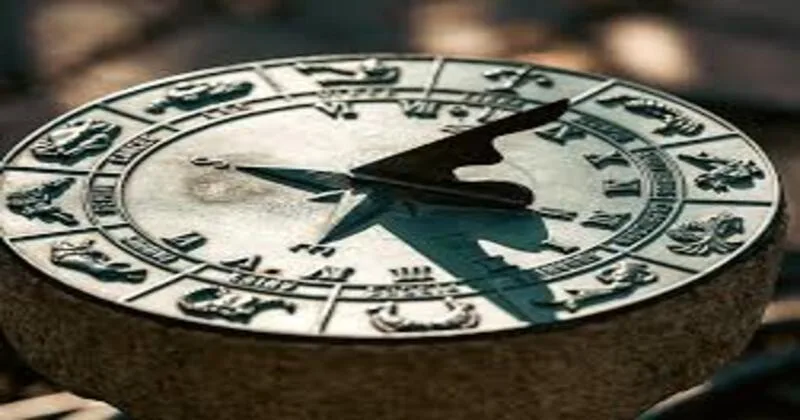
One of the earliest scientific instruments used in ancient India was the Shanku, a simple vertical rod fixed on a flat surface, which we today call a gnomon. When sunlight fell on this rod, it produced a shadow. By carefully measuring the length and direction of this shadow, scholars were able to determine important information such as local noon (when the shadow became shortest), the north – south direction, seasonal changes based on variations in shadow length during solstices, and even the latitude of a location. This method is described in the Surya Siddhanta, a respected astronomical text. The idea behind it is straightforward, if the height of the rod is known and the shadow length is measured, the angle of the Sun can be calculated using basic trigonometry. This clearly shows that ancient Indian astronomers combined careful observation with mathematical reasoning in their study of time and the sky.
From small rods to giant observatories
The idea of the gnomon was later developed into large stone instruments. A famous example is the Jantar Mantar in Jaipur, built in the 18th century by Maharaja Jai Singh II. The Samrat Yantra, a giant sundial there, can measure time with an accuracy of about two seconds. It works purely on geometry and sunlight, no electricity, no machines. This is a powerful example of how simple scientific principles can be scaled up with precision.
Ghati Yantra
Time in ancient India was not measured only with sunlight. During the night, or on cloudy days when shadows could not be used, people relied on the Ghati Yantra, also known as the water clock. It consisted of a small bowl with a tiny hole at the bottom. The bowl was placed in a larger vessel filled with water. As water slowly entered through the hole, the bowl gradually filled up and eventually sank. The time taken for one complete sinking was called one ghati, which was roughly equal to 24 minutes. This method was widely used in temples to maintain proper ritual timing, in royal courts for administrative purposes, and by astronomers for calculations. The working principle of the water clock is based on simple fluid mechanics, the flow of water depends on gravity and water pressure. Although it was not as precise as modern clocks, it was a highly innovative and practical system for its time.
Mathematical Astronomy
Ancient Indian scholars did not rely only on direct observation, they also used clear mathematical formulas to calculate time. A good example is the calculation of a tithi, or lunar day. Instead of simply watching the Moon, they measured the angular difference between the Moon and the Sun along the zodiac. The formula was,
Tithi = (Moon longitude − Sun longitude) ÷ 12°
This means that every 12 degrees of angular separation between the Sun and the Moon marks one lunar day. Such calculations are described in classical works like the Aryabhatiya. This method shows that timekeeping in ancient India was based on geometry, angular measurement, and mathematical reasoning rather than guesswork or superstition.
Hierarchical units of time
The Surya Siddhanta presents a well organized hierarchy of time units built on fixed numerical relationships. According to the text, 15 nimesha make 1 kashtha, 30 kashtha make 1 kala, 30 kala make 1 muhurta, and 30 muhurta together form one full day. This step-by-step structure is similar to the way modern science defines time today for example, 60 seconds make 1 minute and 60 minutes make 1 hour. In both systems, smaller units are combined in exact integer ratios to create larger units. This shows that ancient Indian scholars understood time as something that could be divided and organized mathematically. Their structured approach closely resembles modern quantized systems of measurement, where a fundamental unit is defined and larger units are built systematically from it.
The Yugas
Ancient Indian cosmology also described very long cycles of time known as Yugas. According to traditional texts, there are four main Yugas, Satya Yuga lasting 1,728,000 years, Treta Yuga lasting 1,296,000 years, Dvapara Yuga lasting 864,000 years, and Kali Yuga lasting 432,000 years. Together, these form a repeating cycle of cosmic time. These extremely large numbers show that Indian thinkers imagined time on a grand, universal scale rather than limiting it to human history. Although these figures are mainly symbolic and religious in meaning, they reflect a serious attempt to think about time far beyond individual lifetimes or even civilizations. This broad vision placed human existence within a much larger cosmic framework.
From astronomical time to atomic time
Ancient systems of timekeeping were mainly based on astronomical motion, especially the apparent movement of the Sun and Moon and the rotation of the Earth. Day and night were measured by Earth’s rotation, months by the Moon’s phases, and years by the Sun’s position in the sky. For many centuries, this method worked very well and was accurate enough for daily life, agriculture, rituals, and navigation. However, modern science later discovered that Earth’s rotation is not perfectly constant. It changes slightly over time due to several natural factors. Tidal friction caused by the gravitational pull of the Moon gradually slows Earth’s rotation. Movements inside the Earth, such as shifts in the core and mantle, also affect rotational speed. Even large earthquakes and seismic activity can cause very tiny changes in Earth’s spin. Due to these small but real variations, astronomy alone cannot provide extremely precise and stable time measurement.
For this reason, modern science moved beyond purely astronomical definitions of time. Today, the international standard unit of time, the second is defined using atomic clocks. Specifically, it is based on the vibration frequency of Cesium – 133 atoms. Atomic clocks are incredibly stable and accurate, losing only a fraction of a second over millions of years. This shift from astronomical observation to atomic measurement shows how timekeeping has evolved from observing the sky to studying the fundamental properties of matter.
The atomic clock
Modern time measurement is based on the atom of Cesium – 133 rather than on the movement of the Sun or the flow of water. One second is officially defined as 9,192,631,770 vibrations of the radiation produced during a specific energy transition in the cesium – 133 atom. This definition was adopted because atomic vibrations are extremely stable and do not depend on changes in Earth’s rotation, gravity, or environmental conditions. Atomic clocks are extraordinarily precise, with an accuracy that can reach 10⁻¹⁶ to 10⁻¹⁸ seconds, meaning they may lose or gain less than a second over millions or even billions of years. Such high precision is essential for modern technologies like GPS systems, satellite communication, scientific research, and internet synchronization. Unlike ancient instruments such as sundials or water clocks, atomic clocks rely on the fundamental and constant properties of nature, representing the most advanced stage in the evolution of timekeeping.
Water clock vs atomic clock
If we compare a traditional water clock with a modern atomic clock, the difference clearly shows the progress of science over time. A water clock works on the simple principle of gravity and water flow. The speed at which water fills or empties a vessel depends on pressure and gravitational force, and it can be affected by temperature and other environmental conditions. Its accuracy is limited, usually measured in minutes rather than seconds. In contrast, an atomic clock is based on quantum transitions inside atoms, specifically the stable vibration frequency of cesium – 133. These atomic vibrations are not affected by ordinary environmental changes and remain extremely consistent. As a result, atomic clocks can measure time with accuracy in billionths or even quintillionths of a second. This comparison highlights the scientific journey from classical physics, which studies visible physical processes, to quantum physics, which explores the fundamental behaviour of matter at the atomic level.
Relativity and Time
Ancient Indian astronomers understood that day and night are caused by the rotation of the Earth, and Aryabhata clearly expressed this idea in his work, explaining that the apparent movement of the stars is due to Earth’s own motion. This was a remarkable scientific insight for his time. Modern physics, however, goes even further. Through Einstein’s theory of relativity, we now know that time is not absolute. It can change depending on physical conditions. For example, time runs slower in regions of strong gravity, and it also runs differently for objects moving at very high speeds. These effects are not just theoretical, they are practical realities. Atomic clocks placed on satellites experience both weaker gravity and high orbital speeds, so their time must be corrected according to relativity. Without these corrections, GPS systems would quickly become inaccurate and fail to provide correct locations. This demonstrates that modern timekeeping is a combination of quantum physics, which defines time through atomic vibrations, and relativity, which explains how time behaves under different physical conditions.
Sidereal time and nakshatras
Ancient Indian astronomy carefully tracked the movement of fixed stars known as Nakshatras, using them as reference points to measure time and predict celestial events. These star-based observations helped scholars understand the difference between various kinds of time measurement. Modern astronomy also makes a similar distinction between solar time, which is based on the apparent motion of the Sun, and sidereal time, which is based on the position of distant stars. A sidereal day, the time taken by Earth to complete one full rotation relative to the fixed stars is about 23 hours and 56 minutes, which is slightly shorter than the 24 hour solar day. This small difference occurs because Earth is also moving around the Sun while rotating on its axis. The fact that ancient astronomers worked with star-based systems like the Nakshatras shows their deep observational skill and careful study of celestial motion.
A shared insight
Both ancient Indian science and modern physics share one important understanding: time is not merely a social invention created for convenience, it is a fundamental structure of reality. Ancient Indian thinkers viewed time as cyclic, moving in repeating patterns such as days, months, yugas, and cosmic cycles. At the same time, they treated it as measurable through precise units, hierarchical in structure from tiny moments to vast cosmic periods, and cosmically vast in scope. Modern physics, although using different language and tools, also places time at the centre of its understanding of the universe. It describes time as a coordinate in spacetime, inseparably linked with space itself. It connects time with entropy, explaining the direction of time through the increase of disorder. It defines the second using atomic transitions and recognizes that time is affected by gravity and motion, as shown in relativity. Even though these two traditions are separated by thousands of years, both treat time as a core principle necessary for understanding nature and the structure of the universe.
The journey of timekeeping in India
The journey of timekeeping can be seen as a continuous path of scientific progress, from the Shanku (shadow stick) to the water clock, from trigonometric astronomy to the mechanical clock, then to the quartz clock, the atomic clock, and now the advanced optical clock. Each stage represents a deeper understanding of nature and a more refined method of measurement. The Shanku used simple shadow observation, water clocks relied on gravity and fluid flow, mechanical clocks used gears and springs, quartz clocks used electrical vibrations, atomic clocks depend on quantum transitions, and optical clocks measure even higher-frequency atomic vibrations for extreme precision. Yet, despite these technological changes, the underlying spirit of science remains unchanged: observe carefully, measure precisely, and understand deeply.
Ancient India developed a sophisticated and layered system of timekeeping that combined careful observation of the sky, mathematical calculations, philosophical reflection, and large-scale cosmological ideas. Time was measured in small practical units for daily life, but it was also imagined on vast cosmic scales. This shows a deep and thoughtful approach to understanding reality. Modern science, in comparison, has taken time measurement to an extraordinary level of precision using atomic physics and Einstein’s theory of relativity. Today, seconds are defined by atomic vibrations, and corrections are made for gravitational and motion based effects.
The instruments have changed and the equations have become more advanced, but the human desire to measure, organize and understand time has remained constant. From the shadow cast by a simple rod to the vibration of a cesium atom, the story of timekeeping reflects the steady growth of scientific thinking. It reminds us that science does not appear suddenly or in isolation. It is a long and continuous journey, built step by step across different civilizations and centuries, guided by curiosity, observation and the search for deeper understanding.