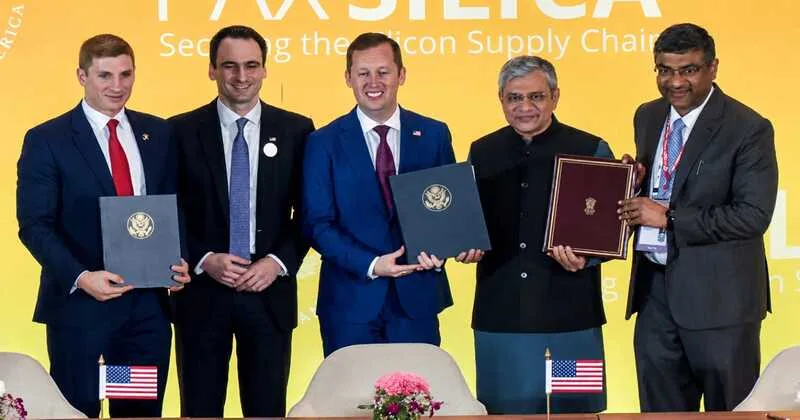
The emergence of artificial intelligence has transformed global geopolitics. The competition is no longer confined to military power or traditional economic strength. It now revolves around control over semiconductors, critical minerals, computing infrastructure, advanced manufacturing and AI ecosystems. In this changing landscape, the United States has launched Pax Silica, a strategic coalition designed to build trusted technology supply chains among like-minded countries while reducing dependence on China. India’s participation in the initiative represents one of its most consequential strategic decisions in the technology domain since the India-US Civil Nuclear Agreement.
At the second Pax Silica Summit in Washington, India joined thirty-four other countries in endorsing the Joint Statement on AI Opportunity, committing itself to a pro-growth, pro-innovation approach towards artificial intelligence. More importantly, New Delhi has secured a seat at the table where future rules governing AI infrastructure, semiconductor manufacturing and technology supply chains will increasingly be shaped.
Rather than viewing Pax Silica merely as another multilateral technology forum, India sees it as an opportunity to accelerate domestic industrial transformation while safeguarding long-term strategic autonomy. The challenge now is to maximise economic gains without compromising policy independence.
Building the AI supply chains of the future
Unlike earlier technology partnerships that were largely confined to research collaborations or software development, Pax Silica seeks to integrate the entire artificial intelligence value chain into a trusted and resilient production network. Its scope extends from securing critical minerals essential for advanced electronics to strengthening energy infrastructure that powers AI data centres.
The initiative also promotes cooperation in semiconductor fabrication and advanced chip packaging, AI computing infrastructure, software development, AI models, developer ecosystems, secure telecommunications and digital connectivity. In addition, it aims to facilitate cross-border venture capital flows, joint research and development, and innovation financing, creating an integrated technology ecosystem in which trusted partners collaborate across every stage of AI development, manufacturing and deployment.
This reflects a major shift in international technology policy. Artificial intelligence cannot function without chips; chips cannot be manufactured without rare earths and critical minerals; and all three depend on secure logistics, energy systems and trusted manufacturing partners.
A delegation led by Secretary, MeitY, attended the two-day Summit for Pax Silica partner economies on June 25 and 26, hosted at the U.S. Department of State.
India joined the Pax Silica initiative in February this year on the margins of the AI Impact Summit held in New Delhi.… pic.twitter.com/TyGlcIyDvp
— Digital India (@_DigitalIndia) June 27, 2026
The United States therefore seeks to establish an alternative supply chain architecture among trusted partners that is insulated from geopolitical disruptions. For India, participation means entering this architecture not merely as a consumer market but increasingly as a manufacturing, design and innovation partner.
India’s delegation, led by Electronics and Information Technology Secretary S. Krishnan, also held discussions with global industry leaders on semiconductors, artificial intelligence and resilient technology supply chains, signalling India’s intention to move beyond policy declarations towards industrial collaboration.
India’s Economic Opportunity: From market to manufacturing hub
India’s greatest advantage within Pax Silica lies in its unique combination of market size, engineering talent, semiconductor design capability and emerging mineral strategy. India already possesses one of the world’s largest pools of semiconductor design engineers. Many leading global chip companies conduct substantial design work from India. What has been missing is manufacturing capacity. Pax Silica can help bridge this gap.
The coalition promotes joint investments in semiconductor fabrication, advanced packaging, AI infrastructure and trusted manufacturing ecosystems. It also proposes coordinated research partnerships, venture capital flows and technology investments that reduce financial risks for private investors.
India’s recent domestic initiatives complement this international partnership. The Union Budget 2026-27 announced dedicated Rare Earth Corridors in Odisha, Keralam, Andhra Pradesh and Tamil Nadu. These corridors integrate mining, processing, manufacturing and research into unified industrial ecosystems.
Simultaneously, the government approved the Rs 7,280 crore Rare Earth Permanent Magnet Manufacturing Scheme aimed at creating integrated domestic magnet production capacity. These initiatives significantly strengthen India’s bargaining position within Pax Silica. Instead of joining merely as a large market, India enters with expanding domestic industrial capabilities.
The presence of IREL’s existing rare earth extraction and refining facilities further allows faster scaling of domestic production while integrating Indian industries into global advanced manufacturing value chains. This alignment between domestic industrial policy and international partnerships creates opportunities for large-scale investment, skilled employment, technology transfer and export-oriented manufacturing.
Reducing China’s strategic leverage without sacrificing strategic autonomy
The geopolitical context behind Pax Silica cannot be ignored. China dominates approximately 90 per cent of global rare earth processing and maintains overwhelming control over several critical mineral supply chains essential for semiconductor production and advanced manufacturing.
India currently imports nearly 80-90 per cent of its rare-earth magnets and related materials from China. Recent Chinese export restrictions exposed this vulnerability, affecting India’s automobile, electronics and electric vehicle sectors.
Pax Silica directly addresses this strategic weakness. By creating trusted supply chains among partner countries, India gains diversified access to minerals, semiconductor technologies and AI infrastructure, reducing exposure to disruptions arising from geopolitical tensions.
#WATCH | Hyderabad, Telangana: US Ambassador to India Sergio Gor says, "When the United States announced a new initiative called Pax Silica, India was one of the first 10 countries that we invited to join. That is because we trust India. When the United States needs medicine, 40… https://t.co/FS08uCJH6U pic.twitter.com/EXaP5EMRB7
— ANI (@ANI) June 23, 2026
However, India has carefully avoided entering an alliance that restricts its broader foreign policy choices. Unlike military alliances, Pax Silica remains sector-specific. India continues to pursue its long-standing doctrine of strategic autonomy, participating in issue-based partnerships while preserving independent decision-making.
This balancing approach allows New Delhi to cooperate closely with the United States in AI and semiconductor supply chains without abandoning relationships with other major powers or its broader engagement with the Global South.
The initiative therefore strengthens India’s technological security without fundamentally altering its independent foreign policy.
AI Governance, innovation and India’s global influence
Beyond manufacturing, Pax Silica also has implications for global AI governance. The Joint Statement on AI Opportunity promotes a regulatory environment centred on innovation, entrepreneurship and investment rather than restrictive regulation. Participating countries committed themselves to supporting developers, startups, private enterprises and trusted AI ecosystems while encouraging cross-border research collaboration and venture capital flows.
This approach aligns closely with India’s own ambitions to become a global AI innovation hub. India’s expanding startup ecosystem, digital public infrastructure, skilled workforce and growing AI market make it one of the coalition’s most valuable participants.
Membership also provides access to collaborative research, trusted AI models, high-performance computing infrastructure and official mechanisms for technology procurement. The coalition further opens opportunities for cooperation in next-generation data centres, fibre-optic connectivity, secure hardware and emerging technologies such as 6G.
India has already invested significantly in developing indigenous 6G capabilities. Participation in Pax Silica enables India not only to adopt international standards but also to contribute to shaping them.
Equally important, India’s inclusion strengthens its voice in future discussions on AI governance, standards, digital infrastructure and responsible technology development. Instead of adapting to rules framed elsewhere, India now has greater opportunities to influence them.
Strategic Balancing: Converting partnership into national capability
The true significance of Pax Silica lies not simply in joining another international coalition but in converting global partnerships into domestic capability.
India possesses four major strategic strengths within the initiative. First, its growing reserves and processing potential in critical minerals. Second, one of the world’s fastest-growing AI and digital markets. Third, an internationally recognised semiconductor design talent base. Fourth, ambitious policy leadership in emerging technologies such as 6G.
These assets give India leverage rarely available in earlier phases of technological globalisation. Yet success will ultimately depend on implementation. Semiconductor manufacturing projects, mineral processing facilities, research partnerships and industrial investments must move rapidly from policy announcements to operational capacity.
India must simultaneously ensure that participation does not create new technological dependencies or constrain future policy flexibility. Its leadership role within the Global South also requires ensuring that technology partnerships remain inclusive and do not undermine broader development priorities.
United States Hosts Second Pax Silica Summit in Washington, DChttps://t.co/vCQyi3dOUu
— U.S. State Dept – Near Eastern Affairs (@StateDept_NEA) June 26, 2026
India’s diplomacy has consistently demonstrated the ability to balance multiple strategic relationships simultaneously. Pax Silica offers another opportunity to practise this approach, deepening cooperation with advanced technology economies while preserving independent strategic decision-making.
Pax Silica marks the emergence of a new technology bloc where artificial intelligence, semiconductors, critical minerals and trusted supply chains are becoming the defining pillars of geopolitical influence. India’s inclusion reflects international recognition of its growing importance in the global technology ecosystem.
The initiative offers tangible economic benefits through investment, manufacturing, research collaboration, supply chain resilience and access to advanced technologies. At the same time, it enhances India’s geopolitical standing by integrating the country into one of the world’s most significant AI and semiconductor partnerships.
Unlike traditional alliances, Pax Silica complements India’s strategy of issue-based cooperation and strategic autonomy. By aligning international partnerships with domestic initiatives such as Rare Earth Corridors, semiconductor manufacturing, AI innovation and advanced infrastructure, India is positioning itself not merely as a participant but as a future pillar of trusted global technology supply chains.