उद्यमेन हि सिद्ध्यन्ति कार्याणि न मनोरथैः।
न हि सुप्तस्य सिंहस्य प्रविशन्ति मुखे मृगाः॥
“Works are accomplished through effort, not merely through wishes. Even the lion must rise; the deer does not walk into its mouth”!
This old Sanskrit wisdom feels deeply relevant to the moment Bharat stands in today. For decades, we spoke of technology mostly as consumers. We imported platforms, followed global trends, waited for foreign innovation, and then adjusted ourselves to it. But that phase is slowly giving way to something far more serious. Bharat is no longer only a market for technology. Bharat is preparing to become a trusted builder of the world’s digital future.
The recent statement by Dr Jitendra Singh, Union Minister of State for Science & Technology, on India’s expanding data centre sector must be read in this larger context. He said India is entering a decisive phase where data centres, Artificial Intelligence, quantum technologies and next-generation digital infrastructure will shape the future global economic order. He also stated that India’s data centre capacity is projected to grow from
1.5 GW to nearly 6.5 GW by 2030, creating nearly one lakh engineering jobs in areas such as AI systems, cooling technologies, smart grids, renewable energy integration and advanced digital infrastructure. These are not ordinary numbers. They signal a shift in national direction.
For a long time, when Indians heard the word “infrastructure”, we thought of roads, ports, bridges, railways and power plants. All of these remain crucial. But the infrastructure of the coming age will also include data centres, semiconductor facilities, quantum communication networks, clean energy grids, undersea cables, high-speed telecom networks and secure digital platforms. A nation that controls these foundations will not merely participate in the future; it will shape it.
That is why the phrase “data is the new oil” is not justified. Data is economic power. Data is strategic power. Data is social power. It influences commerce, governance, security, education, healthcare, agriculture, banking, defence and even public opinion. A country that generates enormous data but does not build the capacity to store, secure, process and govern it will always remain dependent on others.
Bharat cannot afford that dependence. India’s rise in the data centre economy must therefore be seen as part of a broader journey towards technology sovereignty. In simple terms, this means that India should have the ability to build, host, secure and use its own digital infrastructure in line with its national interests and civilisational values. This does not mean closing our doors to the world. On the contrary, it means engaging with the world from a position of strength.
Dr. Singh’s statement that the world now looks towards India for technology partnerships, rather than India waiting for success stories abroad, captures the new confidence of Bharat. This confidence has not appeared overnight. It has been built through a combination of digital public infrastructure, policy reforms, startup energy, private sector participation, scientific talent and political will.
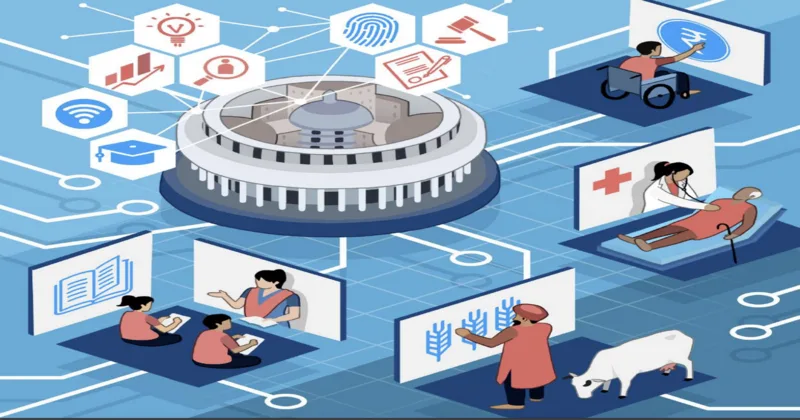
India’s digital public infrastructure has already shown the world what can be done at population scale. UPI changed the way ordinary people make payments. Aadhaar enabled identity-led service delivery, DigiLocker, CoWIN and other platforms showed that technology, when designed for public good, can serve both efficiency and inclusion. The next logical step is to build the deeper infrastructure behind the screen, the servers, chips, networks, energy systems and security architecture that keep the digital nation alive.
This is where data centres become important. A data centre is not merely a building filled with machines. It is a nerve centre of the digital economy. Every online payment, video call, cloud service, e-governance platform, AI tool, hospital record, logistics network and business application depends on strong data infrastructure. If Bharat wants to lead in Artificial Intelligence, 6G, semiconductors, quantum communication and digital services, it must also build world-class data centres supported by reliable power, clean energy, cooling systems, skilled engineers and secure supply chains.
The employment potential is especially important. The projection of nearly one lakh engineering jobs from the expanding data centre sector should be welcomed not only by policymakers but also by parents, students, universities and industry leaders. These will not be routine jobs. They will require new capabilities in thermal management, electrical systems, cybersecurity, cloud infrastructure, AI workloads, automation, renewable energy, grid management and advanced electronics. This is a wake-up call for Indian engineering education.
Our colleges cannot continue to prepare students only for yesterday’s IT services model. The new economy will need engineers who understand hardware as well as software, energy as well as algorithms, security as well as scale. A data centre engineer of the future may need to understand AI servers, power usage effectiveness, chip-level performance, cooling architecture, network resilience and green energy integration. This opens a huge opportunity for institutions in Tier-2 and Tier-3 India.
Nagpur, Indore, Bhubaneswar, Jaipur, Lucknow, Coimbatore, Guwahati, Ranchi and many such cities should not see themselves as distant observers of the technology revolution. They can become active participants if state governments, universities, industry bodies and startups work together. The data centre economy should not become another story limited to a few metro cities. Bharat’s digital future must be geographically distributed. There is another point that deserves attention- clean energy.
Data centres consume large amounts of power. If India has to become a trusted global data centre hub, energy planning will become central. Dr Singh rightly mentioned clean energy integration, smart grids and sustainable energy systems as part of the sector’s future. This is not only an environmental issue. It is also an economic and strategic issue. Countries and companies will increasingly prefer digital infrastructure that is reliable, cost-effective and powered responsibly.
This is where India has an advantage if it acts with discipline. Our solar capacity, renewable energy ambitions, green hydrogen plans and growing power infrastructure can be aligned with the data centre sector. States that can offer land, power, fibre connectivity, water planning, clean energy access and skilled manpower will attract serious investment.
But the real test will be coordination.The future of India’s data centre economy cannot be built by one ministry alone. It will require cooperation between government, private industry, infrastructure providers, telecom companies, renewable energy players, research institutions and state governments. Dr Singh spoke of such an integrated national approach. This is the right direction. Technology leadership is not built in silos. It is built through ecosystems.
This is also why the Semiconductor Mission, National Research Foundation, National Quantum Mission and opening of sectors like space and nuclear energy to private participation become part of the same national story. Each of these reforms addresses a different layer of the future economy. Semiconductors address the hardware foundation. Quantum addresses secure communication and next-generation computing. Space opens strategic and commercial possibilities. Nuclear and clean energy support long-term power needs. Data centres bring these strands together in practical economic form.
The National Quantum Mission deserves special attention. According to the minister, India has already crossed 1,000 kilometres of secure quantum communication infrastructure against a target of 2,000 kilometres over eight years. In an age where cyber threats, espionage and digital manipulation are growing, secure communication will become a core national requirement. It will matter for defence, banking, governance, research and critical infrastructure.
For Bharat, technology cannot be separated from national security. The next generation of conflict will not only happen at borders. It will happen through cyberattacks, data theft, misinformation, supply-chain disruption, satellite interference, financial manipulation and attacks on critical infrastructure. A strong data centre ecosystem, secure digital networks, domestic semiconductor capability and quantum communication are therefore not luxuries. They are shields.
At the same time, Bharat must ensure that its technology rise remains rooted in dharma – in balance, responsibility and public good. Technology without values can become a tool of exploitation. We have seen how global platforms can influence behaviour, shape narratives and even disturb social harmony. India must offer a different model: innovation with responsibility, scale with trust and growth with human purpose.
This is where Bharat’s civilisational perspective matters. Our tradition has never treated knowledge as a private weapon. Knowledge was meant for upliftment. Science was not seen as separate from society. Prosperity was not seen as separate from duty. If Bharat builds the data centre economy only as a commercial opportunity, we will miss its deeper meaning. It must become a foundation for national self-confidence, skilled employment, secure governance, rural inclusion, better education, stronger healthcare and global trust.
The coming decade will decide whether India remains a large digital market or becomes a genuine digital power. The difference lies in ownership, capability and intent. A market consumes. A power creates. A market depends. A power secures. A market follows. A power contributes.Bharat has the talent. Bharat has the demand. Bharat has the demographic strength. Bharat has the policy momentum. What is needed now is execution with seriousness.
Industry must invest beyond short-term gains. Universities must redesign curriculum. States must compete responsibly. Startups must enter deep-tech areas, not only app-based models. Young engineers must prepare for infrastructure-heavy technology careers. Policymakers must keep regulations clear and stable. And citizens must understand that digital convenience is only the surface; beneath it lies a vast national architecture that must be built with care.
The old shloka reminds us that wishes alone do not create destiny. Nations rise when they act with clarity and courage. Bharat’s data centre moment is one such call to action. It is not merely about servers and cables. It is about jobs, sovereignty, trust, security and the right to shape our own technological future. If India builds this foundation well, the world will not merely come to Bharat for talent. It will come to Bharat for trust. And in the coming global order, trust may become the most valuable infrastructure of all.