

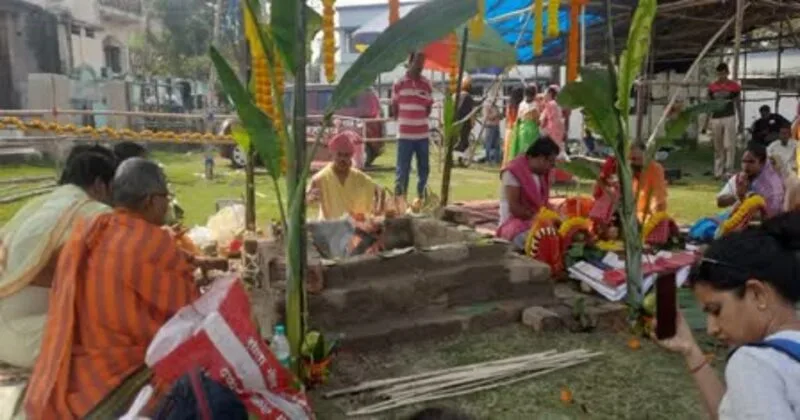
Sanātana Dharma has always expressed itself through a vast network of sacred geographies, stretching from the Himalayas to the deltaic plains of the east and the river basins of the south. Prayagraj, Kashi, Ujjain, and Nashik remain luminous anchors of this civilisational map. At the same time, this map has never been singular or limited. Across Bharat, multiple Triveni Sangams have served as centres of ritual, reflection, and renewal. Among them stands Tribeni in Bengal—revered in classical literature as Dakṣiṇa Prayāga and deeply embedded in the spiritual memory of the land.
The sacred Tribeni of Hooghly district in Bengal is one such site. Its importance does not need archaeological conjecture or colonial validation. Its meaning is encoded in its very name: Tri-beni—the confluence of three braided rivers. Just as Prayagraj is revered as Triveni Sangam, Tribeni stands as Bengal’s own Triveni, anchored in geography, ritual practice, classical literature and uninterrupted sacred memory.
A Sangam that needs no discovery
Hindu sacred geography has always been grounded in lived reality. Wherever three rivers meet—particularly where the Ganga is one of them—Hindu tradition accords that site exceptional sanctity. Tribeni Hooghly satisfies this criterion self-evidently. Here, the Ganga (Jahnavi), Yamuna and Saraswati converge in a visible and experiential manner. Unlike Prayagraj, where Saraswati is understood as subterranean, Tribeni is remembered as Muktaveni, the open braid, where the sacred rivers remain manifest.
For centuries, Hindus have taken ritual baths at Tribeni just as they have at Prayag, Rishikesh, Nashik or Ujjain. Snāna at Tribeni is not a revived custom; it is an inherited one. Generations of pilgrims have approached its waters with the same theological understanding that governs all Triveni sangams: that the confluence dissolves sin, renews dharma and realigns the individual with cosmic order.
Tribeni as Dakṣiṇa Prayāga
The recognition of Tribeni as Dakṣiṇa Prayāga—the southern Prayag—is not a modern ideological construction. It is firmly recorded in classical Bengali scholarship. The authoritative poet and ritual theorist Raghunandan, in his Prāyaścitta Tattva, writes unambiguously: “In the Southern Prayag, its open braids adorn seven villages; the southern land acknowledges it as Triveni.”
This statement is not poetic exaggeration. It establishes Tribeni’s ritual equivalence to Prayagraj within the Hindu theological framework. The phrase “seven villages” is a clear reference to Saptagram, the sacred cluster that forms Tribeni’s ritual landscape. The designation of Dakṣiṇa Prayāga provided the doctrinal foundation for snānas and melās historically observed here, particularly during calendrically significant moments such as Kumbh Sankranti.
Saptagram: Where sacred geography meets sacred memory
Tribeni cannot be understood in isolation from Saptagram, one of medieval Bengal’s most important religious, cultural, and commercial centres. The sanctity of this region is vividly preserved in Vaishnava literature. Brindaban Das, in his Chaitanya Bhagabat, describes Saptagram Triveni Ghat as the place where the Saptarishi performed penance, where the three goddesses—Ganga, Yamuna, and Saraswati—united, and where ritual bathing erased the accumulated sins of humanity.
Significantly, Brindaban Das records that Nityananda Mahaprabhu himself bathed joyfully at this ghat. This is a critical marker: it affirms that Tribeni was not a dormant relic but a living devotional site during the height of the Bhakti movement in Bengal. The celebrated poet Madhabacharya, author of Chandimangal, further anchors Tribeni in sacred literary memory. Identifying himself as a resident of Tribeni, he situates his lineage on the banks of the threefold Ganga at Saptagram, associating the region with Parashar Muni, yajña, and ascetic excellence. Such self-identification by classical poets reflects not only personal devotion but collective recognition of the site’s sanctity.
Saraswati, Saptarishi and the civilizational continuum
Local traditions, carefully documented by historian Munindra Deb Roy in Saga of Hooghly, preserve deeper layers of Tribeni’s sacred past. According to these traditions, Saptagram derives its name from seven sages—or in some versions, seven princely devotees of Vishnu—who settled along the banks of the Saraswati River. The confluence here was believed to possess such spiritual potency that even legendary births were shaped by its presence.
Deb Roy records that when Devi Suradhani, the Ganga, journeyed southward from Haridwar, she was accompanied by the Saptarishi—Marichi, Atri, Angira, Pulastya, Pulaha, Kratu, and Vashishtha—who worshipped her at Saptagram. The continued existence of Rishi Ghat, also known as Saptarishi Ghat, with the names of the sages engraved at the nearby ashram established by Abhayananda Giri, stands as a living testament to these traditions.
What Is Kumbh—Beyond symbolism
To understand Tribeni’s place in the Kumbh tradition, one must first demystify the term itself. Leaving aside Puranic symbolism, Kumbh is fundamentally an astronomical and celestial phenomenon. Large congregational snānas at sacred confluences predate the formal usage of the term “Kumbh Mela,” which entered common parlance only in the nineteenth century.
The absence of early textual usage does not imply absence of practice. Bharat’s history has endured prolonged phases of disruption—political upheaval, temple destruction, population displacement—during which documentation was fragmented or lost. Bengal, in particular, experienced repeated cycles of such rupture.
Astronomically, Kumbh observances fall into distinct categories:
- Mahākumbh and Ardha Kumbh: Governed by complex planetary alignments.
- Anu (Mini) Kumbh: Which occurs when the Sun transitions from Makara (Capricorn) to Kumbha (Aquarius), an event known as Kumbh Sankranti.
The ritual bath taken on this day is variously called Sankranti Snāna, Māghī Snāna, or Kumbh Snāna. At Prayagraj, this Anu Kumbh is observed annually during the month of Magha. The same calendrical logic historically governed ritual baths and melās at Tribeni, rooted in its identity as Dakṣiṇa Prayāga.
Tribeni in the political history of Bengal
The endurance of Tribeni’s sacred status becomes even more remarkable when viewed against Bengal’s turbulent medieval history. Early medieval Bengal was characterised by political fragmentation and repeated foreign incursions. According to Minhaj-i-Siraj’s Tabaqat-i-Nasiri, during the reign of Narasimha Deva I of the Eastern Ganga dynasty, Turkic forces attempted to extend control into southern Bengal but suffered decisive defeat in 1244 CE.
Archaeological and literary evidence confirms that during the Bhaumakara, Pala, Sena, and Eastern Ganga periods, the Tribeni-Saptagram region was dotted with temples dedicated to Shiva, Vishnu, Varaha, Chandi, Saraswati, and other deities. Sites such as Pandua, Mahanad, Dwarbasini, and Sangrampur formed a dense sacred network.
Historians note that Bengal was effectively divided into three political zones during the decline of the Sena dynasty, with Saptagram and Tribeni remaining under Eastern Ganga control, preserving Hindu religious life longer than other regions. Muslim political dominance arrived later, between the late thirteenth and early fourteenth centuries. Conquest inscriptions and architectural remains document systematic demolition of Hindu and Buddhist structures, with spolia reused in mosques and dargahs. Yet, even this violent disruption failed to erase Tribeni’s sanctity from popular memory.
Endurance beyond rupture
Despite centuries of political subjugation and cultural suppression, Tribeni’s religious significance never vanished. Anthropologist Alan Morinis observes that apart from Gangasagar, Tribeni alone in Bengal retains a strong claim to antiquity, explicitly identifying it as the southern counterpart of Prayaga. Morinis further records a crucial ritual distinction preserved by priests: Prayaga is known as Yuktaveni, the closed braid, while Tribeni is Muktaveni, the open braid, because Saraswati remains invisible here. This subtle theological nuance reflects a sophisticated continuity of sacred geography, not a reconstructed tradition.
Bharat’s Kumbh geography is plural, not singular
With Mamankam and Mahamagham reawakening in Kerala, Magha Mela continuing at Prayagraj, and Tribeni’s Kumbh-aligned snānas reaffirmed in Bengal, a larger truth emerges. Bharat has never had a single Kumbh. It has always had a network of Kumbh geographies, each shaped by local rivers, calendars, and cultural memory, yet bound by a shared cosmological framework.
Tribeni Hooghly is not a borrowed tradition, nor a modern reinvention. It is a living sacred landscape sustained by geography, scripture, poetry, ritual practice, and collective remembrance. Its Sangam, its snānas, and its melās—especially those aligned with Kumbh Sankranti—stand firmly within the continuum of Hindu civilisation.
To acknowledge Tribeni is not to dilute Prayagraj’s primacy. It is to restore civilisational balance, recognising that Sanātana Dharma flows through many rivers, converging repeatedly across the length and breadth of Bharat.