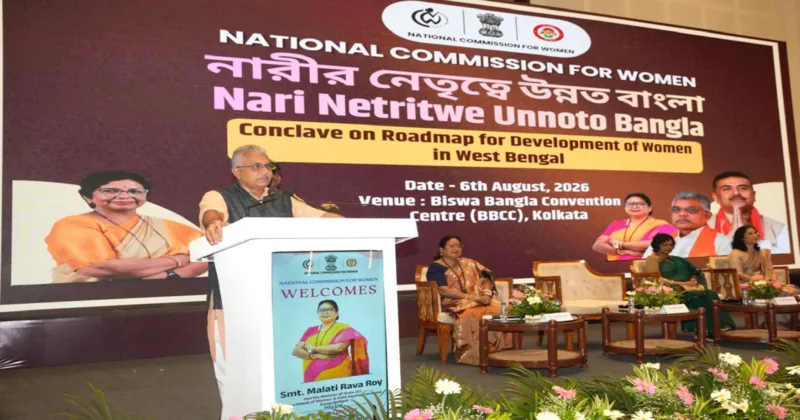
On August 6, 2026, around 150 women of West Bengal were invited by the National Women’s Commission in a Conclave titled NARIR NETRITWE UNNOTO BANGLA (Women-led Development in Bengal)organized in Biswa Bangla Convention Centre, New Town, Kolkata. The graceful conclave was chaired by the NCW Chairperson Vijaya Rahatkar and was attended by distinguished guests including Ministers of the West Bengal Government such as Shri Dilip Ghosh, Minister of Panchayats and Rural Development, Agricultural Marketing and Animal Resources Development & Malati Rava Roy, Minister of State (Independent Charge), Women and Child Development. Along with them, the Home Secretary of the State Government Smt. Sanghamitra Ghosh, IAS too staged her graceful presence.
Aimed at getting insights from the women of eminence to draw the future roadmap of a developed West Bengal, the conclave organised 3 panel discussions amongst which I was fortunate to attend the 3rd one as an Entrepreneur and Author. The 3rd panel discussed “Women Led Development-Entrepreneurship, Industry and Economic Empowerment.” Based on my field of education being Pharmaceutical Technology & Management Studies and from the experience background of serving Pharma Corporates as a Brand Management Executive followed by that of entrepreneurship as a business consultant, I was asked a straightforward question by the organising body.
‘From your experience as a pharmaceutical technology expert and entrepreneur, what support systems, skills and opportunities are needed to encourage more women to become leaders in healthcare innovation and technology-driven start-ups’? My answer aimed to suggest how the pharma sector could do much more for healthcare development of Bharat and how women could be the key group to take up entrepreneurship & various other leading roles in this field.
Women has the potential to excel in Pharma Industry be it in Product Development, Quality Assurance, Manufacturing, Marketing or Research & Development. This is because women, by nature, are meticulous, perfectionists & sincere which are the desirable qualities in chemical laboratories, in precision analysis & manufacturing of various dosage forms.
For due development of the Pharma Industry to ensure comprehensive wellness in each stratum of the society, Bharat requires education of superlative quality in the field of Pharmaceutical Technology & Engineering accompanied by at least 3 months’ industry internship in every year of the curriculum.
Out of these 3 months, internship of one and a half months needs to be in the Pharmaceutical Industry (either in manufacturing or QA or R&D) sector i.e. in Pharma Corporates and another one and a half months’ internship in Hospitals & Health Centres so that the students can witness the everyday challenges in both the healthcare sector of Bharat as well as the Pharma Corporates.
As understanding the challenges is the first step of any innovation, such yearly internships of each student of each year would equip students with clear ideas of challenges on the ground. At the end of internship of a particular year, if each student writes, in the form of project report, about his/her experiences, requirements on the ground & suggest solutions which would also include technological solutions, great ideas are supposed to emerge to handle healthcare challenges of Bharat.
In their annual project reports, the students can suggest technological solutions from existing technologies as well as new solutions, innovative ideas for new machineries & ideas of the required Research and Development for the same.
In this way, each year, a bunch of project reports of students of various institutes would get prepared with the help of the Professors thereof which can be subsequently submitted to the health ministry of the State. Such project reports are supposed to showcase glittering ideas of innovation in the healthcare sector including new medicines, new medical instruments & new patient care mechanisms.
The august platform of the conclave organised by the National Women’s Commission offered me an opportunity to recall the great achievement of manufacturing the first ever indigenous antibiotic of Bharat named Nafithromycin falling under the ketolide (semi-synthetic macrolide) class of antibiotics that comes handy to treat antibiotic-resistant community-acquired pneumonia.
Apart from Nafithromycin, Bharat has developed another novel beta-lactamase inhibitor named Zidebactam which, when formulated along with the penicillin or cephalosporins, acts to prevent bacterial resistance against those antibiotics. While we hardly talk about such path breaking achievements of Bharat in the Pharma sector, NCW discussion Panel III provided me with an opportunity to talk on such topics in front of the eminent listeners.
West Bengal is a State infamous for selling spurious drugs. Districts like Maldah, Murshidabad, Uttar Dinajpur are running criminal rackets of spurious drugs, counterfeit medicines, NSQ & expired drugs. Ex-MLA of Englishbazar, Malda, Sreerupa Mitra Chaudhury known as NIRBHOY DIDI, was smiling sitting in the front row as I talked about the West Bengal rackets of spurious drugs as she fights day in & day out as a legislator against various such menaces in her domain.
To reduce manufacturing & black marketing of spurious drugs, we need to have, just like private diagnostic laboratories, private analytical laboratories for chemical analysis of any formulation to identify its true APIs, their potencies & excipients. Women would do excellent as analytical chemists & as entrepreneurs to open such analytical laboratories as their venture.
While medicine retailers often offer a huge percentage of discounts on the MRP of medicines, customers feel happy without pondering upon how could a retailer offer such massive discounts on the MRP. Government of India needs to regulate the Pharma Corporates such that they advertise regularly against unduly high discounts offered by the retailers on the price of medicines manufactured and marketed by them. Along with the presence of such advertising mechanism, presence of private analytical laboratories would help suffocate the spurious drug rackets. In addition to that, analytical laboratories would also come handy in finding out the components of various Ayurvedic supplements being marketed these days.
In addition to these, Pharmaceutical Technology Education should offer specialization in practicing pharmacy & provide them with licence to dispense medicines. Practicing Pharmacists can strengthen the community healthcare facilities in a big way, reducing pressure on doctors and paramedics in the expanding healthcare infrastructure of New India, especially at a time when the Central Government has prioritised Pharmaceutical Education and Research. It has to be mentioned that the Government of India had sanctioned in its budget 2026 a 10,000 crore “Biopharma Shakti Mission” in next 5 years for the development & expansion of National Institute of Pharmaceutical Education and Research i.e NIPERs, prioritizing development of the Biopharma sector of Bharat.