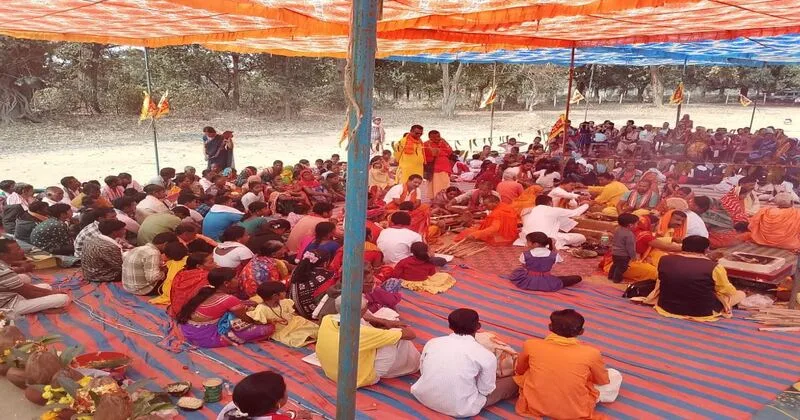
141 members of 47 families return to sanatan fold in Sambalpur
BHUBANESWAR: In the Bamra block of Sambalpur district, 141 members from 47 families, who had previously converted to Christianity under the influence of pastors, have returned to Sanatan Dharma in a Ghar Wapsi programme. On February 6, the Dharma Prasar Vibhag of the Vishva Hindu Parishad (VHP) organised a Panchakundiya Dharmaraksha Yajna at the Vedmata Mahila Seva Ashram in Solbaga village. During this event, the participants formally embraced Hinduism, performing ghar wapsi while chanting Vedic mantras.
These individuals had converted to Christianity in prior years due to the influence of pastors and missionaries. They reported that they chose to return to their “original faith” after receiving sustained counselling and awareness efforts from VHP karyakartas.
The ceremony was conducted with Vedic chants and rituals. As part of the traditional observances, the returning individuals were welcomed with foot washing, garlands, and participation in a havan. Several sadhus and religious leaders attended the ceremony, which organisers described as both solemn and celebratory.
A grand kalash yatra (procession) was held, starting from the Sri Jagannath Temple at Kaisai Bahal and proceeding to the yajna venue. The procession saw participation from local residents and members of various social organisations, reflecting what the organisers termed “strong community involvement.”
The program was conducted under the guidance of Achyutananda Kar, a senior functionary of the VHP’s Dharma Prasar Vibhag. Among those present were VHP Kendriya Margdarshak Mandali member Swami Jivanmuktanand Giri, Western Odisha Prant president Rajkumar Badapanda, Sangathan Mantri Satyanarayan Senapati, Sheshdev Baba, and Baba Shivanand. The religious leaders welcomed the participants with shrifal (coconut) and sandalwood garlands and addressed the gathering on issues related to religious identity and social awareness.
Several individuals who participated in the homecoming ceremony shared their personal experiences. Jayanti Jaypuriya, who had previously converted to Christianity, alleged that she and her family were influenced by what she described as false assurances. She recounted that her father had been suffering from a prolonged illness, and after seeking medical treatment without success, a nun associated with Christian missionary activities visited their home. The nun suggested that embracing Christianity and seeking refuge in Jesus would lead to recovery.
“We trusted her words but later realized that these assurances were not true. There was no improvement in my father’s health. After conversion, we were made to participate in regular prayers, but the promises made to us did not materialise,” she told the gathering.
Another participant, Rahasya Manjari Patel, shared her experience involving her nephew’s illness. She claimed that Christian pastors approached her family during a time of emotional distress, urging them to abandon idol worship and pray to Jesus Christ instead, assuring them that the child would recover. “At that time, our mental condition was such that we accepted what they said. However, despite everything, the child passed away. That was when I understood the reality behind their words,” she said, adding that she later decided to return to her original faith. “Today, after ghar wapsi, I feel deeply content,” she remarked.
Addressing the gathering, Achyutananda Kar alleged that Christian missionary organisations were using various inducements and methods to disconnect people from their cultural roots. “They are distancing people from Indian traditions and identity. Bringing back those who have been separated from their roots for various reasons is essential. This is not merely a religious act but a form of cultural reawakening and rediscovery of lost identity,” he asserted.
Rajkumar Badapanda, president of VHP’s Western Odisha Prant, stated that the program aimed to facilitate the return of those who had adopted another faith “due to mistake, compulsion, or circumstances.” He noted, “The personal testimonies shared today clearly highlight the methods used by certain pastors to carry out conversions. Such activities must be brought before society so that people remain alert and informed.” He urged attendees to avoid what he termed “foreign religions” and to understand the values of Sanatan Dharma.
Swami Jivanmuktanand Giri remarked that individuals had returned to their faith voluntarily and with self-realisation. “This has been a dignified and grand program with active participation from society. While the number of people attending churches is declining in several foreign countries, missionaries are targeting innocent and vulnerable people here in Bharat. Such practices should stop,” he stated.
Speakers at the event also raised concerns about alleged illegal religious conversions and stressed the need for strict enforcement of existing laws in Odisha that regulate religious conversion. They emphasised that any conversion carried out through coercion, inducement, or misrepresentation should be prevented through effective enforcement mechanisms.
The event saw the presence and cooperation of several social and religious workers, including provincial Dharma Prasar head Dilip Kumar Meher, Bharatiya Jan Seva Sanstha provincial treasurer Daulataram Agrawal, Matru Shakti district head Suvidhani Patel, Tula Baba, Dr Kumar Vikram Pandit, Alekh Kumar Pati, Saroj Das, Ghasiram Sahu, and other volunteers. Overall arrangements were coordinated by Sarva Vyavastha Pramukh Subodh Patel, while Sajan Khandelwal delivered the vote of thanks.
Organisers described the event as a significant initiative aimed at reinforcing cultural identity and social awareness in the region. They reiterated their commitment to ongoing outreach programs and awareness campaigns, while calling on authorities to ensure that laws related to religious freedom and conversion are implemented in their “true spirit.”


