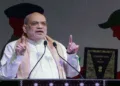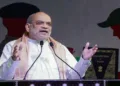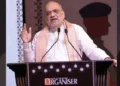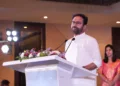

The second session at the Organiser conclave, “Chhattisgarh @ 25: Shifting the Lens,” focused on security and was titled “Chhattisgarh Beyond Maoism.” It was held at Mayfair Lake Resort, Raipur, on February 8, 2026. The session was moderated by Organiser Editor Prafulla Ketkar.
The panellists included Sandip Patil, Special Inspector General of Police (Anti-Naxal Operations), Government of Maharashtra; Sanjeev Prashar, Director, IIM Raipur; and Binay Kumar Singh, Director, Dr Syama Prasad Mookerjee Research Foundation.
Sharing his ideas, Binay Kumar Singh said that one should not make the mistake of categorising Leftism too narrowly. They claim that they believe in the electoral process, but how similar their processes are can be seen in Kerala, where, even while in power, hands are cut off, and in Bengal, where 10,000 Hindus are killed.
He referred to an incident in Bardhaman where two brothers were murdered, and their mother was fed rice mixed with their blood; she later went mad and died. He said that Leftism kills whether it is in politics or in the jungle. He cited a science blog survey in America with a sample size of 9,000, which found that 40 per cent of Leftists were mentally unstable. In Germany, an organisation named “Monkey Feed” conducted a survey of 10,000 people and found that 80 per cent of those identified as mentally unstable were Leftists. He termed it a disease and said that if the country wants to be free from naxalism, it has begun in the jungle but must also happen in the cities. Until the country is free from this disease, the vision of India in 2047 cannot be realised.
Sharing his experience, Sandip Patil said that the MMC zone, covering Maharashtra, Madhya Pradesh and Chhattisgarh, was created to wage war zone-wise. After 2014, a campaign was launched, and Maoism is now on the verge of being eliminated. He said that urban leaders from Mumbai were living in Chandrapur and Bhalasheg, and that one individual, Milind, who later became a Leftist leader, was told to take up arms. He went underground in the Gadchiroli jungles and was later made in charge of the MMC zone.
#ChhattisgarhAt25 | “The Joint Task Force (anti-Naxal operation) that began in 2018 achieved significant success.
Following that success, similar Joint Task Forces were formed in the Bastar region and in South Gadchiroli.
This improved internal coordination, and the advantage… pic.twitter.com/75kZgFaybu
— Organiser Weekly (@eOrganiser) February 8, 2026
He also mentioned that Saibaba, an English professor, was convicted. Apart from the MMC zone, a task force was formed in 2018, creating an example in India where police forces from three states operated together from a single police station, which proved quite successful. Milind was later killed at the borders. Interstate coordination and steps taken by the Central government yielded results.
Speaking on the opportunities for post-Maoism Chhattisgarh, Sanjeev Prashar said that by 2047 India will become a 30-trillion-dollar economy, and that figure will be achieved. The bigger question is which state will lead. Chhattisgarh has been affected by Maoism, and it is being cleaned up. The state has a GSDP of Rs 6.3 lakh crore and contributes around 1.3 per cent to the total. It has considerable reserves of bauxite, limestone and quartzite, and accounts for 13.1 per cent of the total value of mineral production in Bharat. Industry accounts for 45 per cent of the state’s economy, while agriculture contributes only 20 per cent, meaning it is not primarily an agrarian state. Sixty per cent of Chhattisgarh’s population contributes only 20 per cent, which is not a good sign. There is a productivity issue. Chhattisgarh has become like a utility room, supplying iron and bauxite while other states process them.
Binay Kumar Singh further said that in other parts of the world, when insurgencies end, governments follow certain models, but in India it is different. The government is very powerful, yet its policy offers a red-carpet welcome for surrender. Even Naxalites in jail are allowed to surrender. He said the current Indian model of dealing with Naxalism is an example. In Bastar, poverty has reduced by 13 per cent, and in Dantewada by 24 per cent, and Naxalism has also declined there, showing a link between poverty and Naxalism. Earlier, there was a half-hearted approach, but now even if they do not surrender, security forces are confronting them firmly. After 2014, the casualty figures of Naxalites doubled compared to those of the security forces. In 2025, 800 Naxalites were arrested and more than 2,000 surrendered.
Sanjeev Prashar further said that first of all, Chhattisgarh needs industry, as the current 45 per cent contribution largely comes from mining and extraction. The state must immediately diversify its industrial base and move towards manufacturing. It should not limit itself to steel alone but also expand into other alloys.
He added that the Government of Chhattisgarh can establish joint research centres in collaboration with major institutions, which can play a significant role in the state’s development.
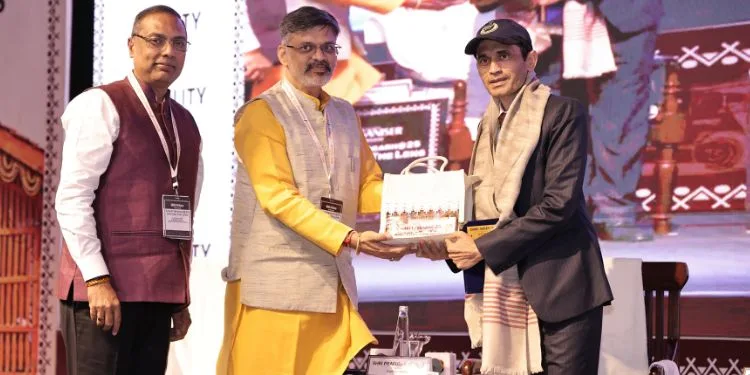
All the panellists were felicitated by Vineet Kumar Garg, Director, Bharat Prakashan Delhi Limited.