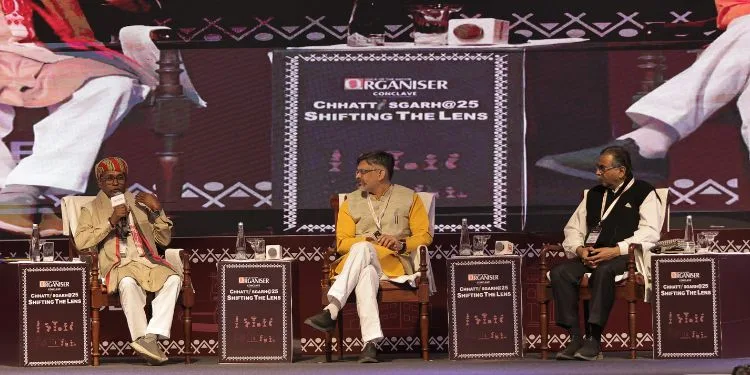
Raipur | As Chhattisgarh marks 25 years since its formation in 2000, a high-level intellectual and social discourse titled “Chhattisgarh@25: Shifting the Lens” organised by Organiser sought to fundamentally reframe how the state and particularly Bastar is viewed within national consciousness.
The session, which formed part of a larger series commemorating Chhattisgarh’s silver jubilee, brought together senior political leadership, Rashtriya Swayamsevak Sangh (RSS) functionaries, social activists, and tribal welfare leaders to reflect on the transformation of a region long associated with insurgency, violence, and underdevelopment.
The thematic pillars of the session were articulated as “Sangharsh se Safalta tak” (from struggle to success), “Asthirta se Sthirta tak” (from instability to stability), and “Bhay se Prakash ki or” (from fear to light). Speakers described Chhattisgarh@25 not merely as an anniversary event, but as a “vichar yatra” an intellectual and civilisational journey.
From a state born in hope to a region defined by headlines of violence
Formed in the year 2000 after being carved out of Madhya Pradesh, Chhattisgarh was envisioned as a state that would bring governance closer to tribal and forest-dwelling communities. However, for a significant part of its existence, the state, especially the Bastar region, came to be viewed almost exclusively through the prism of Naxal violence.
For years, Bastar dominated national headlines not for its cultural wealth or civilisational depth, but for ambushes, landmines, encounters, and red terror. Cultural sensitivity, speakers noted, was drowned out by the sound of gunfire. The region’s identity was flattened into a security problem.
“Today,” speakers asserted, “that sound has been replaced by the echo of development.”
They emphasised that this transformation was not accidental, but rooted deeply in Bastar’s civilisational foundations, describing it as the sacred land of Maa Danteshwari, whose spiritual presence has historically shaped the region’s resilience.
The session witnessed the participation of several senior figures from social, ideological, and administrative backgrounds, including: Arun Kumar Goyal ji, Toplal ji, Vineet Kumar Garg ji, Prafulla Ketkar ji, Dr. Purnendu, Saxena ji, Rajeev ji, Sanjeev Parashar ji and Shri Satyendra Singh.
A recurring theme throughout the session was the rejection of resource-centric definitions of development.
The session theme, “Samaj aur Samriddhi” (Society and Prosperity), focused on how education, healthcare, and self-reliance must reach Vanvasi regions at the grassroots level, and how development must be accompanied by social self-confidence.
One of the key speakers was Dr. Purnendu Saxena, an eminent orthopedic surgeon known for decades of clinical service. Dr. Saxena currently serves as the Kshetra Sanghchalak of RSS, Madhya Kshetra, and is also the Director of DRI. A renowned surgeon with MBBS and Orthopedic qualifications from the United Kingdom, he has been engaged in public healthcare service for several years.
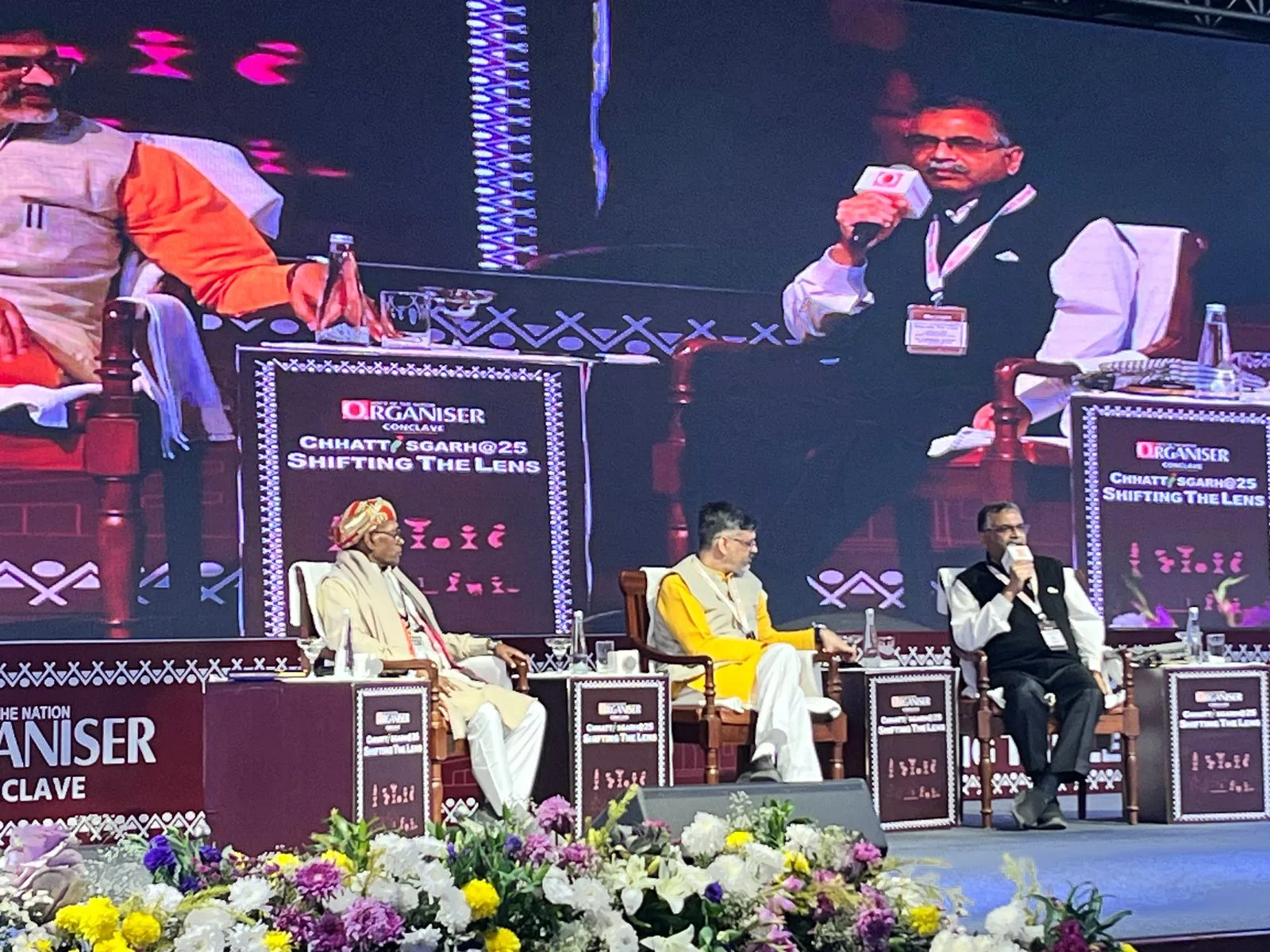
Another key voice in the session was Shri Satyendra Singh, President of the Akhil Bharatiya Vanvasi Kalyan Ashram, who hails from Jashpur district. Shri Singh served as a Sangh Pracharak from 1985 to 1990, and since 1994, he has been working as a full-time karyakarta of the Vanvasi Kalyan Ashram. Over the years, he has emerged as a prominent figure in tribal welfare initiatives across Chhattisgarh and beyond.
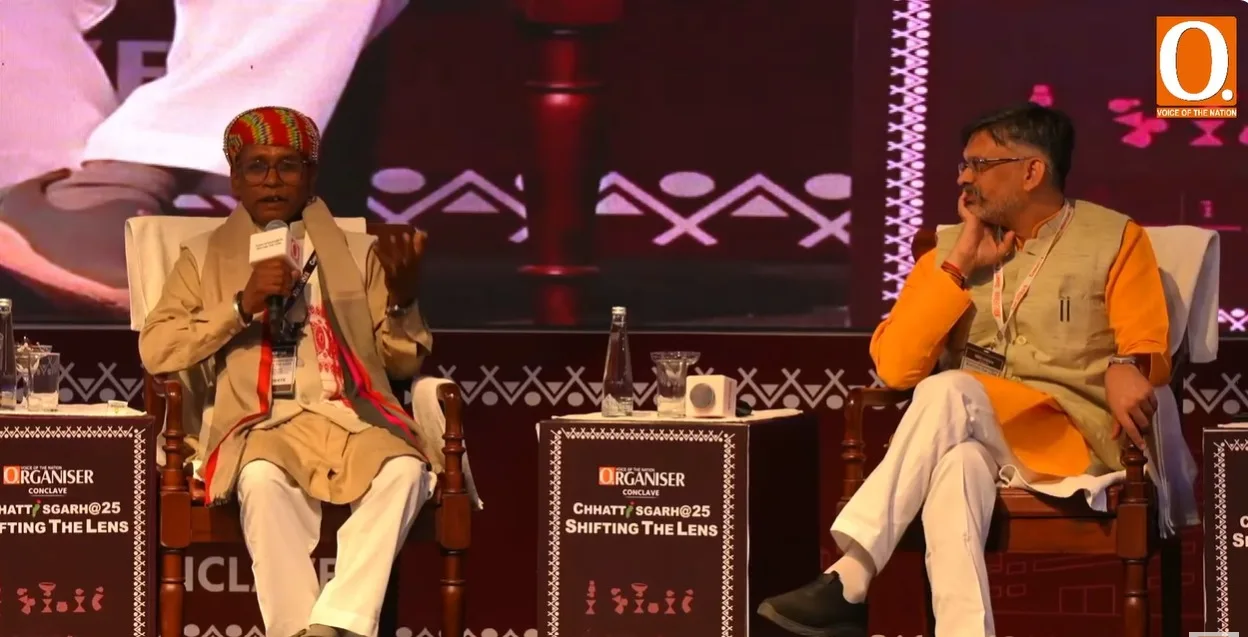
The session formally began with Arun Kumar ji welcoming the guests on stage, followed by Prafulla Ketkar ji, who welcomed the dignitaries and moderated the discussion.
While contextualising “Chhattisgarh@25: Shifting the Lens”, Prafulla Ji referred to a 2023 book published in Australia, authored by a woman researcher who studied the contribution of indigenous societies. The reference was used to underscore the argument that societies often dismissed as “uncivilised” possess knowledge systems from which the modern world must learn.
The discussion also recalled how the formation of Chhattisgarh fulfilled Atal Bihari Vajpayee’s vision. Speakers noted that while the state has completed 25 years, it is now embarking on a longer journey towards 2047, when India marks 100 years of Independence.
The purpose of the session, they said, was not limited to reviewing security or economic indicators, but to reflect deeply on model development, political stability, cultural continuity, and the role of society in shaping Chhattisgarh’s future.
Has Chhattisgarh escaped the twin narratives of backwardness and red terror?
A central question posed during the session was whether Chhattisgarh has truly moved beyond the narratives that once defined it backwardness and Left Wing Extremism.
When the movement for statehood was underway, speakers recalled, discussions around Chhattisgarh were dominated by fears of underdevelopment and insurgency. The question was whether society’s role has changed in dismantling these narratives.
Responding to this, speakers unanimously agreed that “shifting the lens” is not only necessary, but long overdue.
Over the last 25 years, Chhattisgarh and Bastar in particular, was painted as a land of perpetual terror. There was a widespread perception that travel after dark was unsafe and that violence was omnipresent.
While acknowledging that Bastar was indeed deeply affected by Left Wing Extremism, speakers argued that an entire ecosystem evolved that justified violence, amplified it beyond proportion, and normalised fear. This ecosystem created a negative image that engulfed the entire region.
Today, however, that image is changing.
Speakers attributed this shift to strong political will, which they said has led to the collapse of the terror mindset. Bastar is now being seen through a different lens—one that highlights its cultural richness, Dhamra traditions, and social resilience.
Poverty, discrimination, and instability, while not entirely eradicated, are gradually being replaced by developmental momentum.
A crucial historical turning point discussed was the assassination of Raja Praveer Chandra Bhanj Deo. Speakers noted that his killing created a vacuum in tribal leadership and communication that no institution or individual could adequately fill. This vacuum, they said, was exploited by Naxals fleeing from across the country, who established Bastar as a stronghold. Over time, they entrenched themselves within society, capturing narratives, controlling movement, and exerting influence over everyday life.
Despite this tragic chapter, speakers emphasised that Bastar has retained its unique character, a region where ancient traditions, village culture, forest life, and reverence for traditional deities continue to coexist.
Why Bastar’s worldview matters today
The Bastar worldview, its relationship with nature, environment, and life was presented as a model with lessons for humanity.
Speakers argued that Bastar communities do not see nature as a resource to be exploited, but as an extension of themselves. As society transitions from darker periods to an era of dialogue, access, and connectivity, it becomes essential to learn from Bastar rather than impose upon it.
Gratitude was expressed to Organiser for facilitating such a discourse that allows Bastar’s voice to be heard beyond security-centric narratives.
Responding to a question on tribal aspirations and governance, Shri Satyendra Singh said the history of tribal society is deeply glorious.
“Tribal pride is national pride,” he asserted, noting that whenever India faced invasion, whether by Mughals or the British, tribal communities were among the fiercest resistors.
Post-Independence, however, gaps in governance and administrative failures allowed divisive forces to exploit the simplicity of tribal society. As a result, Bastar remained under extremist influence for nearly four decades, depriving villages of basic facilities.
Vanvasi Kalyan Ashram and Community-led change
Shri Singh explained that tribal society fundamentally desires village development and social progress. The Vanvasi Kalyan Ashram, he said, works to preserve tribal identity while ensuring holistic development.
He acknowledged recent initiatives by the Chhattisgarh government and stated that commitments made by the Home Minister have nearly been fulfilled.
Crucially, he emphasised that the liberation of many Naxal-affected areas would not have been possible without local community cooperation.
Despite progress, speakers cautioned that challenges remain. Attempts are still underway to re-enter society through fairs, pamphlets, and alternative mobilisation strategies.
“Winning hearts is crucial,” Shri Singh said, arguing that government must work closely with local caste groups and small social organisations.
He suggested that MOUs for basic needs would help build trust, as villagers often continue to fear administration and police. Youth aspirations for skill development were highlighted, with many young people seen as potential Agniveer recruits.
Trust between villagers, police, and administration, he said, must be built through dialogue. Vanvasi Kalyan Ashram, he added, has been doing this work consistently and will continue.
A major portion of the discussion focused on redefining development itself.
Speakers argued that development cannot be reduced to GDP growth, business expansion, or the number of graduates. While these indicators have value, they are incomplete.
Drawing from Deendayal Upadhyaya’s philosophy, they stressed that development must reflect positivity across individuals, families, cultures, villages, and the social fabric.
Bastar communities, speakers said, view themselves as part of nature, not separate from it. Forcing them into mainstream models risks destroying social balance.
Their pace of healing, recovery from violence, and cultural rhythms must be respected. “Ready-made prescriptions are counterproductive,” speakers warned, adding that healing must precede growth.
Culture, Faith, and the Battle Over Narratives
The session also addressed narratives claiming that tribal deities are separate from Hindu traditions, an assertion speakers categorically rejected.
They pointed to historical distortions, book burnings, and institutional capture that enabled such narratives. Missionary schools and elite academic frameworks, speakers said, played a role in promoting these divisions.
In contrast, tribal worship traditions have consistently included Mahadev, Parvati, Hanuman, Lakshmi, Tulsi, and village deities. Sites such as Rohtasgarh Teerth Yatra and Oraon origin centres were cited as evidence.
The Ramayana’s references to Bhil, Kol, and Kirat communities were highlighted to show civilisational continuity. Across India, tribal societies worship Mahadev and Parvati.
Movements proclaiming “Jo nahi Bholenath ka, wo hamari jaat ka nahi” were cited as expressions of cultural assertion.
‘Adivasi’ Terminology and Historical Context
Speakers noted that the term Adivasi entered public discourse only between 1932 and 1935, following a 1883 Church Association meeting in Kolkata where the term “aboriginal” was reinterpreted.
They argued that the term was strategically used to divide tribal and Hindu society, something they said is historically and culturally untenable.
On the issue of conversion, speakers stated that conversion has no place in Indian cultural traditions and is primarily a demographic engineering project, not spiritual upliftment.
Projects such as the Joshua Project, which openly aim to convert at least 10% of populations, were cited as examples.
Delisting was discussed as a response to the erosion of tribal identity following conversion, loss of names, rituals, festivals like Sarhul and Karma, and reverence for deities.
Speakers argued that the question of whether tribal identity continues after conversion requires serious academic and policy examination, particularly in the context of ST reservation benefits.
The future of Budhadev-Bade Deo-worshipping tribal communities will be discussed in the next session.
The conversation, speakers emphasised, has only begun. Watch the evnt live here.