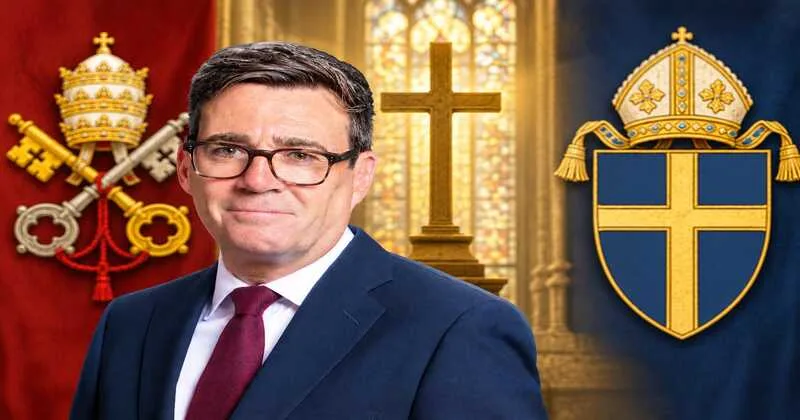
London: Andy Burnham’s appointment as the 59th Prime Minister of the United Kingdom on July 20, following the resignation of Sir Keir Starmer, has revived a centuries-old constitutional debate in Britain. Burnham has become Britain’s first lifelong Roman Catholic-born Prime Minister, but despite occupying the country’s highest elected office, he cannot advise the British monarch on matters relating to the Church of England. The reason lies in Britain’s constitutional framework, which continues to reflect the historic rivalry between Roman Catholicism and Protestantism.
While Britain today has people belonging to different faiths and many with no religious affiliation, the British state still retains an established church. The Church of England, founded during the English Reformation, remains the official church of the state. The British monarch is its Supreme Governor, and the Prime Minister traditionally advises the Sovereign on the appointment of bishops and other senior church leaders.
However, a Roman Catholic Prime Minister occupies a unique constitutional position because the Church of England is a Protestant church that does not recognise the Pope as its supreme religious authority.
Five centuries of Catholic-Protestant rivalry
The constitutional anomaly has its origins in the 16th-century English Reformation. During the reign of King Henry VIII, England severed ties with Rome after the Pope refused to approve the King’s annulment. Henry subsequently established the Church of England, replacing papal authority with royal supremacy over the English Church.
The break from Rome transformed England into a Protestant kingdom. Although Queen Mary I temporarily restored Roman Catholicism, her successor Queen Elizabeth I firmly re-established Protestantism as the state religion. From that point onwards, rivalry between Roman Catholics and Protestants became deeply embedded in British political and constitutional life.
For centuries, many English Protestants viewed Roman Catholicism not merely as a religious denomination but as a political challenge because Catholics recognised the authority of the Pope. This fear intensified during the reign of King James II, Britain’s last Catholic monarch. His removal during the Glorious Revolution of 1688 reinforced Protestant control over the Crown and Parliament.
Following the revolution, Parliament enacted several anti-Catholic laws that excluded Catholics from public office and prevented them from exercising political authority. Catholics were barred from becoming Members of Parliament and were effectively excluded from the country’s highest constitutional positions for generations.
Many of those restrictions were removed through the Roman Catholic Relief Act of 1829, commonly known as the Catholic Emancipation Act, while additional barriers disappeared through legislation passed in 1858. Yet one important constitutional provision survived.
Section 18 of the Roman Catholic Relief Act, 1829 specifically bars “any person professing the Roman Catholic religion” from advising the Sovereign on appointments within the Church of England. Since the Church of England is Protestant and rejects papal authority, the law prevents a Roman Catholic Prime Minister from exercising those responsibilities.
According to a UK Parliament research briefing, if the Prime Minister is a Roman Catholic, responsibilities relating to appointments within the Church of England must be delegated to another government minister who belongs to the Church of England. Although such appointments are largely ceremonial today, the legal provision remains part of Britain’s constitutional framework.
The British monarch also continues to pledge during the coronation to uphold the Protestant religion, demonstrating that the constitutional relationship between the Crown and the Church of England remains unchanged.
Burnham’s Catholic identity shaped his politics
Burnham, 56, has consistently acknowledged his Catholic upbringing while also making clear that he is “not particularly religious now.” Born in 1970, he was raised by his Catholic mother Eileen Burnham, attended Roman Catholic schools and served as an altar boy.
His mother once recalled that all her sons served in church but Andy always insisted on standing at the front holding the Communion plate.
In a 2009 interview, Burnham described the three biggest influences in his life as Everton Football Club, the Labour Party and the Catholic Church, explaining that Catholicism represented an important part of his cultural identity rather than regular religious practice.
After meeting Pope Francis in the Vatican in 2023, Burnham said he still felt the “magnetic pull” of the Vatican despite no longer being a practising Catholic. Comparing religion with football, he remarked that a person remains an Everton supporter without attending every match and similarly “you can stop going to church but you’re still a Catholic.”
Burnham has repeatedly stated that Catholic social teaching continues to shape his political philosophy. He believes Labour politics reflects many of the principles he learnt through the Catholic Church, particularly concern for the poor, solidarity and the common good.
Speaking at the religion and politics think tank Theos, Burnham called for moving from a crisis of trust towards a “culture of encounter,” a phrase he attributed to Pope Francis.
Growing up between Manchester and Liverpool, where many families trace their roots to Irish Catholic migrants, Burnham witnessed economic decline in northern England. During those years, Archbishop Derek Worlock of Liverpool strongly criticised the economic policies of Margaret Thatcher. According to Oxford academic Francis Davis, the young Burnham, while serving as an altar boy, often played cassette recordings carrying the Archbishop’s messages to church congregations.
During his unsuccessful 2010 Labour leadership campaign, Burnham told The Tablet that his family practised Catholicism without outward displays, saying they did not “lick the altar steps.” Nevertheless, he maintained that Catholic social teaching continued to influence his politics. During his nine years as Mayor of Greater Manchester, he promoted greater devolution and stronger local government, ideas he linked to those principles.
Historic appointment but constitutional limitations remain
Burnham is the first lifelong Roman Catholic-born Prime Minister, although earlier British Prime Ministers had Catholic links. Tony Blair, Prime Minister from 1997 to 2007, regularly attended Mass with his Catholic wife Cherie Blair and their children but converted to Roman Catholicism only after leaving office, reportedly because doing so earlier could have complicated negotiations surrounding the Good Friday Agreement in Northern Ireland.
At the same time, Burnham has insisted that Catholic social teaching remains the moral foundation of his politics.
His own children attended Catholic schools, while his brother Nick Burnham heads Cardinal Newman College in Preston. His father Roy Burnham, who has dementia, lives in a Catholic care home despite not being Catholic.
Catholic leaders are expected to closely watch Burnham’s handling of issues such as assisted dying and funding for faith schools. Archbishop Richard Moth, the senior Catholic cleric in England and Wales, has expressed hope that Burnham’s government will prioritise support for families, the homeless and vulnerable people. In his first speech outside 10 Downing Street, Burnham announced that ending rough sleeping would be one of his government’s immediate priorities.
Burnham is also expected to meet international leaders, including US Vice President JD Vance, a Catholic convert, and potentially Pope Leo XIV, who recently issued the encyclical Magnifica Humanitas on artificial intelligence after choosing his papal name in honour of Pope Leo XIII, author of Rerum Novarum, the foundational document of Catholic social teaching.
Britain is also preparing to mark the bicentenary of Catholic Emancipation in 2029, but Burnham’s appointment demonstrates that even after nearly two centuries of Catholic emancipation, constitutional restrictions rooted in the historic Roman Catholic-Protestant divide continue to limit the authority of a Roman Catholic Prime Minister in matters relating to the Church of England.