For decades, India was characterised globally as one of the world’s most prolific arms importers, heavily reliant on foreign technology to safeguard its borders. However, the last decade has witnessed a seismic shift in this narrative. Guided by the twin pillars of “Make in India” and “Aatmanirbhar Bharat” (Self-Reliant India), the nation has fundamentally reimagined its defense industrial complex.
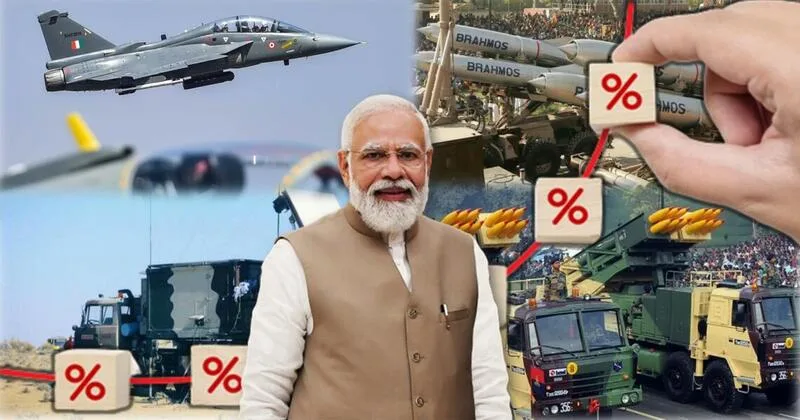
From a modest export base of Rs 4,467 crore in 2014, India’s defense exports have skyrocketed by over 30 times, reaching a historic Rs 23,622 crore (USD 2.8 billion) in the 2024–25 fiscal year. This transformation is not merely about volume; it is about sophistication. India has transitioned from exporting sub-assemblies and components to delivering high-value, battle-proven platforms like the BrahMos supersonic missile, Akash air defence systems, and LCA Tejas fighter jets to over 100 nations.
In the last decade, Bharat has undergone a massive transformation, shifting from one of the world’s largest arms importers to a rising global defense exporter. Between 2014 and 2026, the country’s defense exports surged by over 30 times, reaching a record-breaking Rs 23,622 crore (USD2.8 billion) in the 2024–25 fiscal year. Driven by the “Make in India” and “Aatmanirbhar Bharat” initiatives, this evolution has seen India move beyond exporting small components to selling sophisticated, high-value platforms like the BrahMos supersonic missiles, Akash air defense systems, and LCA Tejas fighter jets to over 100 nations. Today, India is no longer just a buyer; it is a credible provider of cost-effective, high-tech military hardware on the global stage.
This report examines 10 key defense systems exported by India between 2014 and 2026. It highlights India’s strategic shift from being a top global arms importer to becoming a credible and competitive defense exporter on the world stage.
Between 2014 and 2026, India’s defense sector achieved a historic turnaround, transitioning from an import-heavy buyer to a competitive global supplier. Driven by the “Make in India” push and indigenous innovation from the DRDO, BEL, HAL, and private giants like Bharat Forge, the nation’s domestic production has nearly tripled—surging from Rs 46,425 crore in 2014 to a record Rs 1.51 lakh crore today.
A key highlight of this era is the record-breaking export performance in FY24-25, where sales exceeded Rs 23,000 crore. Armenia has emerged as a major strategic partner, heavily investing in Indian hardware to modernise its forces. Key deals include:
Akash SAM System: A massive USD720 million deal (2022).
Pinaka MBRL: A USD250 million contract (2022) for the multi-barrel rocket launcher.
ATAGS Howitzers: A USD155 million order for over 90 units of the Advanced Towed Artillery Gun System.
These exports represent more than just sales; they are a global validation of India’s ability to produce battle-proven, high-tech weaponry.
Pinaka Rocket System: Bharat’s Artillery Might Goes Global
Under the visionary leadership of the Modi government, India achieved a historic milestone in defense exports. On January 18, 2026, Defence Minister Rajnath Singh flagged off the first batch of guided Pinaka rockets bound for Armenia. This marks India’s first major artillery export, proving that the days of being a mere buyer are over. The Pinaka Multi-Barrel Rocket Launcher (MBRL), a world-class indigenous system developed by DRDO, was secured by Armenia in a landmark USD250 million (Rs2,000 crore) deal signed in 2022.
The Pinaka is a true “Make in India” powerhouse, capable of delivering devastating saturation fire. It features 12-tube launchers with a lethal range starting at 38 km for the Mk-I and reaching up to 75-90 km for the precision-guided versions. With advanced GPS/INS navigation, it can strike enemy depots and troop clusters with surgical accuracy, putting it in the same league as the American HIMARS.
For Bharat, this isn’t just a business deal; it’s a bold statement of strategic autonomy. By sending battle-proven technology to the global market, India is advancing its “Atmanirbhar Bharat” goals and cementing its role as a reliable security partner. This export validates that Indian-engineered weaponry is now ready to dominate the modern battlefield, bringing in massive revenue while strengthening geopolitical ties.
Akash SAM: Guarding Foreign Skies with Indian Firepower
Under the resolute leadership of the current administration, Bharat has shattered the “import-only” glass ceiling. In November 2024, the first battery of the indigenous Akash Surface-to-Air Missile (SAM) system was shipped to Armenia as part of a massive USD720 million (Rs6,000 crore) deal. This isn’t just a sale; it’s a global endorsement of the DRDO-BEL genius. Capable of neutralizing drones, cruise missiles, and fighter jets at altitudes of up to 18 km, the Akash system has transformed India into a reliable protector of sovereign skies. This landmark deal proves that Indian technology is now a formidable, cost-effective alternative to Western and Russian systems.
BrahMos: The World’s Deadliest Missile Marks India’s Arrival
April 19, 2024, will be remembered as the day India truly arrived as a high-tech arms superpower. The delivery of the BrahMos supersonic cruise missiles to the Philippines—under a USD375 million contract—has sent a clear message to the world. Traveling at a staggering Mach 2.8, this “Brahma-Astra” is virtually impossible to intercept. By arming a Southeast Asian ally with such lethal precision, India has not only boosted its defense revenues but also asserted its role as a key player in maintaining regional balance against expansionist forces.
ATAGS: Indian Artillery Reclaims the Global Battlefield
In a bold strike for Aatmanirbhar Bharat, India’s next-gen ATAGS (Advanced Towed Artillery Gun System) has officially entered the international arena. In September 2023, the first batch of these 155mm/52-calibre powerhouses was delivered to Armenia under a Rs1,300 crore contract with Bharat Forge. These guns are faster, lighter, and more mobile than their global competitors, proving that Indian private industry can outmatch the world’s best. By replacing Soviet-era junk with battle-proven Indian steel, we are cementing strategic ties and validating our indigenous tech on high-altitude frontiers.
MCGS Barracuda: Ruling the Waves with “Made in India” Warships
India’s maritime dominance reached a new peak with the export of the MCGS Barracuda to Mauritius on December 20, 2014. This was the first time an Indian-designed and built warship was exported, marking a historic shift in our “Neighbourhood First” policy. Built by Goa Shipyard, this 1,300-ton patrol vessel showed the world that India is the primary security provider in the Indian Ocean. From anti-piracy to coastal defense, the Barracuda laid the foundation for India’s journey toward becoming a global shipbuilding hub.
Dhruv ALH: The Winged Sentinel of Indian Engineering
The Dhruv Advanced Light Helicopter (ALH) stands as a shining testament to India’s burgeoning aerospace prowess. Under the push for Aatmanirbhar Bharat, this 5.5-ton class twin-engine marvel, designed and built by HAL, has become India’s most successful aviation export. Since its early deployments to nations like Mauritius, Nepal, and the Maldives, the Dhruv has proven its mettle in some of the world’s most demanding terrains. Equipped with a state-of-the-art glass cockpit and a high-strength composite airframe, it excels in high-altitude performance where Western counterparts often struggle. Whether it is performing life-saving Search and Rescue (SAR) missions, medical evacuations, or providing light armed support, the Dhruv has established India as a credible, cost-effective alternative to traditional Russian or Western helicopter giants. By exporting this platform, India isn’t just selling a machine; it is building long-term strategic depth through training and maintenance partnerships across the globe.
Ammunition Powerhouse: Feeding the World’s Defence Needs
India has rapidly evolved into a global “Armory of Democracy.” Between 2023 and 2025, India’s exports of ammunition and explosives reached unprecedented heights, contributing significantly to the record-breaking Rs23,622 crore export figure in FY 2024-25. From 30mm rounds to heavy 155mm artillery shells and precision aerial bombs, Indian munitions are now sought after by powerhouses like the UAE, Saudi Arabia, and Vietnam, as well as various nations across Europe and Africa. A landmark USD225 million contract with Saudi Arabia in 2024 via Munitions India Ltd. highlights the global trust in Indian quality. These are not just basic shells; they are modern, factory-packaged munitions produced with automated quality assurance, ensuring that when our allies face high-intensity operations, Indian-made fire is there to support their artillery barrages and air defense systems.
Dornier Do-228: Dominating the Indian Ocean Skies
In a masterstroke of the “Neighbourhood First” policy, India has utilized the HAL-built Dornier Do-228 to cement its status as the “Net Security Provider” in the Indian Ocean Region. Between 2016 and 2022, India supplied these highly versatile maritime patrol aircraft to Mauritius and the Maldives. A key highlight occurred on September 15, 2021, when an interim aircraft was leased to Mauritius pending a new HAL order under a USD100 million Line of Credit. This twin-turboprop STOL (Short Take-Off and Landing) aircraft is a technological gem, equipped with maritime surveillance radars and EO/IR sensors that allow it to loiter for over 200 nautical miles at low levels. By providing these eyes in the sky, India has empowered its neighbors to protect their Exclusive Economic Zones (EEZ) from illegal activity and Chinese encroachment, while ensuring Indian aerospace technology remains the standard in the region.
Coastal Radar Networks: Bhara’s Invisible Shield for Allies
India has successfully integrated its maritime neighbors into a sophisticated surveillance grid, countering foreign influence through technology. Between 2016 and 2023, Bharat Electronics Limited (BEL) supplied advanced Coastal Surveillance Radar Systems (CSRS) to the Maldives, Seychelles, and Mauritius. These systems are designed to detect even small, sub-20-metre vessels in cluttered coastal environments, providing real-time situational awareness. By networking these static and mobile sensors, India has effectively created a transparent maritime domain across the Indian Ocean. This initiative, under the SAGAR (Security and Growth for All in the Region) vision, ensures that our partners are not dependent on expansionist powers for their coastal security, while solidifying India’s leadership in regional maritime law enforcement and anti-smuggling operations.
Advanced Offshore Patrol Vessels: Delivering Indian Steel to Sri Lanka
Marking a massive milestone in naval exports, India executed its largest-ever warship export order by supplying two Advanced Offshore Patrol Vessels (AOPV) to Sri Lanka. The USD133 million deal, signed in February 2014, saw Goa Shipyard Limited (GSL) deliver both vessels—SLNS Sayurala and SLNS Sindurala—ahead of schedule in 2017-2018. These 24-knot warships are built for endurance, capable of patrolling 4,500 nautical miles without refueling. This deal was a strategic triumph, reinforcing India’s footprint in the Indian Ocean and proving that Indian shipyards can build world-class, long-range naval platforms faster and better than global competitors. By equipping the Sri Lankan Navy with Indian-built steel, the Modi government has ensured that maritime co-operation remains the bedrock of our regional security architecture.
The transition of Bharat from an arms importer to a top-tier exporter represents more than just economic success—it is a testament to the nation’s growing strategic autonomy. The diverse range of exports—from the precision-guided Pinaka rockets in the mountains of Armenia to the BrahMos missiles in the maritime reaches of the Philippines—demonstrates that Indian engineering can thrive in any theater of modern warfare.
Through the collaborative efforts of the DRDO, defense PSUs like HAL and BEL, and a surging private sector led by giants such as Bharat Forge, India has built a defense ecosystem that is cost-effective, reliable, and technologically advanced. By arming allies with “Made in India” steel and surveillance tech, the country is not only boosting its GDP but also cementing its role as a “Net Security Provider” in the Indian Ocean and a stabilizer in global geopolitics. As India moves toward its goal of becoming a USD 5 billion defense exporter, the message to the world is clear: Bharat has arrived, and it is ready to defend not just its own borders, but the peace and sovereignty of its partners worldwide.