NEW DELHI: In a major boost to India’s maritime combat capability and indigenous defence manufacturing, the Indian Navy has significantly strengthened its multi-layered ocean defence architecture with the induction of four indigenously designed and built frontline warships in less than a month. The commissioning of INS Dunagiri, INS Sanshodhak, INS Agray and INS Mahendragiri marks another milestone in India’s transformation from a defence importer into a builder of advanced naval platforms under the vision of Aatmanirbhar Bharat.
The new warships belong to three strategically important indigenous classes the Nilgiri-class stealth frigates, Sandhayak-class survey vessels, and Arnala-class anti-submarine warfare shallow water crafts each designed to perform a specialised role in safeguarding India’s vast maritime interests.
Guardians of India's Maritime Frontiers: Three Indigenous Naval Classes for Combat, Survey and Coastal Defence
💠India's maritime strength depends on a balanced fleet protecting national interests across the full spectrum of naval operations.
💠Recently commissioned INS… pic.twitter.com/FhfI2lSmiF
— PIB India (@PIB_India) July 13, 2026
With nearly 90 per cent of India’s trade by volume passing through sea routes, a coastline stretching over 11,000 kilometres, and an Exclusive Economic Zone spanning around 2.4 million square kilometres, the Indian Navy’s latest acquisitions significantly enhance the country’s ability to deter threats, protect critical sea lanes and project power across the Indian Ocean Region.
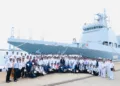
On June 21 2026, the Indian Navy commissioned three indigenously built warships at Kolkata:
- INS Dunagiri – a Nilgiri-class stealth frigate
- INS Sanshodhak – a Sandhayak-class Survey Vessel (Large)
- INS Agray – an Arnala-class Anti-Submarine Warfare Shallow Water Craft
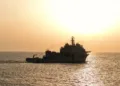
Barely three weeks later, on July 11 2026, India commissioned INS Mahendragiri, the sixth Nilgiri-class stealth frigate, at Visakhapatnam.
All four platforms were designed by the Indian Navy’s Warship Design Bureau, highlighting the country’s growing capability to independently design sophisticated frontline warships.
The Indian Navy described these vessels as representing different layers of India’s maritime defence architecture.
The Nilgiri-class stealth frigates form the Navy’s frontline strike capability, protecting aircraft carriers, escorting naval task forces and carrying out anti-air, anti-surface and anti-submarine warfare missions.
The Sandhayak-class survey vessels strengthen India’s hydrographic capability by mapping the seabed, preparing accurate nautical charts and improving maritime domain awareness critical for both military operations and commercial shipping.
Meanwhile, the Arnala-class anti-submarine warfare shallow water crafts are specifically designed to detect and neutralise enemy submarines operating close to India’s coastline, allowing larger warships to remain focused on blue-water operations.
Together, these vessels provide India with a layered naval shield capable of responding to conventional warfare, underwater threats, humanitarian crises and disaster relief operations.
Project 17A, under which the Nilgiri-class has been developed, represents India’s most advanced indigenous stealth frigate programme. The seven-ship class comprises:
- INS Nilgiri
- INS Himgiri
- INS Taragiri
- INS Udaygiri
- INS Dunagiri
- INS Mahendragiri
- Vindhyagiri (under construction)
Built by Mazagon Dock Shipbuilders Limited and Garden Reach Shipbuilders and Engineers Limited (GRSE), these frigates feature approximately 75 per cent indigenous content, reflecting India’s growing self-reliance in complex defence manufacturing.
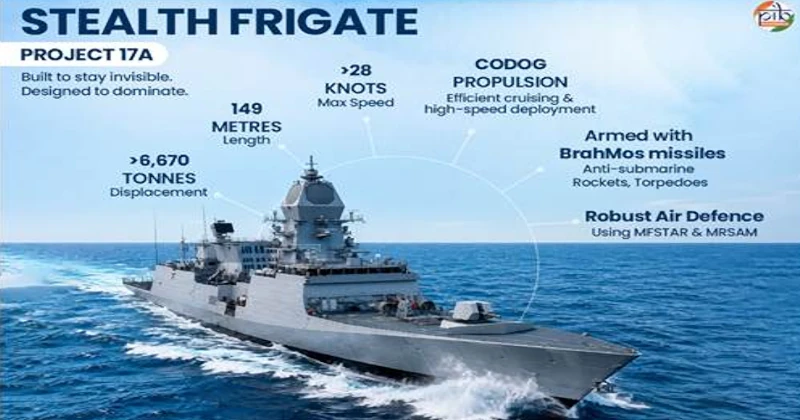
Each frigate measures nearly 149 metres in length and displaces around 6,670 tonnes. The warships are equipped with:
- BrahMos supersonic cruise missiles
- Medium-range air defence missile systems
- Advanced radars
- Hull-mounted sonar
- Helicopter operations capability
- Combined Diesel or Gas (CODOG) propulsion
- Maximum speed of 28 knots
Designed with reduced radar, thermal and acoustic signatures, the stealth frigates are significantly harder for adversaries to detect, enhancing survivability during combat operations.
The Nilgiri-class also symbolises India’s transformation in naval shipbuilding. While the earlier Talwar-class stealth frigates were imported from Russia, the subsequent Shivalik-class became India’s first indigenously designed stealth frigates.
Project 17A now represents the next evolution with improved stealth, better weapons, enhanced sensors and substantially higher indigenous content. Officials describe this as India’s transition from a “Buyer’s Navy” to a “Builder’s Navy.”
Accurate knowledge of the seas remains as important as combat capability. The Sandhayak-class survey vessels strengthen India’s hydrographic services by conducting detailed seabed mapping using multi-beam echo sounders, side-scan sonar and autonomous underwater vehicles.
The four-ship class consists of:
- INS Sandhayak
- INS Nirdeshak
- INS Ikshak
- INS Sanshodhak
Built entirely by GRSE, these vessels have over 80 per cent indigenous content. Each vessel is approximately 110 metres long, displaces around 3,400 tonnes, and can travel more than 6,500 nautical miles, enabling extended survey missions throughout the Indian Ocean Region.
Apart from hydrographic operations, they can also function as hospital ships, support helicopter operations and undertake humanitarian assistance and disaster relief missions.
Between 2019 and 2024, Indian hydrographers surveyed nearly 89,000 square kilometres and produced 96 nautical charts, supporting both India’s maritime security and friendly nations across the region.
The newest Arnala-class Anti-Submarine Warfare Shallow Water Crafts are designed specifically to counter submarine threats in shallow coastal waters where larger destroyers and frigates face operational limitations.
The eight-ship class includes:
- Arnala
- Androth
- Anjadip
- Amini
- Abhay
- Agray
- Akshay
- Ajay
Built jointly by Garden Reach Shipbuilders and Engineers Limited and L&T Shipbuilding, these agile warships replace the ageing Abhay-class corvettes.
Powered by advanced waterjet propulsion, the vessels can attain speeds of nearly 25 knots while carrying lightweight torpedoes, anti-submarine rockets, advanced sonar systems and integrated combat management systems.
A parallel Mahe-class currently under construction at Cochin Shipyard will further expand India’s shallow-water anti-submarine fleet to 16 specialised vessels.
Beyond military capability, the three indigenous warship programmes represent one of India’s largest successes in defence manufacturing.
According to official data:
- 64 out of 66 ships and submarines currently on order for the Indian Navy are being built domestically.
- Project 17A engaged more than 200 MSMEs across India.
- The programme generated nearly 4,000 direct jobs and over 10,000 indirect employment opportunities.
- Defence exports reached a record Rs 23,622 crore during FY 2024-25, reflecting India’s emergence as an exporter of sophisticated defence platforms.
Officials say the serial production of indigenous warships is strengthening India’s defence industrial ecosystem while reducing dependence on foreign suppliers.
The newly inducted vessels also support India’s broader maritime diplomacy initiatives under the SAGAR (Security and Growth for All in the Region) doctrine launched in 2015 and its expanded MAHASAGAR (Mutual and Holistic Advancement for Security and Growth Across Regions) vision introduced in 2025.
Survey ships improve navigation for partner countries, stealth frigates safeguard freedom of navigation across critical sea lanes, while anti-submarine vessels enhance coastal security throughout the Indian Ocean Region. Collectively, these capabilities reinforce India’s role as the primary security provider in the region.