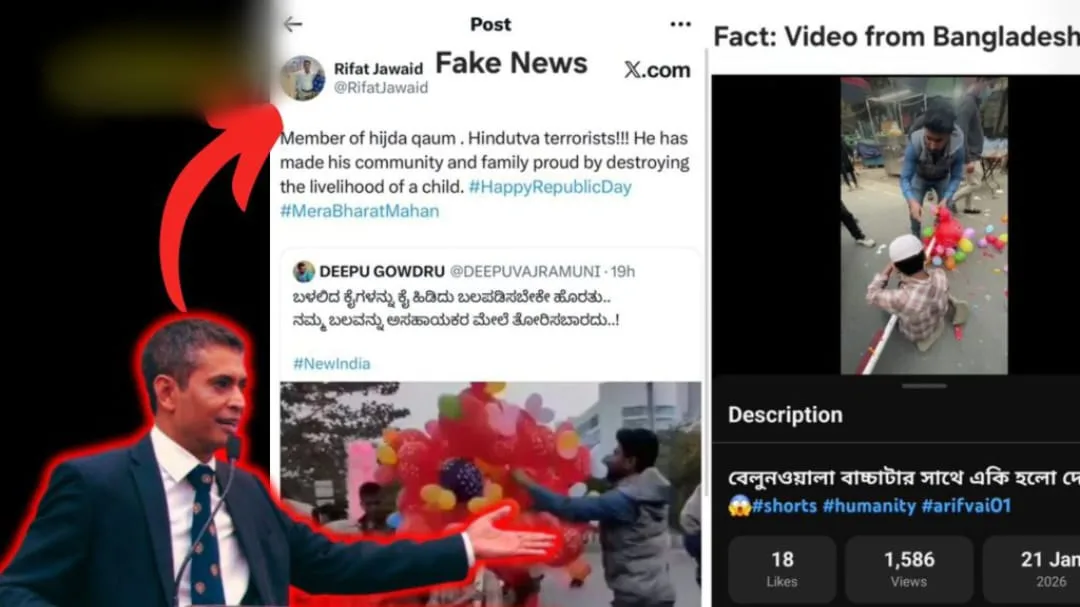
A new controversy has engulfed Rifat Jawaid, a former contributor to the BBC and founder of the platform Janta Ka Reporter, following the circulation of a misleading video alleging a communal assault on a Muslim child in India. Jawaid shared the clip on X (formerly Twitter), claiming that a Muslim boy selling balloons had been attacked by “Hindutva terrorists,” stating that the act brought “pride” to his community. The post went viral among several online circles, fuelling outrage and polarisation.
However, the video was later verified to be from Bangladesh, not India. Following exposure of the truth, Jawaid silently deleted the post without issuing any clarification or apology. The absence of accountability highlights a persistent pattern of misleading reportage, questioning whether the intent was to inform or inflame communal tensions.
A pattern of controversies
The balloon-video episode is part of a broader pattern of contentious activity by Jawaid over the years. Frequently accused of misinformation and biased reporting, he has cultivated a reputation for blending journalism with ideological activism. In September 2022, Jawaid accused an individual, described as an “AAP supporter,” of calling his children “suicide bombers” for wearing Islamic attire during madrasah classes. Social media posts shared screenshots and framed the individual as politically aligned with Arvind Kejriwal’s party. Subsequent investigations revealed that the profile cited had been locked and no longer contained any links to the Aam Aadmi Party, casting doubt on the accuracy and framing of his claims.
Jawaid has also been a vocal defender of madrasas in India, often downplaying concerns of radicalisation. In 2020, he argued that madrasas serve as permanent hostels for underprivileged children and criticised those who “demonise Muslims using madrasa children as an example.” He frequently posts images of his children attending madrasas as evidence of the positive social role of these institutions.
Confrontations with Political Leaders
Jawaid’s social media activity has led to direct confrontations with political figures. In one incident, Naresh Balyan, an AAP MLA, publicly criticised Jawaid for labelling the Indian Army as “cowards” in a tweet that was later deleted. The remark provoked widespread outrage, with the MLA calling it a “direct insult to soldiers who laid down their lives for the nation.” Such confrontations have amplified debates around the boundaries of responsible journalism versus ideological activism.
Similarly, during the hijab controversy in Karnataka in 2022, Jawaid’s platform referred to students chanting “Jai Shri Ram” as “terrorists.” The headline and description were quietly edited only after backlash on social media. Archived versions show that the initial framing was deliberately provocative, raising concerns about editorial integrity and the ethics of selectively presenting narratives.
Accusations of Fake News and Sensationalism
Jawaid and Janta Ka Reporter have faced criticism for allegedly spreading fake news related to India’s electronic voting machines (EVMs). In 2019, the portal claimed that 20 lakh EVMs had gone missing, a report officially refuted by the Election Commission of India. While other outlets that carried similar claims issued clarifications or removed content, Jawaid accused the Commission of “bullying” social media platforms to delete posts.
Moreover, the website has reportedly published soft-porn and sexually explicit content to drive traffic. Cached articles and screenshots reveal sensationalised, explicit material that undermines the platform’s credibility, particularly given its promotion as a legitimate news source by prominent political figures.
Ideological Agenda and Targeting of Institutions
Jawaid’s reporting often advances a narrow ideological agenda, portraying Indian institutions, Hindu religious expressions, and the military in a negative light. He has targeted public figures such as actor Naseeruddin Shah, accusing him of being a “non-practising” Muslim and questioning his right to speak on Islamic extremism. Other instances include repeated amplification of unverified or false claims with communal overtones, labelling soldiers as “cowards,” and framing routine incidents as evidence of systemic discrimination.
The recent Bangladesh video incident once again casts doubt on Jawaid’s credibility. By presenting foreign events as domestic communal incidents, he intentionally misleads audiences, potentially inflaming tensions and undermining public trust in media reporting.
The BBC Connection and Historical Concerns
Rifat Jawaid’s former association with the BBC adds another layer of concern. While employed as a contributor, he was involved in several controversial reports that drew criticism for factual inaccuracies, selective framing, and ideological bias. The BBC, globally regarded as a benchmark for journalistic standards, has historically faced scrutiny over instances of editorial lapses, particularly in its coverage of India and South Asia.
Some Notable BBC-Related Controversies
1. Coverage of 2002 Gujarat Riots: The BBC’s reporting on the 2002 Gujarat riots drew extensive criticism in India for alleged bias and selective framing. Observers noted that the channel highlighted government inaction while underplaying the scale and nature of rioters’ attacks, particularly those targeting Hindu communities in certain regions. Indian authorities and civil society groups raised concerns that the coverage relied heavily on anecdotal reports and selectively edited visuals, which could mislead international audiences about the context of the violence. The reporting was challenged in Indian courts, and national media extensively debated the BBC’s editorial choices, questioning whether they adhered to principles of balanced journalism. Such coverage contributed to a skewed perception of events abroad, feeding narratives of Indian state oppression without adequately reflecting the complex local dynamics.
2. BBC’s 2021 Kashmir Reporting: In 2021, the BBC faced criticism for its coverage of the situation in Jammu and Kashmir, particularly in the aftermath of the revocation of Article 370. The channel was accused of using selective visuals, interviews, and language that portrayed India’s security and administrative actions as oppressive, often omitting broader historical and security contexts, including decades of cross-border terrorism and insurgency in the region. Analysts contended that the coverage underrepresented the challenges faced by the Indian state in maintaining law and order while protecting civilians, creating a narrative of unilateral state aggression. By failing to contextualise the events, the BBC inadvertently amplified a one-sided story, which fueled misperceptions internationally about the realities on the ground in Kashmir.
3. Misreporting During Farmer Protests (2020-21): During the nationwide farmers’ protests against the three contentious farm laws in 2020-21, the BBC’s coverage again faced backlash for allegedly misrepresenting both the scale and nature of demonstrations. Many claimed that the channel’s reporting implied mass violence, widespread oppression, and systemic government failures without adequately verifying facts or providing on-ground context. Certain video clips and images were circulated repeatedly, portraying isolated incidents as representative of the entire movement. Several Indian journalists and government officials accused the BBC of amplifying alarmist narratives that did not reflect the largely peaceful nature of the majority of protests, raising questions about the media outlet’s adherence to verification standards.
4. Coverage of Pakistan-Bangladesh Relations: Over the years, the BBC has repeatedly faced criticism for reporting on Pakistan and Bangladesh in ways that conflate or exaggerate regional communal incidents. Observers noted that in multiple instances, incidents from Pakistan or Bangladesh were presented in a manner that implied similar patterns or trends in India, often without sufficient verification or local reporting. Such reporting has been accused of fuelling misinformation, especially when complex historical, social, and political contexts are not adequately explained. These editorial lapses have sometimes been exploited to advance narratives of India’s alleged failures in minority protection, while similar events in neighbouring countries were not scrutinized with equal rigour.
These historical lapses, combined with the recent actions of Jawaid, fuel concerns that former contributors may continue to propagate partial or misleading narratives under the BBC’s brand, undermining journalistic credibility.
The Rifat Jawaid controversy underscores the challenges of maintaining integrity in journalism amidst the rapid amplification of content on social media. Misrepresentation of foreign events as domestic communal incidents, as seen in the Bangladesh-balloon video episode, illustrates the ease with which misinformation can spread and the potential social harm it can cause.
Combined with a long record of controversial reporting, ideological bias, and targeting of public institutions, Jawaid’s actions reinforce the urgent need for accountability mechanisms, both within media organisations and on social media platforms. For readers, the episode serves as a reminder to critically evaluate news sources and cross-check facts, especially in an era of high-stakes, emotionally charged reporting.